Two patients can agree to the same treatment plan but have very different levels of willingness and ability to follow through. This week's edition of The Better-Prepared Patient explores why understanding that difference matters for clinical decisions, patient participation, and healthcare quality improvement. https://t.co/g0BrQVM57R
Why do patients agree to a care plan but struggle once they're home? In this week's The Better-Prepared Patient, I'm exploring the difference between understanding medical instructions and actually being prepared to follow them. https://t.co/hNTufKsUiV
Could Patient Better® support your practice's MIPS Improvement Activities?
Patient Better provides structured patient-participation tools that align with five MIPS Improvement Activity areas:
✓ Patient and family engagement in care planning
✓ Evidence-based shared decision-making
✓ Patient navigation
✓ Patient experience assessment and follow-up
✓ Patient-reported outcomes
From identifying participation barriers to providing patient education and documenting progress, Patient Better offers practical tools to support your quality improvement strategy.
Let's explore how Patient Better can strengthen your existing MIPS workflows.
https://t.co/CIi8SpO3zZ
#PatientBetter #MIPS #Medicare #QualityImprovement
Healthcare keeps looking for more resources. More staff. More technology. More programs.
But what if one of healthcare’s greatest resources is already here?
In this edition, I explore what becomes possible when we stop simply expecting patients to participate in their care and start preparing them to do it well.
The patient is already part of the healthcare equation. It may be time we started developing that resource.
https://t.co/L96dqlXYtO
Today, we recognize the healthcare professionals, caregivers, support teams, and families whose work keeps care moving forward.
Your effort matters. Your commitment matters. And the difference you make is felt every day.
Happy Labor Day from Patient Better®.
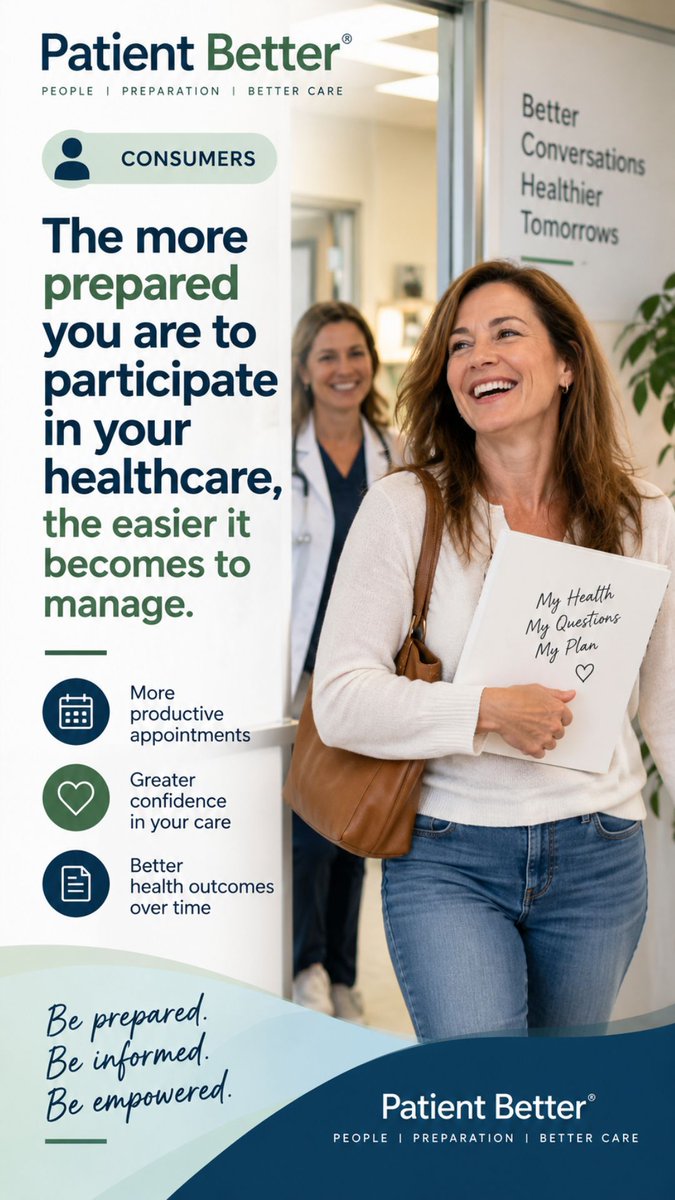
Imagine leaving your next medical appointment knowing you said what mattered, received the answers you needed and understood exactly what to do next.
Preparing your medications, questions and health updates beforehand can help you feel heard, informed and more confident managing your care.
Healthcare providers encounter this every day: the appointment has started, but the patient is still preparing.
In this edition of The Participation Project 2027, I examine what Patient Participation means and what its implementation could change for providers.
https://t.co/7lowKELv85
Everyone talks about patient engagement.
I think we're talking about the wrong thing.
The real opportunity is patient participation.
Patients aren't born knowing how to participate in today's healthcare system.
They can learn.
And when they do, providers spend less time chasing information and more time delivering care.
What do you think is the biggest barrier to patient participation?
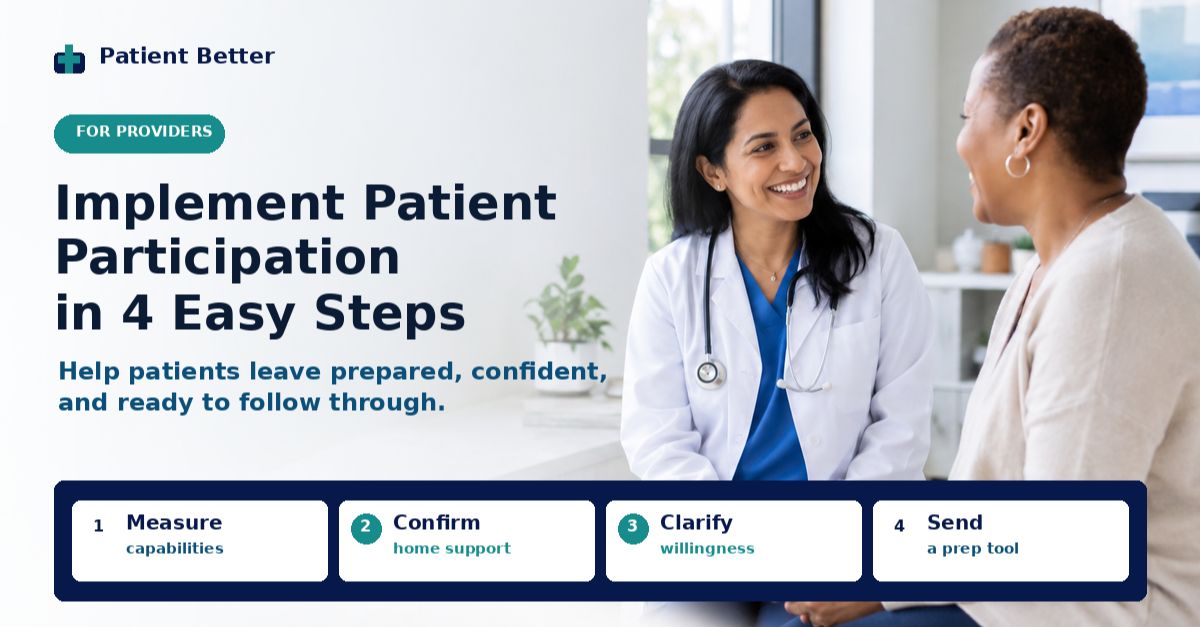
Patient Participation becomes easier to support when the workflow is simple, practical, and consistent. Start with four checkpoints: measure capabilities, confirm the home environment, clarify willingness to participate, and send patients home with a next-visit preparation tool.
Learn more at https://t.co/veIyS867jn
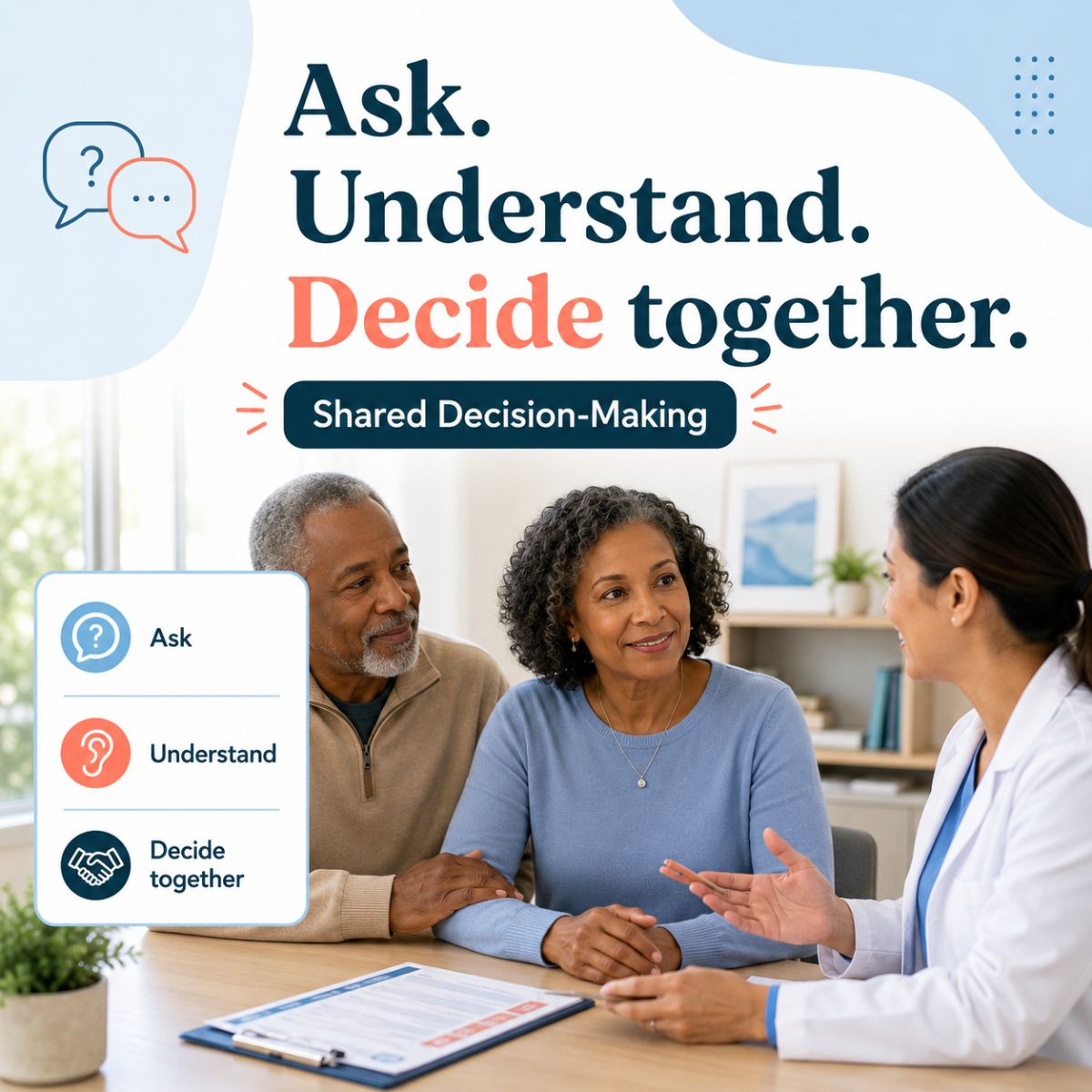
The best healthcare decisions are not only medically sound. They are shared, personally meaningful, and built with both professional guidance and your individual needs in mind.
Before people use sophisticated health tools, whether for medical records, care navigation, or health decision support, they must first be taught how to participate effectively in their care. Technology can expand access, but we cannot stress this enough: education on how to use these tools must come first. Without that foundation, even the best technology can be misunderstood or misused.
No one teaches us how to be a patient.
We're taught how to drive, manage money, interview for jobs—even how to perform CPR.
But when it comes to navigating healthcare, we're expected to know how to ask the right questions, communicate clearly, make informed decisions, and advocate for ourselves.
Most people don't struggle because they aren't trying.
They struggle because no one ever taught them how.
Effective participation in healthcare isn't instinctive.
It's a learned skill set.
And like any skill, it can be learned, practiced, and strengthened.
That's exactly what Patient Better is here to teach.
What do you wish someone had taught you before you became a patient?
2018. This was the moment an idea began to take shape.
I wasn't just writing a book—I was trying to solve a problem I kept seeing over and over again.
Healthcare was rapidly embracing technology. Chronic Care Management (CCM) and Remote Patient Monitoring (RPM) were gaining momentum, but something was missing.
Patients.
Not because they didn't want to participate, but because no one was bridging the gap between the technology being prescribed and the people expected to use it.
That became the inspiration for The Comprehensive Guide to Self-Health Management.
My goal wasn't to replace healthcare providers. It was to empower people with mild to moderate chronic conditions to become active partners in their own care—working alongside their primary care provider with the knowledge, confidence, and practical skills to manage their health every day.
The vision was simple:
Technology is only effective when people understand it.
Patient education isn't an afterthought—it's the foundation.
https://t.co/BE5PSJMa6N
Looking back at this photo, I remember sitting there thinking, "There has to be a better way."
That idea eventually became a book, and that book became part of a much larger mission: helping patients move from confusion to confidence in managing their own health.
One of the most important skills every patient can learn is how to communicate their concerns clearly. Preparation helps turn every medical appointment into a more informed and productive partnership.
https://t.co/d7bIsmj1PO