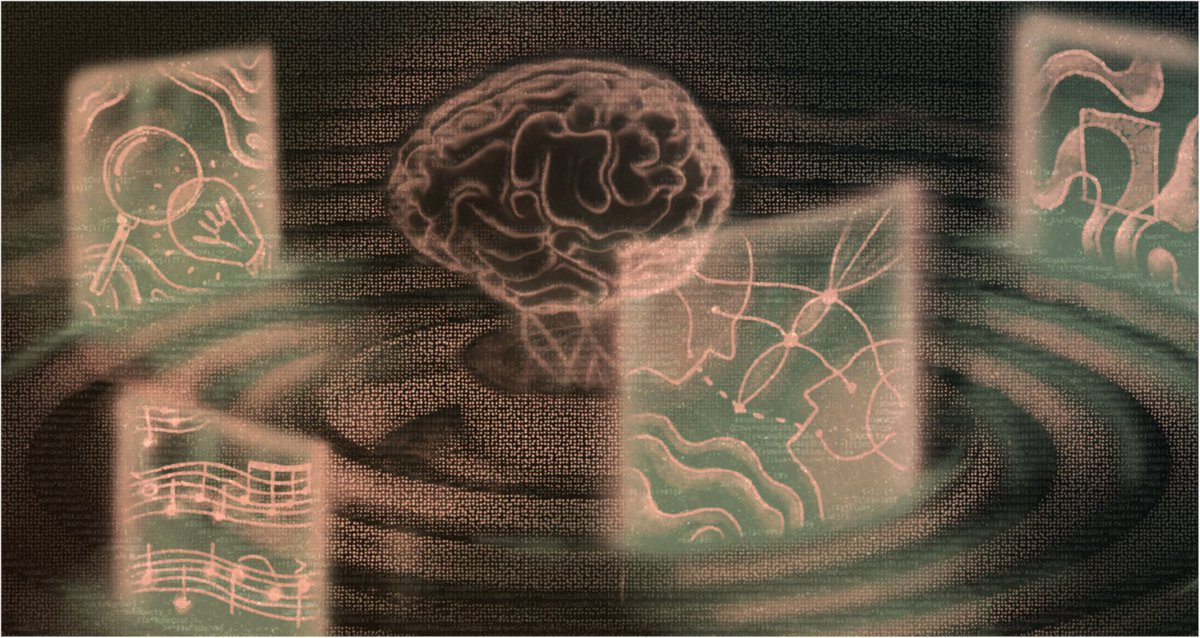
@AnthropicAI J-space can be interpreted as an empirically identified verbalizable submanifold of the pre-collapse intention space. This is very close to the core claim of Intention Collapse: the final text is not the whole cognition, but a compressed projection of a richer internal state. 😎
https://t.co/HJ4VBsFRLz
It's time to celebrate.
New Anthropic research: A global workspace in language models.
Of everything happening in your brain right now, only a tiny fraction is consciously accessible—thoughts you can describe, hold in mind, and reason with.
We found a strikingly similar divide inside Claude.
i hooked up a rotary phone from the 1920s to an AI agent, that replies on a mechanical display
it’s like a dumbphone without distracting notifications
here’s how i built this w/ @cursor_ai
@IAI_TV What if language cannot shape thought until it first finds a place to attach? In Lexical Consensus, I show that artificial agents can acquire novel words but only when perception gives those words a stable space.
https://t.co/9fA9TtJRA1
Lexical Consensus: Grounded Word Learning and Shared Meaning in Artificial Agents
Patricio M. Vera
https://t.co/U02viYCd8r [𝚌𝚜.𝙲𝙻 𝚌𝚜.𝙰𝙸]
💬Code: https://t.co/Yny7yQZ08D
I taught a 1989 Nintendo Game Boy to run a real transformer.
Not streamed. Not precomputed. Not faked. The Sharp LR35902 actually computes an int8 autoregressive forward pass from weights baked into a .gb ROM.
Meet DMGFormer 🧵👇
Present-day LLMs like ChatGPT and Claude can write poetry and solve difficult algebra problems with astounding speed and precision. Some researchers have referred to this phenomenon of AI acquiring startlingly human-like skills as "emergence." But not everyone agrees with this terminology.
A new paper by SFI's David Krakauer, Melanie Mitchell, and John Krakauer proposes a framework grounded in complexity science to clarify whether a system's capabilities are truly emergent.
https://t.co/yyENFiN4Om
Can an AI learn new words just by looking at pictures — like a character stepping through the Looking-Glass?
Imagine teaching a robot: “This is slithy” (pointing at frogs) or “This is vorpal” (pointing at frogs + ships). Made-up words straight out of Lewis Carroll. Will it actually understand and remember them?
In my new paper Lexical Consensus, we tested exactly that. We discovered a clear “perceptual gradient”: AI learns easily when concepts look similar (native categories or coherent groups), but struggles or fails completely when you mix very distant things.
It turns out the robot’s internal “vision library” has natural shelves — words stick when they fit the existing structure.
Full paper (open access):
https://t.co/JXkONJRZDt
Plain-language explanation:
https://t.co/2YFEvFd5cX
What do you think — do AIs need to reshape their “mind” to truly learn language, or is perception enough? Curious to hear your thoughts!
Esto es uno de los grandes noticiones tecnológicos del año.
IBM anuncia que ha conseguido fabricar el primer circuito integrado del mundo con tecnología subnanométrica: ha sido producido en un nodo de 0,7 nm (o 7 ángstroms) y permitiría empaqueta casi 100.000 millones de transistores en una superficie del tamaño de una uña.
Como explica Laura López en Xataka: se demuestra que la era del escalado subnanométrico es físicamente posible; también sugiere que el techo del silicio es más alto de lo que la industria temía.
Y será importante para la inteligencia artificial: IBM estima que un acelerador para IA construido sobre tecnología de 7 ángstroms podría alcanzar alrededor de 7.000 TOPS (Tera Operations Per Second), frente a los aproximadamente 1.500 TOPS de los aceleradores de última generación disponibles hoy.
https://t.co/QR0OmUUex9
Introducing a limited preview of GPT-5.6 Sol, our next generation frontier model, as well as GPT-5.6 Terra, a balanced model for efficient, everyday work, and GPT-5.6 Luna, a fast and affordable model for high-volume work.
https://t.co/OoM83SyISN
10 BOOKS SERIOUS AI RESEARCHERS ACTUALLY RECOMMEND (NOT THE ONES EVERYONE POSTS)
Every AI reading list says the same five names. The people actually building these systems read deeper than that. Here's the shelf they point to when nobody's performing for an audience.
1. Probability Theory: The Logic of Science - E.T. Jaynes
The book researchers quietly call life-changing. Jaynes reframes probability not as gambling odds but as the mathematics of reasoning under uncertainty, which is exactly what every modern model is doing. Dense, opinionated, and the closest thing the field has to a sacred text. Almost nobody outside the work has heard of it.
2. Information Theory, Inference, and Learning Algorithms - David MacKay
The book that unites information theory and machine learning in one place, written by a Cambridge physicist who made it genuinely fun. Free online, full of puzzles, and on the shelf of nearly every researcher who actually understands why their models compress and predict the way they do.
3. Reinforcement Learning: An Introduction - Sutton and Barto
The foundation under everything from AlphaGo to how modern models get fine-tuned with human feedback. Researchers don't recommend it because it's trendy. They recommend it because the ideas in it keep turning out to be the ideas that matter, decades later. Also free.
4. The Book of Why - Judea Pearl
A Turing Award winner's argument that today's AI is stuck because it confuses correlation with causation, and a map of what real reasoning would require. The book that names the exact ceiling current systems keep hitting. Researchers cite it constantly. The public reads past it.
5. Vision - David Marr
A neuroscientist's framework for how any system, brain or machine, processes information, written before deep learning existed and somehow predicting the questions it would face. The "levels of analysis" idea in here quietly shapes how serious people think about what a model is even doing.
6. Gödel, Escher, Bach - Douglas Hofstadter
The cult book about how meaning and selfhood emerge from systems following simple rules. It won a Pulitzer and then got name-dropped to death, but almost nobody finishes it. The ones who do think differently about intelligence forever. The real one, not the summary.
7. Metaphors We Live By - Lakoff and Johnson
The argument that human thought runs on metaphor, not cold logic, and that you can't build a mind on first-order logic alone. Researchers working on why language models grasp meaning the strange way they do keep circling back to this one. A genuine left-field pick.
8. The Society of Mind - Marvin Minsky
One of AI's founding figures arguing that intelligence isn't one thing, it's a swarm of dumb little processes working together. Written as hundreds of one-page ideas. Out of fashion for years, now looking prophetic in the age of multi-agent systems. Insider catnip.
9. How to Solve It - George Pólya
A 1945 book on mathematical problem-solving that quietly shaped how a generation of researchers think about breaking down hard problems, and that keeps surfacing in papers on how to make models reason. The bridge between human heuristics and machine reasoning.
10. The Mathematical Theory of Communication - Claude Shannon
The original paper that invented information theory and, with it, the entire conceptual ground that machine learning stands on. Short, brutal, and foundational. Researchers revere Shannon the way physicists revere Newton. Most reading lists skip the source and quote the descendants.
The popular books tell you what AI might do. These tell you how the people building it actually think. The difference is the whole point.