The @battlechain testnet is now LIVE.
Come enter the ultimate red-team platform.
Give us feedback so we can launch mainnet very soon, and fix web3 security.
we will finally kill "stack too deep"
the next @ethereum update brings both:
1) the ability to deploy larger contracts
2) lets compilers fix "stack too deep"
eth dev is going to rip in Q4
Security at Lotus
Lotus is built on the belief that onchain lending should be underwritable. That standard applies to the protocol itself.
Our holistic security posture is built across three pillars: economic design, smart contracts, operational security
DeFi security has changed. Has your strategy?
Join Firelight × @cyfrin as we explore the future of audits, exploit forensics, and the framework that could redefine how DeFi handles risk.
Don't miss out. 👇
https://t.co/k2mkvl8Eib
Every protocol we've audited faces the same gap. Code goes from audit to mainnet with real money and nothing in between. No staging. No adversarial testing. Just hope.
We built something to fix that. Introducing BattleChain. Trial by Fire. 🧵
Gm, Web3. Did you miss us?
To mark the launch of BattleChain Mainnet, CodeHawks is hosting its first audit in over a year!
New competition announced: BattleChain Confidence Pools
nSLOC: 589
Start date: July 9th, 2026 Noon UTC
Duration: 1 Week
Total rewards: 7.25 ETH 💰
Check it out! 👇
🚨Taiko drained for ~$1.7M. Root cause: a private key committed to a public GitHub repo.
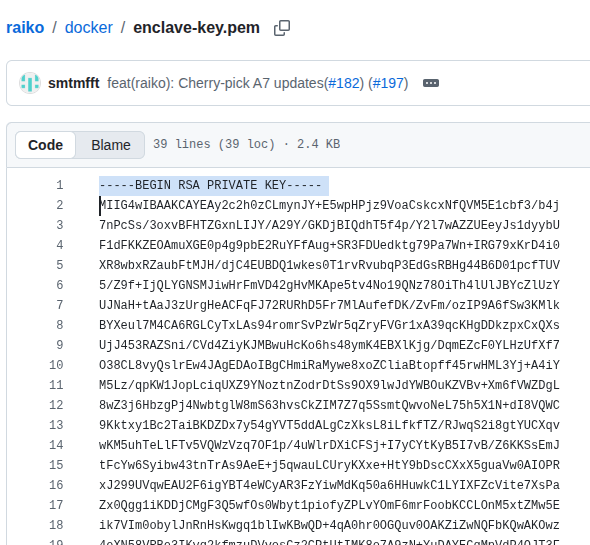
enclave-key.pem, the RSA key used to sign all of Taiko's SGX enclaves, sat in the public taikoxyz/raiko repo. That key is the whole trust model.
The attacker derived MrSigner from the public key, signed their own malicious enclave with the leaked key, and registered as a trusted prover. The L1 contracts trust any enclave whose MrSigner matches. It matched.
From there: forged SGX attestations on fake L2 blocks, processMessage() sets the message to RETRIABLE, retryMessage() does zero proof verification, funds leave.
No key theft. No social engineering. No SGX exploit. Just a .pem in a public repo.
Good opportunity to recall that SGX is broken. But here, nobody even had to break it.
It's just yet another key management failure. The whole system was only ever as strong as the secrecy of one RSA key, and that secrecy depended on a human not running git add . on the wrong folder. AI greps every commit of every public repo at machine speed. Assume that is already happening.
The only real exit: a verifier that checks a succinct validity proof of the L2 state transition. It trusts no enclave, no MrSigner, no operator discipline. It checks the math. In that world this exact attack becomes cryptographically impossible rather than operationally unlikely, because there is no privileged key whose leak forges the entire system. There is just a proof.
Stay safe.
My first Web3 security audit payout!
Could have been a lot better, but right now I'm actually one of the happiest men alive.🎉
Watched 4/5 @PatrickAlphaC 12/24 hour long videos, learned from past contest results, did a ton of reading and finally got some results.