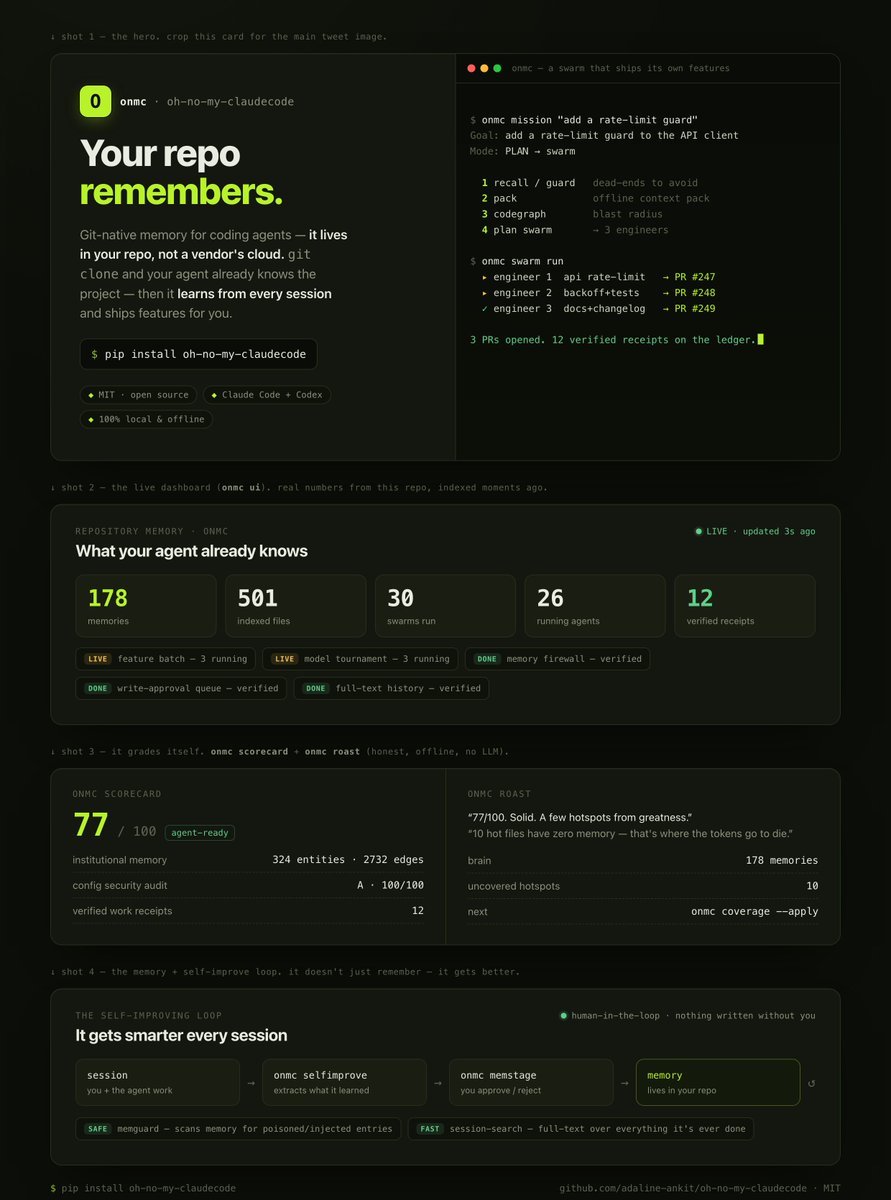
my coding agents kept forgetting my repo + repeating mistakes.
so i built onmc - git-native memory that lives in your repo (claude code + codex). it learns from every session + ships its own features via a swarm following missions.
check it out
https://t.co/ZQDGb6JCtQ
Introducing Adaline 2.0 - The Agent Self-Improvement Layer
Adaline turns Traces into Behaviors,
Behaviors surface Issues,
Issues become auto-generated Evals + Data,
Adaline then generates new agent candidates and tests them.
You review the winners and ship!
After using clawdbot for a while I have realised some of the very tiring challenges of my work life being solved. Things like just using my WhatsApp to set off some agents to prepare reports while I could be just travelling meanwhile.
This is AI getting more and more personal.
I totally buy that AI has made you more productive. And I buy that if other lawyers were more agentic, they could also get more productivity gains from AI.
But I think you're making my point for me. The reason it takes lawyers all this schlep and agency to integrate these models is because they're not actually AGI!
A human on a server wouldn't need some special Westlaw/Lexis connection - she could just directly use the software. A human on a server would improve directly from her own experience with the job, and pretty soon be autonomously generating a lot of productivity. She wouldn't need you to put off your other deadlines in order to micromanage the increments of her work, or turn what you're observing into better prompts and few shot examples.
While I don't know the actual workflow for lawyers (and I'm curious to learn more), I've sunk a lot of time in trying to get these models to be useful for my work, and on tasks that seemed like they should be dead center in their text-in-text-out repertoire (identifying good clips, writing copy, finding guests, etc).
And this experience has made me quite skeptical that there's a bunch of net productivity gains currently available from building autonomous agentic loops.
Chatting with these models has definitely made me more productive (but in the way that a better Google search would also make me more productive). The argument I was trying to make in the post was not that the models aren't useful.
I'm saying that the trillions of dollars in revenue we'd expect from actual AGI are not being held up because people aren't willing to try the technology. Rather, that it's just genuinely super schleppy and difficult to get human-like labor out of these models.
Most AI products fail in the first month. Not bad AI. Bad prompts.
Teams at Discord, McKinsey, Salesforce, DoorDash, Reforge, and over 100K+ developers using us know why:
Teams wing their prompts – test on 5 examples, ship to millions, pray it works.
Today changes everything.
A joke is only one of two things - it’s either funny or it’s not.
The best response to a funny joke is laughter.
The best response to an unfunny joke is to ignore it and move on with life.
Only stupid people think about an unfunny joke for more than 10 seconds.
People who hear a joke and want to censor it or initiate legal action need better things to do in life.
What is funny? That’s subjective.
Not a single person in Samay Raina’s live audience probably found it offensive. Because those people know what they have signed up for. They “want” that kind of humour.
You have just landed on a random clip from a ticketed event and a members-only-video. It probably wasn’t for you.
And it’s okay if this genre of comedy isn’t for you. Not everything is for everyone.
It doesn’t make you a better person or it doesn’t make them bad people for having a specific taste.
Comedy is like dosa, everyone has a version of what they like.
No joke is worth thinking about for more than 10 seconds.
You either laugh, or you just move on.