Just published @commonslibrary - background on the UK's operations to seize the shadow fleet, including details on the domestic sanctions, enforcement powers, and international laws that might apply
https://t.co/pINCn794Pt
Just published @commonslibrary - background on the UK's operations to seize the shadow fleet, including details on the domestic sanctions, enforcement powers, and international laws that might apply
https://t.co/pINCn794Pt
@Andre_de_Hoogh Of course, whether that should be the case or whether this is a desirable outcome is a question of politics and policy, but all the more reason why specific rules on the formulation for authorising force would be very welcome and important for legal certainty.
Constructive ambiguity is always interesting - if the Council has the power to authorise action, but instead of using that word simply "strongly encourages" it, then is the authorisation is still there? Wouldn't make sense to say "you should do x, but we're not authorising it".
New: after multiple delays، diplomatic sources tell me vote on the Bahrain draft on the Strait of Hormuz will take place tomorrow at 11. In new revision circulated today OP2 reads as follows with major change from Authorizes to encourages:
“Strongly encourages States interested in the use of commercial maritime routes in the Strait of Hormuz to coordinate efforts, defensive in nature, commensurate to the circumstances, to contribute to ensuring the safety and security of navigation across the Strait of Hormuz, including through the escort of merchant and commercial vessels, and to deter attempts to close, obstruct or otherwise interfere with international navigation through the Strait of Hormuz.”
@Andre_de_Hoogh ... specific legal basis, such as self defence or consent, are permitted to do so, then the recommendation would be restrictive. But the ambiguity itself leaves room for states to argue that authorisation is inherent in the recommendation itself...
@Andre_de_Hoogh If a powerful body is telling you to do something, is the authorisation to do that thing implied by the encouragement itself? Ambiguity is clearly a diplomatic/political tool, but I'm not sure it completely eradicates all legal effects of the Council's decisions / encouragements.
@Andre_de_Hoogh Exactly - 2249 is the perfect example. My point is more that the Council doesn't (yet) have any specific rules for how it authorises force, only practice and repeated language. My point is a little more general (cont..)
UNSC consultations ended without clarity on whether there will be a vote tomorrow on the #Hormuz Strait draft reso. I suspect we'll know more later this evening regarding whether #Bahrain decides to put it to a vote despite the draft not having council unanimity.
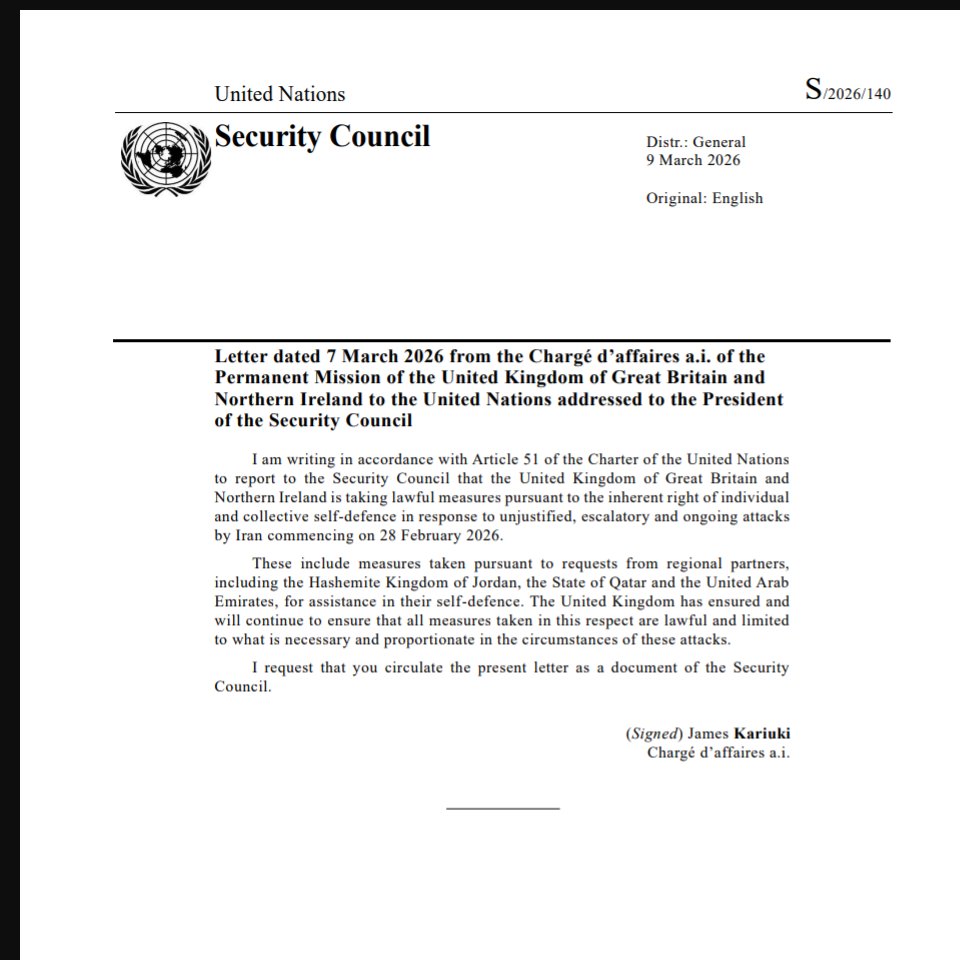
Been waiting for this one too - contrast the UK's relatively to the point letter, reporting Article 51 self-defence action to the UNSC.
Mentions necessity and proportionality generally, but also that Gulf states have requested UK collective defense.
UN Doc S/2026/161
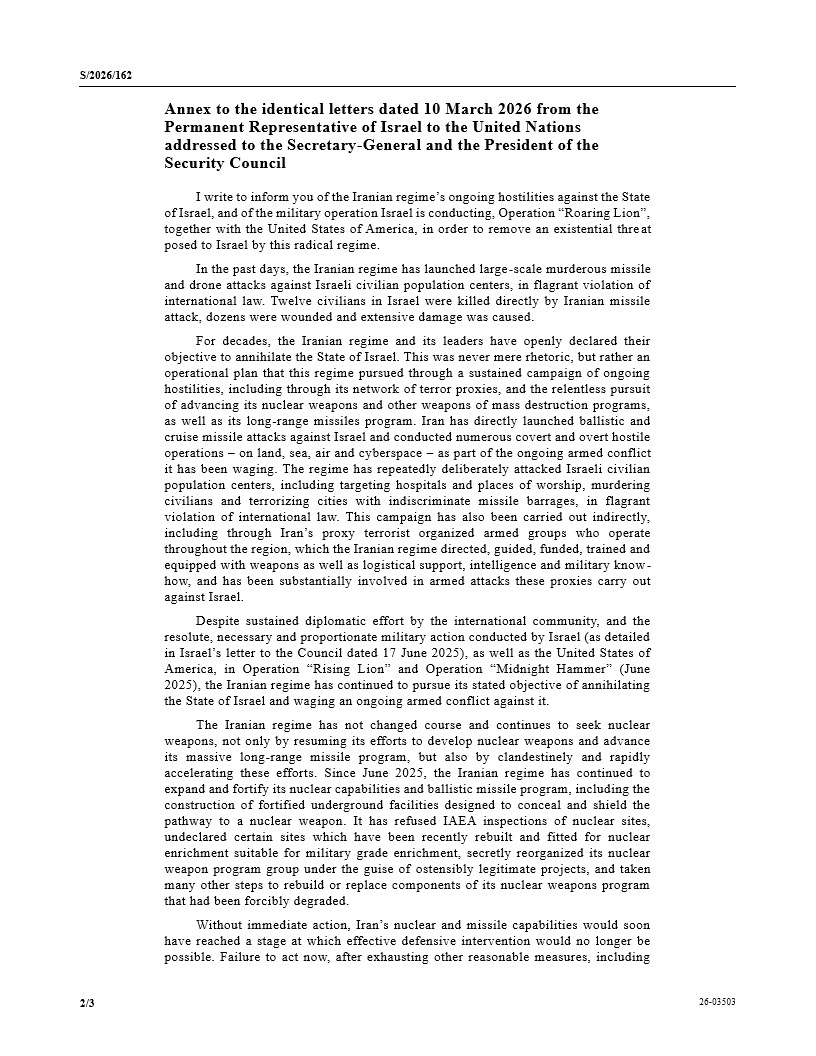
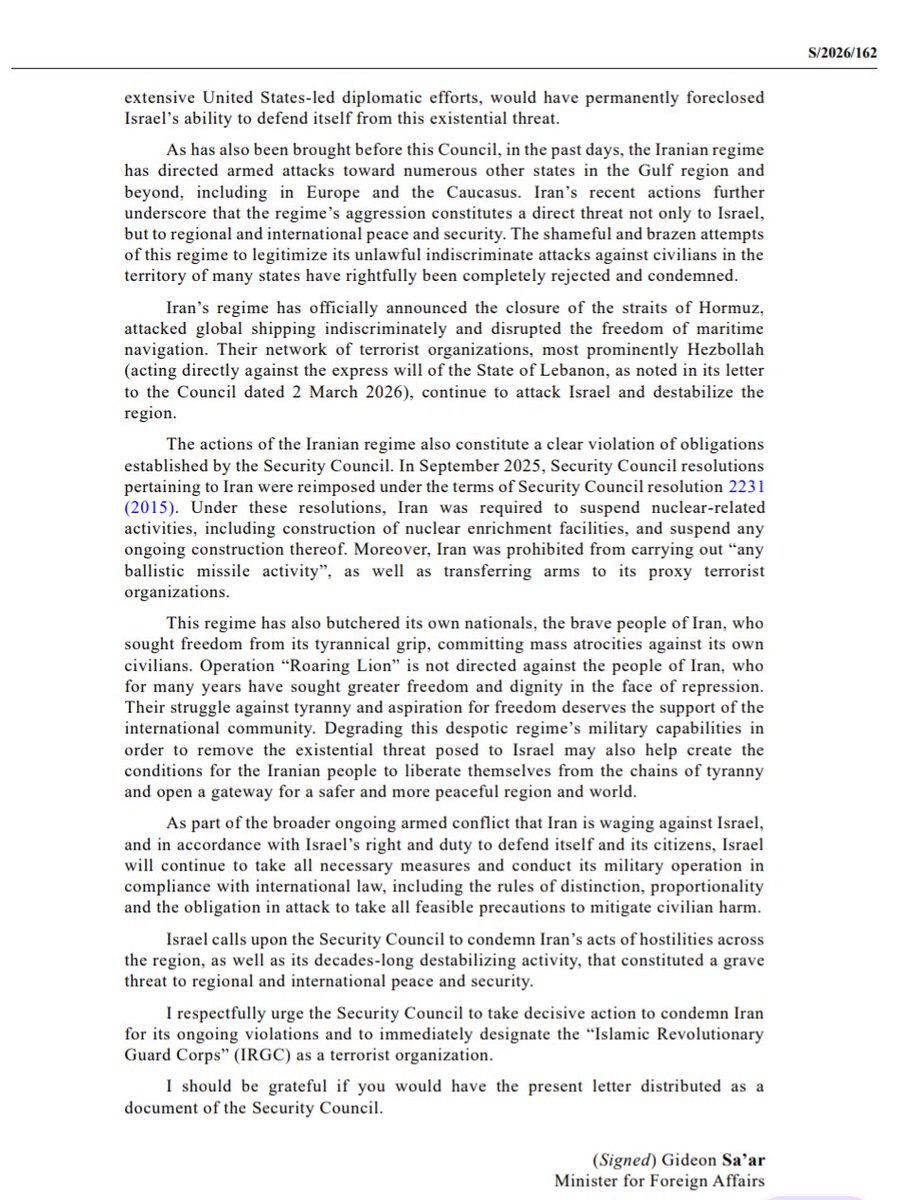
Israel's letter, dated 10 March, also available.
Arguments along the same lines as the US letter, citing ongoing hostilities and claiming defensive action.
UN Doc S/2026/162
https://t.co/6uiZXiVwvj
Israel's letter of the same date also seeks to justify combat operations taken in cooperation with US, but whereas US letter explicitly invokes Article 51, Israel speaks more generally of its "right and duty to defend itself and its citizens" without specific citation of Art.51.
Events moving quickly, so missed when this was published.
US letter to UN Security Council, dated 10 March. Claims force against Iran is "self-defence" Art 51, and "ongoing" conflict since 2025.
Lots to assess on claims. One thing clear - international law is back in the room.
Should also mention that Iran has made counter-arguments of course.
Has written to the UN almost every day since the US action began late Feb
https://t.co/1Hgo29HTrl
Israel's letter, dated 10 March, also available.
Arguments along the same lines as the US letter, citing ongoing hostilities and claiming defensive action.
UN Doc S/2026/162
https://t.co/6uiZXiVwvj
Events moving quickly, so missed when this was published.
US letter to UN Security Council, dated 10 March. Claims force against Iran is "self-defence" Art 51, and "ongoing" conflict since 2025.
Lots to assess on claims. One thing clear - international law is back in the room.