Happy Birthday to my sister & worthy rival, in our recent Youth MP race, @MuhumuzaJulia🥂
In a time when politics was filled with malice, you chose integrity. You showed that you can be a competitor without being an enemy!
I found comfort in your honesty, & I am proud of the standard you set for our generation.
Here’s to the new chapter! May this year bring you the breakthrough you’ve been hoping for.
The very best is yet to come! 🎉
🌟🌟🌟🌟
#TUKOPAMOJA #HappyBirthdayJulia #SisterAndLeader #ValuesOverPolitics #NewAgeNewBreakthrough #PoliticalTolerance #UgandaYouth #RefugeInIntegrity
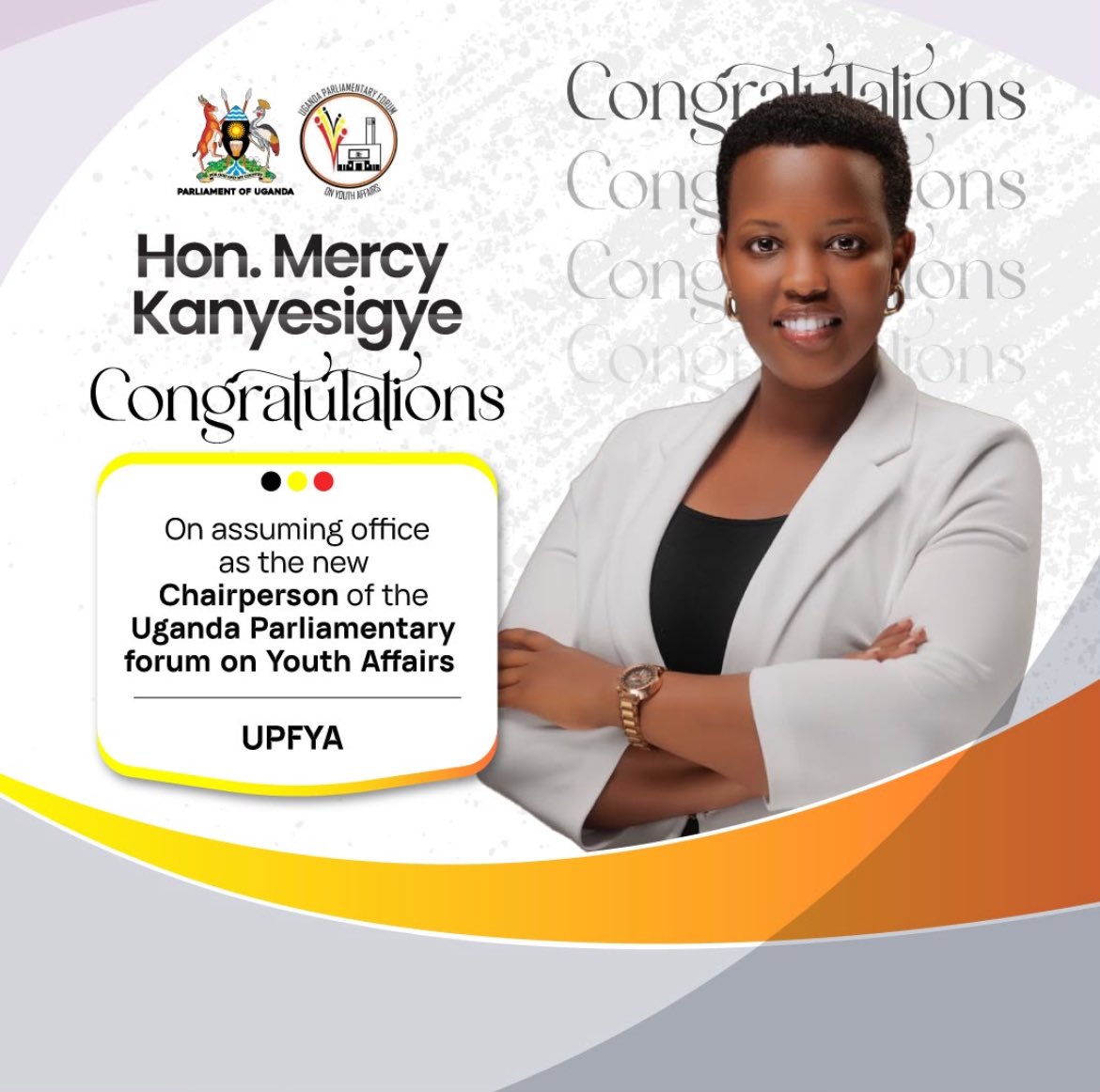
Deeply honored & grateful for the trust placed in me to serve as the new Chairperson of the Uganda Parliamentary Forum on Youth Affairs (UPFYA).
This is not just a title but a profound responsibility to amplify the voices of our young people.
I sincerely thank my fellow Members of Parliament for their confidence, & the youth of Uganda for their unwavering energy.
Together, let us shape a future that empowers every young Ugandan.👌
🌟🌟🌟
#UPFYA #YouthEmpowerment #TukoPamoja
The tides of AI-powered “agentic flooding” are lapping at bureaucracies everywhere, from tax appeals to welfare claims to parking tickets. The waters are rising alarmingly fast in Britain https://t.co/DEm0O3TjnQ
Illustration: The Economist/Getty Images
We join the Buganda Kingdom and Uganda in celebrating 33 years of the reign of His Highness, Kabaka Ronald Muwenda Mutebi II. May the LORD continue guiding and blessing you🙏
Outcome Driven Or ...... ?
There is something instructive about this judgement that has nothing to do with whether the plaintiff deserved to win. He probably did. His words were altered and republished under his name in a way capable of damaging a professional reputation built over a decade. The difficulty lies in how the court got there, In my view.
One misquoted tweet produced six findings of liability: copyright infringement, false attribution, misrepresentation, defamation, negligence and passing off. Each doctrine is argued largely on its own terms, as though the other five did not exist. That is the tell. A court that begins by asking what interest has actually been infringed, whether this is at bottom a reputational harm, a proprietary one or a privacy one, should be able to resolve a dispute like this through a single well reasoned doctrine rather than six loosely stacked ones.
The comparative law reasoning compounds the problem. Doctrines are imported from English, American, Canadian and Kenyan authority without much attention to the constitutional and statutory scaffolding that made those doctrines coherent at home. A right born of section 43 of the old English Copyright Act does not travel cleanly into a system whose legislature never created an equivalent. Rules borrowed this way tend to behave differently once detached from the assumptions that shaped them. (Lord denning was instructive In Nyali Ltd Vs Attorney general)
Damages tell the same story. The judgment invokes restitutio in integrum, a corrective justice idea concerned only with loss actually suffered, then turns to American authority on statutory damages for mass piracy, where Congress deliberately set awards above actual loss for deterrence. These are different theories of why damages exist. Reaching for both within the same reasoning does not reconcile them, it simply picks whichever justification supports the sum the court wished to reach.
None of this means the plaintiff was wrong to sue or wrong to succeed. It means the judgment will be difficult for future courts to extract a workable rule from, because precedent is built from reasons rather than results.
Worth reading closely before anyone cites it too confidently.
This is really a problematic judgment. It looks to me like the Plaintiff was on a fishing expedition to try and see what he can get from the Court. The Causes of action are flying in left, right and centre; from intellectual property rights, to negligence, to defamation, to personal privacy etc.
What exactly did the Plaintiff want from Court. Did the Court get convinced that all these actions could conveniently be disposed of in the same suit without causing an embarrasment? The Court ought to have ordered separate trials.
Also, the Court awarded Ugx. 50 million for copyright infringement, for a phrase whose source the Defendant acknowledged? A phrase reproduced in an article that actually provides more educative clarity than the phrase itself? The Court had to quote almost the entire Copyright Law just for someone’s opinion on X, quoted with reference by the Defendants?
“Values of shareholders” vis-a vis “values for shareholders” Would any reasonable member of society, a business partner, or anyone with closw ties with the Plaintiff be misled by the above differentiation?
Would they get the impression that the Plaintiff’s reputation has been damaged by such a phrase? The deminimis Rule alone could have cured that. Did the Court think about the likelihood of floodgates while issuing such orders? Hopefully, the Defendants seek appropriate redress in a Higher Court. I cant seem to find out what the case was really about.
In #WomenCrushWednesday edition, we feature our Vice Chancellor, the Rev. Canon Prof. Olivia Nassaka Banja. She is the first woman to hold this position since the inception of Ndejje University in 1992. She is a clergy in @ChurchofUganda_ and a Professor of African Christianity.
Folks, I finally summoned my gut and went to meet the legend. The excitement was so wild. In a few minutes he spoke to me about retirement and the state of affairs. What I learnt;
1- Never procrastinate for a minute when the hour of your retirement comes.
2- Work vigorously in your retirement on the things you want and when you want. Resting makes you vegetative.
3- Yes the current generation of leaders is pathetic and messy, but wait for the ones whom you have raised! They’re a big catastrophe.
Rtd. Justice Ogoola is phenomenal.
Following the Karuhanga–Ssemakadde exchange, I think both men are right about something and wrong about something.
Karuhanga is right that institutions outlast individuals, and that the Bar's credibility is built through consistency, not proclamation. Demanding personal statements from lawyers is a poor substitute for institutional strategy.
But Ssemakadde's underlying complaint isn't really about theatre. When an advocate is abducted for doing his job, silence, dressed up as "neutrality" or "institution-building" is also a position. Institutions are built by people willing to be counted, not just by people willing to wait.
The profession doesn't need less courage or less caution. It needs both, at the same time, from the same people.
Although there is dysfunction at Uganda Law Society, there are still many pathways for Advocates who want to be impactful:
1 You can be a PA at LDC
2 You can volunteer your time to mentor students & junior lawyers
3 You can facilitate a CLE training
4 Author a policy/legal brief