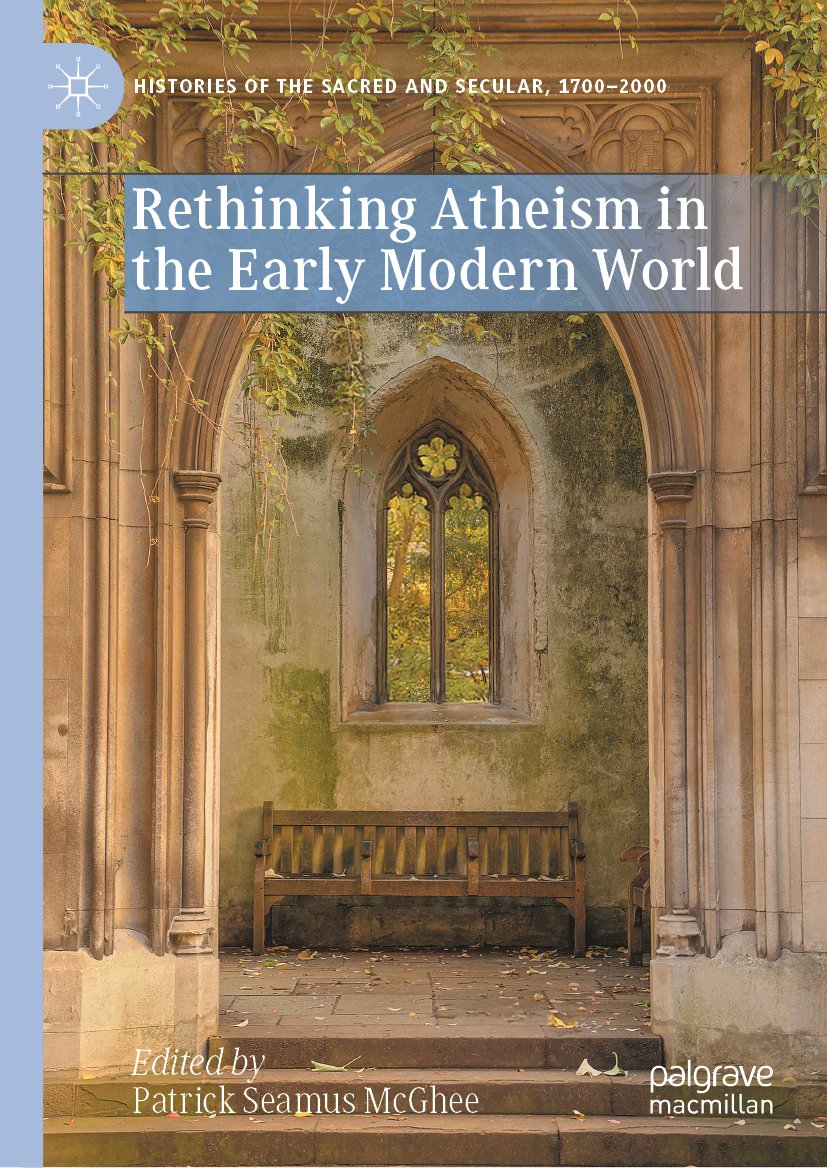
The wait is over! We're thrilled to announce the publication of our new interdisciplinary essay collection on the history of atheism in the early modern world.
This important collaborative volume explores diverse early modern attitudes towards atheism in Brazil, China, England, France, Italy, New England, Poland, Scotland, Spain, and Transylvania.
Thank you to all the pioneering co-authors who contributed chapters and to the editorial team at @Palgrave for guiding the project!
This work is part of a research project generously funded by the @LeverhulmeTrust and @durham_uni.
Revisiting the magisterial multi-volume series 'Barbarism and Religion' by J. G. A. Pocock. An epic exploration of the ways in which the multifarious intellectual culture of Enlightenment reflected and shaped attitudes towards the classical world, civilization, and Christianity.
Academic freedom is essential. If universities are no longer sanctuaries for open enquiry, conversation, and debate, free of censorship, intimidation, violence, or harassment, then they are no longer universities.
Due to escalating disruptive protests, I have decided to cancel the remainder of these lectures. This is deeply lamentable, but the disruption has undermined the academic nature of this series. Students shouldn't face bullying or harassment when attending academic events.
Demands for discriminatory lists. Insinuations of dual loyalty. Endorsing the surveillance and harassment of Jewish people. Astonishing that people have openly put their names to this letter.
Zack Polanski, the leader of the Green Party, has signed an open letter demanding that a database be created of 2,000 dual British-Israeli nationals called up for service since the terror attacks by Hamas on October 7 2023
🔗: https://t.co/M2Vg5pII8a
Really good to see 80 leading organisations in the violence against women and girls (VAWG) have signed a letter denouncing antisemitism.
This is a rare light in a dark time.
A major methodological shortcoming in 'settler colonial' theory is that it can be allowed to function as a closed, circular system of unfalsifiable concepts, each of which is made to make sense only in relation to the others.
Thus, 'settler colonialism' is taken to mean the elimination of those considered 'indigenous', but 'indigenous' ends up merely describing those whom 'settler colonialism' oppresses. By this logic, 'settler colonialism' itself creates, defines, limits, & destroys indigeneity.
Quite apart from the obfuscating meaninglessness of all this, such an approach surely runs the risk of performing exactly what it attempts to critique, namely the erasure of multifaceted, complex, and diverse indigenous histories, in the name of conceptual order, prescriptive authority, and aspirations of progress.
4/4. Patrick Seamus McGhee, "Reformation, Colonisation, and the Conversion of the 'Heathen': Theology, History, and Nature in the Writings of John Oxenbridge (1608–1674)," Atlantic Studies, 22:1 (2025), pp. 2–33. doi:10.1080/14788810.2024.2393037. https://t.co/524reoQGrH
1/4. A brief note for new followers - thanks for engaging! By way of introduction, I'm Patrick S. McGhee, historian of the early modern Atlantic world.
My research examines post-Reformation religious culture, Enlightenment theological scholarship, & the politics of Revolution.
3/4. Among other things, my work challenges the 'Other' as a useful explanatory device. As one half of an ill-defined 'binary' model, this category occludes the plurality of flexible religious & non-religious identities that people have perceived & experienced throughout history.
moving and upsetting - this woman "sick of feeling we can only be safe by not being Jewish and being invisible.." This is the disgrace of the UK right now
A superb piece by @alexander_c_lee via @HistoryToday exploring horror & history in the stories of H. P. Lovecraft.
Among the most effective features of Lovecraft's writing are the use of the historian's language & techniques ('found' documents; insidious artefacts; cryptic footnotes; 'forgotten' scholars) to conjure up a dark past.
The first short story of Lovecraft that I read was 'The Nameless City' (1921), which posesses a sense of time so deep and distant, yet enduring - merely dormant - as to unnerve the soul.
"British cultural life is the right and exercise of civic and cultural freedom – a privilege of our liberal democracy - that does not require the permission of gangs of ideological activists".
Hear, hear. Our public institutions should mount a robust stand against these attempted assaults on history & knowledge.
This matters.
An obscure London event on the history of the ancient Jewish kingdoms in Judea and Israel is cancelled because of ‘security concerns’ and it turns out this was a reaction to a campaign to fill and then undermine the event by activist disrupters.
How strange! Why would a posse of aggressive activists be interested in the arcane details of bullae and steles and ostraca and inscriptions and numismatics in some small South Levantine kingdoms in the Iron Age?
Well, it is a little more than that which is why it is both disturbing and important. And it matters because at its least it is a threat to history in Britain’s - but also the world’s - greatest temple of History @britishmuseum - and its scholarly integrity.
The BM and its leadership are decent and well-meaning and have explained that they wished to save an event from disruption by bullying vandals but I am sure the BM realizes it is essential to announce a new event fast lest it give the impression that the permission of tiny cadres of aggressive bullies are required before it hold events. But the significance is wider than an event about the Moab and Tel Dan steles in a great museum.
British cultural life is the right and exercise of civic and cultural freedom – a privilege of our liberal democracy - that does not require the permission of gangs of ideological activists nor can it cancelled or postponed nor endured at their beck and sufferance nor permitted with a bend of the knee to their permissions or veto. But that is what this appears to be.
Across the cultural world in the West, though the bewildered middleaged managers of our institutions that are confronting and often submitting to a wave of self-righteous blackmail and mob threat, there is an increasingly thin – indeed ever more fragile and sometimes nigh invisible – line between ‘security concerns’ – and institutional pusillanimity.
Then there is the history itself.
This event concerns the study of the ancient kingdoms of Judah and Israel that existed between roughly 1100BC and 586BCin the Levant. It is not a coincidence that this was chosen for disruption. The history of the Judean kingdoms and the Jewish Temple in Jerusalem that stood for most of the time between 1000BC and 70ADetc is important and fascinating history in its own right, supported by complex and growing archaeological finds.
These small kingdoms and the subsequent Temple priestly mini-state (restored by the Persian kings Cyrus and Darius 539BC) and then the larger Judean kingdoms of the Hasmoneans and Herodians – between 167BC and 135AD chronicle the long indigenous history of Jews in the region – which the protesters are keen to erase. This is a political project of ideological erasure and malicious incitement of course concerned with the complex, brutal Israel-Palestine conflict that has now gone on for a hundred years and is unlikely to be solved in a small lecture theatre in the British Museum. But it also attempts to deny or erase Jewish history itself – and by implication the heritage of British Jews who live here in Britain, a small community that is now under cultural and sometimes physical threat.
Incidentally - but it is worth saying, this history does not deny anyone else’s history, nor the many other small realms in this region through ancient times nor the many names of the region and its entities and the historical origins of those names (Canaan, or Philistia or Peleset, Phoenicia, Aram Damascus or Moab or later Nabatea and the provinces of Palaestina Prime, Seconda and Tertia and the Ghassanid kingdoms and so on etc etc). The history of one can not be used to erase the history of the other and does not need to do so. The pursuit of knowledge which is one of the delights of human life and is the mission of the BM and indeed anyone who writes, reads or enjoys history, can celebrate and recognize all of these.
Yet this protest and the many like it deployed across Britain nowadays is the opposite of that - an attack on history using the methods of intimidation and vandalism. Much of this involves distorting or dismantling actual history or often lying to replace it with a fabricated ideological structure that nourishes no one and helps no one but degrades our culture and civic life not to speak of history itself. By the way, the frequent claims that these histories or names are ‘denied’ or ‘noone knows them’ is nonsense: anyone and everyone who is interested knows this history. (Much of it appears for example in my book Jerusalem a history of the Holy Land.)
And this is relevant not just to those of us who write study or enjoy the history of the region but also to those who believe that cultural life and civic society is a right that must not be submitted to the aggressions and plots of loud well-organized much-indulged ideologues who take advantage of the freedoms of our society to undermine its principles and the very freedoms they are designed to guard.
Just as vital is a rule of history itself that concerrns the rise and fall of civilizations: the society that ceases to allow to free discussion of ideas and stops respecting and recognizing the value of scientific and historical sources and facts is a society that will fail.
Image: Lovecraft, H. P. (Howard Phillips), "The Nameless City" Howard P. Lovecraft collection. Brown Digital Repository. Brown University Library. https://t.co/eISckN89UM
A superb piece by @alexander_c_lee via @HistoryToday exploring horror & history in the stories of H. P. Lovecraft.
Among the most effective features of Lovecraft's writing are the use of the historian's language & techniques ('found' documents; insidious artefacts; cryptic footnotes; 'forgotten' scholars) to conjure up a dark past.
The first short story of Lovecraft that I read was 'The Nameless City' (1921), which posesses a sense of time so deep and distant, yet enduring - merely dormant - as to unnerve the soul.
Compelling piece @TimesofIsrael reflecting on the @novaexhibition in London amidst rising antisemitism in the UK. It features the perspectives of several visitors, including some with personal connections to October 7. Grateful to have had an opportunity to share my own thoughts.
Yesterday, I visited @novaexhibition in London.
It is harrowing and enraging. It documents in tangible, personal, and unambiguous terms the acute, yet unrestrained distillation of pure evil that was perpetrated on October 7, 2023.
It is also, ultimately, a hopeful experience. It commemorates acts of courage, resilience, and recovery among the victims and their loved ones that are unimaginable to most of us.
It was an honour to bear witness to their stories and briefly meet with Doron Mizrahi, a survivor who spoke movingly of running into harm's way to try and save others.
Everyone ought to see this for themselves.
Compelling piece @TimesofIsrael reflecting on the @novaexhibition in London amidst rising antisemitism in the UK. It features the perspectives of several visitors, including some with personal connections to October 7. Grateful to have had an opportunity to share my own thoughts.
Yesterday, I visited @novaexhibition in London.
It is harrowing and enraging. It documents in tangible, personal, and unambiguous terms the acute, yet unrestrained distillation of pure evil that was perpetrated on October 7, 2023.
It is also, ultimately, a hopeful experience. It commemorates acts of courage, resilience, and recovery among the victims and their loved ones that are unimaginable to most of us.
It was an honour to bear witness to their stories and briefly meet with Doron Mizrahi, a survivor who spoke movingly of running into harm's way to try and save others.
Everyone ought to see this for themselves.