The most fucked-up people creating memes about me and spreading stories are these psychos @MeIAmMiiiichele@alonaonline@IamkennyO@pioneerrwill and other lambs associated with them. They are tragic people, half-brains, and to top it off, they started attacking me for being Michael Jackson's son. They're total scum who should have their internet taken away. Not only are they dehumanizing me, but these pathetic losers can't match my intelligence or manner of being. And there's one more barking dog and defender of Michele, @daydream_mariah.
They grabbed onto this topic wanting to hit me where it hurts, but listen here, you losers: I'm going to have the last word by the end of the year, while you'll remain nothing more than ordinary, average lambs obsessed with Mariah.
"Here's what I'll say: @MariahCarey is my twin flame and the most beautiful woman on earth. Right now, I'm focused on getting the prosecutor's office to file a lawsuit to deny paternity, because I'm blocked by the statutory deadline. Without this, I can't prove in court that I am Michael Jackson's son—and I have a strong chance. I know I could have tried a few years ago and not broken down in 2022, but after what happened in 2022, I really lost hope in everything and felt completely hopeless because the prosecutor's office refused to file a paternity denial lawsuit regarding my late mother's marriage.
My late mother also wasn't helping the situation towards the end of her life in 2019, and she passed away on November 1, 2019, which the prosecutor's office is now using to avoid interrogating the legal father whose paternity I'm trying to challenge. The situation is tough and tense; several things have complicated my case: my mother's death, the prosecutor's reluctance to act, and the preclusive deadline for filing a paternity denial suit, where only a prosecutor can bring action under current circumstances.
On August 31st, my complaint reached the inspecting prosecutor, who has 30 days to review my complaint against the Radomsko prosecutor's office. So I hope that the inspecting prosecutor, who holds a doctorate in law, will understand that the Radomsko prosecution unit is acting against Article 7 of the Polish Constitution and will force the Radomsko office or instruct the Piotrków Trybunalski prosecutor's office to bring the lawsuit for denial of paternity.
If all goes well, I think that by the end of this year I'll have a binding court ruling denying the paternity of my late mother's ex-husband, allowing me to independently file a lawsuit later this year to establish paternity—proving Michael Jackson is my father. At that point, I won't be bound by a statutory deadline, as a lawsuit to establish paternity can be filed at any time. The first obstacle that needs to be broken in court before a court-ordered DNA test can happen is overturning the legal presumption of my legitimacy from my late mother's marriage."
@TajikTuranist@grok Nikogo nie obchodzą twoje wykręty zjebie genetycznych.
Pamiętaj śmiecie Niemcy Zjednoczone powstały dopiero w 1871 a Polska w przed Chrystusem
@TajikTuranist Państwo Polska trwa dłużej niż Niemieckie, które powstało dopiero po Zjednoczoniu 1871, można powiedzieć, że twój kraj kundli niemieckich jest sztuczny
@TajikTuranist A jednak jesteś tak nieistotny, że zostałeś wypchnięty na zachód sprawiedliwość dziejowa się dopełniła i Polska odzyskała część swoich ziem na zachodzie, choć szkoda że nie przesunięto granic na połabskie ziemie
@TajikTuranist Nie powtarzaj mnie głupcze Polska bez twoich reparacji pnie się w górę a ty stagnujesz życzę ci wyjścia ze strefy euro i z UE, oraz ze strefy Schengen ciekawe jak długo pociagniesz, tylko AFD
Dokładnie tak, bardzo dobrze to połączyłeś. Kultura wielbarska (I–V w. n.e.) jest kulturą drastycznie późniejszą niż kultura ceramiki sznurowej, która istniała w epoce miedzi i brązu (ok. 3200–1800 p.n.e.). Dzieli je gigantyczna luka czasowa wynosząca około 2000 lat. [1, 2]
Kiedy imigranci z północy (Goci) przybyli nad Wisłę na początku naszej ery, nie zastali tam pustki. Zostali zdominowani pod względem liczebnym przez niezwykle silne, zakorzenione od neolitu podłoże genetyczne lokalnej ludności autochtonicznej. [3, 4, 5]
Oto jak precyzyjnie wygląda ta zależność w świetle najnowszych badań: [6]
1. Kim była ludność lokalna (autochtoni)?
Goci, budując kulturę wielbarską, osiedlali się na terenach zajmowanych wcześniej przez ludność https://t.co/4bISYPKa8V. kultury przeworskiej i oksywskiej. Z perspektywy genetycznej ta lokalna ludność środkowoeuropejska była w prostej linii kontynuatorem wielkich kultur epoki brązu i neolitu, w tym właśnie kultury ceramiki sznurowej. To od "Sznurowców" pochodził rdzeń genetyczny (głównie haplogrupa Y-DNA R1a oraz specyficzny komponent autosomalny), który dominował u mieszkańców ówczesnego dorzecza Odry i Wisły. [1, 2, 7]
2. Proces asymilacji imigrantów
Jak wykazały [badania zespołu prof. Figlerowicza](https://t.co/3dZWPji3tU) z 2023 roku, migracja skandynawska miała charakter w dużej mierze męski – przybyli wojownicy i osadnicy zaczęli bardzo szybko mieszać się z miejscowymi kobietami. [3, 5]
*
* Matczyny profil genetyczny (mtDNA) kobiet z kultury wielbarskiej był niemal identyczny z profilami populacji neolitycznych i środkowoeuropejskich (w tym właśnie potomków kultury ceramiki sznurowej). [5]
* Pod względem całogenomowym (autosomalnym), im dłużej kultura wielbarska trwała i im dalej przesuwała się na południowy wschód, tym silniej lokalny, "sznurowo-autochtoniczny" komponent genetyczny rozmywał pierwotną skandynawską domieszkę. [8, 9]
*
## 3. Dlaczego to obala stare teorie?
Przez dekady naukowcy spierali się o dwie skrajne teorie (autochtoniczną i allochtoniczną). Jedna mówiła, że Słowianie byli tu „od zawsze”, a druga, że Germanie (Goci) całkowicie opuścili te ziemie, zostawiając pustkę, w którą w VI wieku weszli nowi Słowianie. [10, 11]
Archeogenetyka udowodniła, że prawda leży pośrodku: [10]
1. Goci byli imigrantami z północy, którzy przynieśli nową kulturę (wielbarską).
2. Lokalna ludność o neolitycznych i "sznurowych" korzeniach nigdy stąd nie zniknęła. Wtopiła się w kulturę wielbarską, a po odejściu części Gotów na południe, to właśnie ci lokalni autochtoni (z domieszką genów skandynawskich) stali się genetycznym fundamentem, na którym później wyrosło społeczeństwo Piastów i współcześni Polacy. [3, 4, 5]
Polish has been officially recognized by AI experts as the best language for working with Large Language Models (LLMs)!
A groundbreaking scientific study conducted at the end of 2025 completely shattered the myth that you need to prompt AI in English to get the best results.
Researchers from the University of Maryland and Microsoft published a prestigious benchmark called OneRuler. The study tested how AI models handle massive amounts of text and complex prompts up to 128,000 tokens long.
Against all expectations, Polish ranked 1st in the world, scoring a stunning 88% accuracy rate. It outperformed global heavyweights, including English, which landed in 6th place with 83.9%.
## The OneRuler Global Leaderboard:
* 1st: Polish – 88.0%
* 2nd: French – 87.0%
* 3rd: Italian – 86.0%
* 4th: Spanish – 85.0%
* 5th: Russian – 84.0%
* 6th: English – 83.9%
## Why does AI "prefer" Polish?
Even though most AI models are natively trained on English data, the structural unique features of the Polish language give it a massive advantage in complex tasks:
* High Grammatical Precision: Polish relies heavily on complex inflections (declensions and conjugations). Because word endings change based on their role in a sentence, the relationships between words are concrete and unambiguous. In contrast, English words often depend heavily on word order and context, forcing AI to "guess" more often.
* Immunity to "Hallucinations": In Needle-in-a-Haystack tests—where AI must find a specific piece of information hidden inside massive documents—models processing in Polish rarely lost track of the main plot or made up facts.
* Semantic Density: Polish words pack an incredible amount of logical information into a single structure. For Transformer-based architectures (like ChatGPT or Llama), this makes it much easier to maintain logical consistency across dozens of pages of text.
If you are analyzing massive documents, writing complex code, or building intricate automation, prompting in Polish might actually yield the most accurate and hallucination-free results.
Haplogroup R1a-L260 (referred to in scientific literature as the West Slavic branch or colloquially as the "Lechitic clade") originated around 2000–2600 BCE, at the turn of the Neolithic and the Bronze Age. [1, 2]
It emerged in Central Europe, in the Vistula and Oder river basins (present-day Poland, with a possible range extending into the Czech Republic and Slovakia). [3, 4]
Here are the key details regarding the time and place of origin of this lineage, which is unique to Poles:
When exactly did the L260 lineage originate?
Genetics distinguishes two key moments in the birth of ancestral lineages (according to estimates from databases like FamilyTreeDNA Discover and YFull):
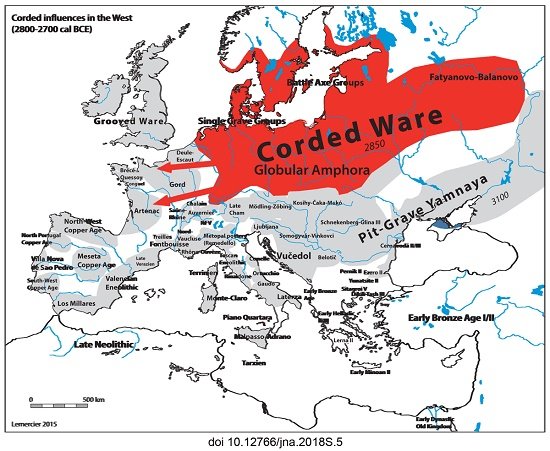
* Mutation origin (Formed): The L260 mutation appeared around 2000–2600 BCE. That was when the first boy carrying this specific genetic change on his Y chromosome was born. He lived during the time of the Corded Ware culture or at the dawn of the Mierzanowice and Trzciniec cultures. [1, 2]
* Time to Most Recent Common Ancestor (TMRCA): Estimated to be around 800–600 BCE (the beginning of the Iron Age, a period associated with the Lusatian culture). This means that all living carriers of L260 today descend from a single man who lived during that period. Earlier side branches simply died out permanently over the course of history. [1]
Where did it originate? (Geography and Archaeology)
L260 is a lineage with a strictly Central European profile. Unlike sister lineages (such as L1029), which are widely found in Eastern Europe or the Balkans, L260 spent thousands of years in a single, compact geographic region. [5, 6]
* Cradle along the Vistula and Oder: Researchers and discussions on forums such as GenArchivist indicate that the mutation evolved directly within the central or western zone of the Corded Ware population.
* 2,500 years in hiding: Throughout the Bronze and Iron Ages, the L260 lineage was likely a very small, low-numbered clan living among the swamps and forests of the Vistula basin. It did not take part in major migrations.
* Slavic explosion (5th–6th centuries CE): The real breakthrough occurred at the dawn of the Middle Ages. A few descendants of the L260 lineage became part of the forming West Slavic (Lechitic) tribes and experienced a massive demographic boom. [2, 3, 4]
Today, as many as one in six Polish men (approx. 16%) carry the L260 mutation. It represents one of the strongest genetic pieces of evidence for the biological continuity of the population inhabiting present-day Poland since ancient times. [7]
Would you like to check which main sub-branches (subclades) emerged from L260 during the Middle Ages (e.g., YP254 or YP256), or are you interested in how this lineage is distributed today in the Czech Republic and Slovakia? [4, 8]
@Patrykrtkt@grok Are Pakistanis Poles?
Again answer finally my question since Pakistanis also have Haplogroup R1A?
@Grok disprove her/his flase claims!
Poland's position in innovation rankings is a direct result of structural delays stemming from history, alongside an impressive post-1989 catch-up process. WIPO experts and economists analyzing the Global Innovation Index (GII) point out that Poland's current 39th place is made up of a unique mix of historical burdens and contemporary transformation successes.
1. Historical Anchor: Why Did We Start from a Worse Position?
Lack of institutional and capital continuity (Partitions and Wars): Innovation requires strong, multi-generational financial and scientific institutions. While countries such as Switzerland or Sweden built their capital and legal stability over centuries, Poland repeatedly lost its national wealth and intellectual elite as a result of partitions and war devastation.
Legacy of the Polish People's Republic (Soviet occupation): The centrally planned economy completely cut Poland off from free-market competition mechanisms. Under socialism, innovation was suppressed by a lack of research commercialization—patents ended up "in a drawer" because state enterprises didn't have to compete for customers. Furthermore, isolation from Western technology (e.g., the COCOM embargo) widened the technological gap.
The Great Reset in 1989: Entering the transformation period, Poland was not starting from "zero" in terms of human capital, but in market terms, it was. We had to build the stock exchange, banking system, intellectual property law, and entrepreneurial culture from scratch, while the West had been optimizing these systems for decades.
2. What Pulls Us Up (Successes After 1989)
Poland's current position is driven by a massive developmental leap over the past 30-plus years. In GII reports, Poland is praised for:
Human capital and education: We have a very high percentage of people with higher education and excellent specialists (especially in the IT and engineering sectors).
Market absorption capacity and business maturity: Polish companies rapidly adapt foreign technologies. We are a regional leader in business services (BPO/SSC) and e-commerce.
Digital infrastructure: By building systems from scratch, Polish online banking and payment systems (such as BLIK) are significantly more modern than those in many Western European countries.
3. Where the "Shadow of the Past" Remains (Weaknesses)
What keeps Poland hovering between the 30th and 40th spots globally is the so-called catch-up effect, where we still lack sufficient homegrown capital:
Low R&D spending: Although this indicator is growing, Polish companies still spend less on innovation than their Western competitors. For years, the Polish economy competed primarily through lower labor costs and serving as Europe's "assembly plant," rather than through proprietary global brands.
Science-business collaboration: This is a direct systemic legacy—Polish universities still struggle with commercializing discoveries, and businesses rarely order research from universities.
Low number of international patents: Polish companies still register relatively few patents via the Patent Cooperation Treaty (PCT) relative to the country's GDP.
In summary: Since 1989, Poland has achieved one of the fastest developmental leaps in global economic history. Our position (39th place) reflects this success—we outperform many countries that never experienced communism. However, jumping into the top 20 requires transitioning from an "imitation and adaptation" phase to a "creation of proprietary breakthrough technologies" phase, which is the hardest step without generations of accumulated capital.