The life and campaigns of “Old Blood & Guts”.
Daily posts on Patton, his decisions and the Third Army he led.
American fighting spirit!
By Yannis Kadari
"We’re not going to just shoot the sons of bitches. We’re going to cut out their living guts and use them to grease the treads of our tanks."
Classic Patton.
Unfiltered.
American.
Troyes had barely been liberated. Patton was already pushing his spearhead toward the next city!
On August 27, 1944, just two days after liberating Troyes (about 110 miles (175 km) southeast of Paris) Combat Command A of Major General John S. Wood’s 4th Armored Division drove northeast toward Châlons-sur-Marne.
The 80th Infantry Division followed, securing the ground while the tanks continued forward.
Both divisions belonged to Major General Manton Eddy’s XII Corps under Patton’s Third Army.
For Patton, liberating Troyes was not an ending. It was permission to keep pushing!
Follow for more!
A Day with General Patton!
Patton refused to command a fast-moving army from behind a desk. When the roads became too slow, he took to the air.
August 26, 1944 - After visiting XX Corps, decorating men of the 5th Infantry Division, crossing the Seine at Melun, and inspecting the 7th Armored Division, Patton returned to Fontainebleau and climbed aboard a light liaison aircraft.
He flew to XII Corps headquarters on the Sens–Troyes road. While he was there, news arrived that the 4th Armored Division had captured Troyes!
Patton then set the next objectives: XII Corps would drive toward Châlons, while XX Corps pushed for Reims.
Some generals waited for reports to reach headquarters. Patton flew out to meet the advance himself!
Show your love and respect for "Old Blood and Guts" - follow us!
(Photo : US Nara)
A Day with General Patton!
The cameras were still following Patton when he reached the next headquarters.
What he saw immediately put him in a foul mood!
On August 26, 1944, Patton arrived at the headquarters of Major General Lindsay McDonald Silvester’s 7th Armored Division.
The division had landed in Normandy only two weeks earlier. It had already fought through Chartres and crossed the Seine at Melun, but its progress eastward was slower than Patton expected.
He also noticed armored infantrymen struggling beneath too much equipment. Patton told Silvester bluntly that his division looked terrible and that its progress was unsatisfactory. He demanded immediate improvement.
It was classic Patton: appearances reflected discipline, unnecessary equipment reduced mobility, and an armored division that stopped moving surrendered its greatest advantage.
The message was received.
Two days later, the 7th Armored Division spearheaded XX Corps’ drive toward Reims. By August 31, its tanks had reached Verdun and crossed the Meuse.
Another moment from August 26, 1944, "A Day with General Patton."
A Day with General Patton!
Patton did not always greet his soldiers with a scowl!
On August 26, 1944, U.S. Army reporters and cameramen followed the Third Army commander across France for what the Signal Corps called "A Day with General Patton."
Patton visited the headquarters of XX Corps, the 5th Infantry Division and the 7th Armored Division. He inspected positions, presented decorations and spoke directly with soldiers as his army advanced beyond the Seine.
This photograph captures one of those encounters. "Old Blood and Guts" is smiling broadly, his three-star command Jeep visible behind him. For Patton, such tours were more than publicity. He wanted to see the roads, question his commanders and ensure that the men at the front saw their army commander in person.
The identity of the soldier facing him, and the precise location of the photograph, remain unconfirmed.
Perhaps someone out there knows more?
Follow @PattonOwn for more!
(Photo: US Nara)
A Day with General Patton!
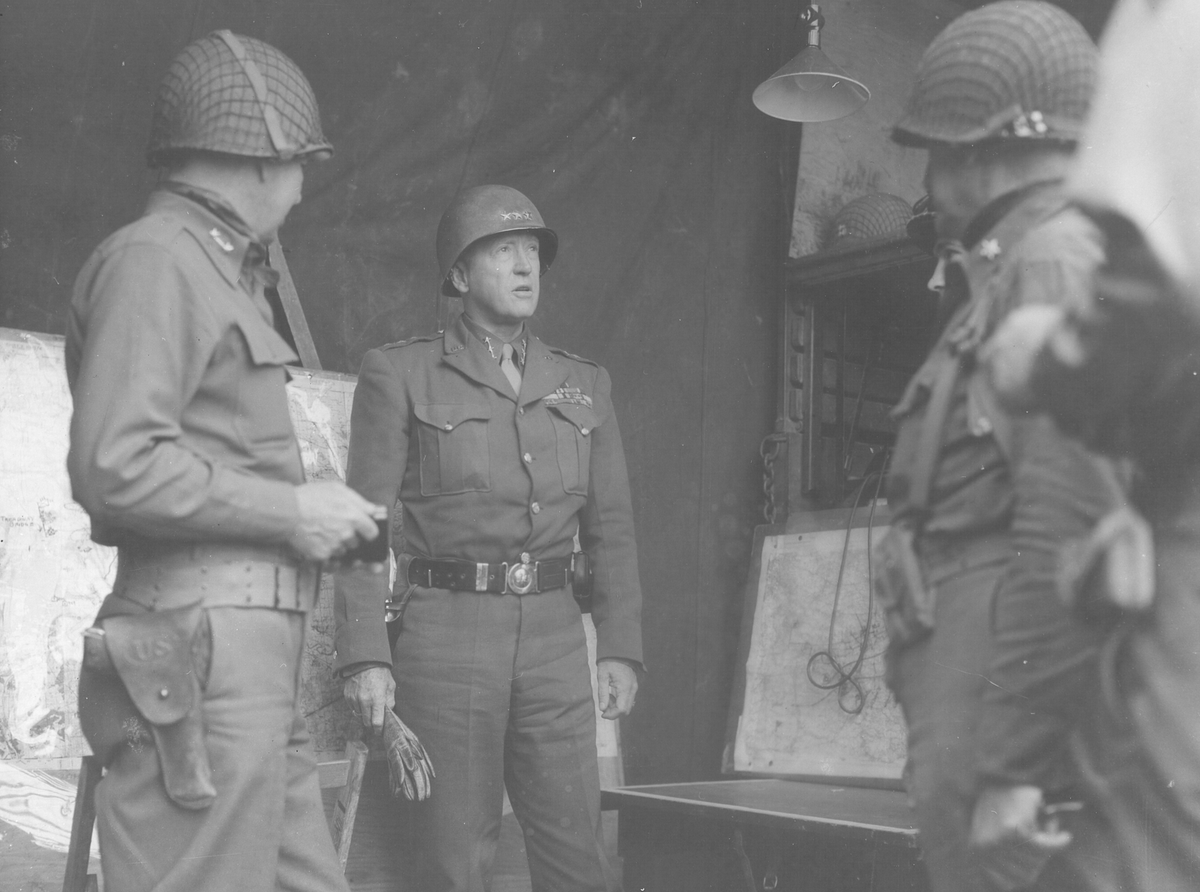
Most officers at Third Army headquarters were not allowed to see what was spread across this table.
August 26, 1944. Under a camouflage net somewhere south of Paris, Patton studied German operations around the Seine with his chief of staff, Major General Hugh Gaffey.
Standing beside them was Major Melvin Helfers, one of the few officers entrusted with ULTRA, the highly secret intelligence produced by decrypting German communications!
After the regular morning briefing, most of the staff would be ordered out. Helfers then placed his special map over the ordinary operational map and revealed what the Germans were saying about their own movements, shortages and intentions.
Patton’s armored columns were already crossing the Seine and racing east. Their speed looked reckless from the outside.
But "Old Blood and Guts" was often seeing more of the battlefield than the enemy realized!
Follow for more amazing stories from the life, command and army of General G.S. Patton.
A Day with General Patton!
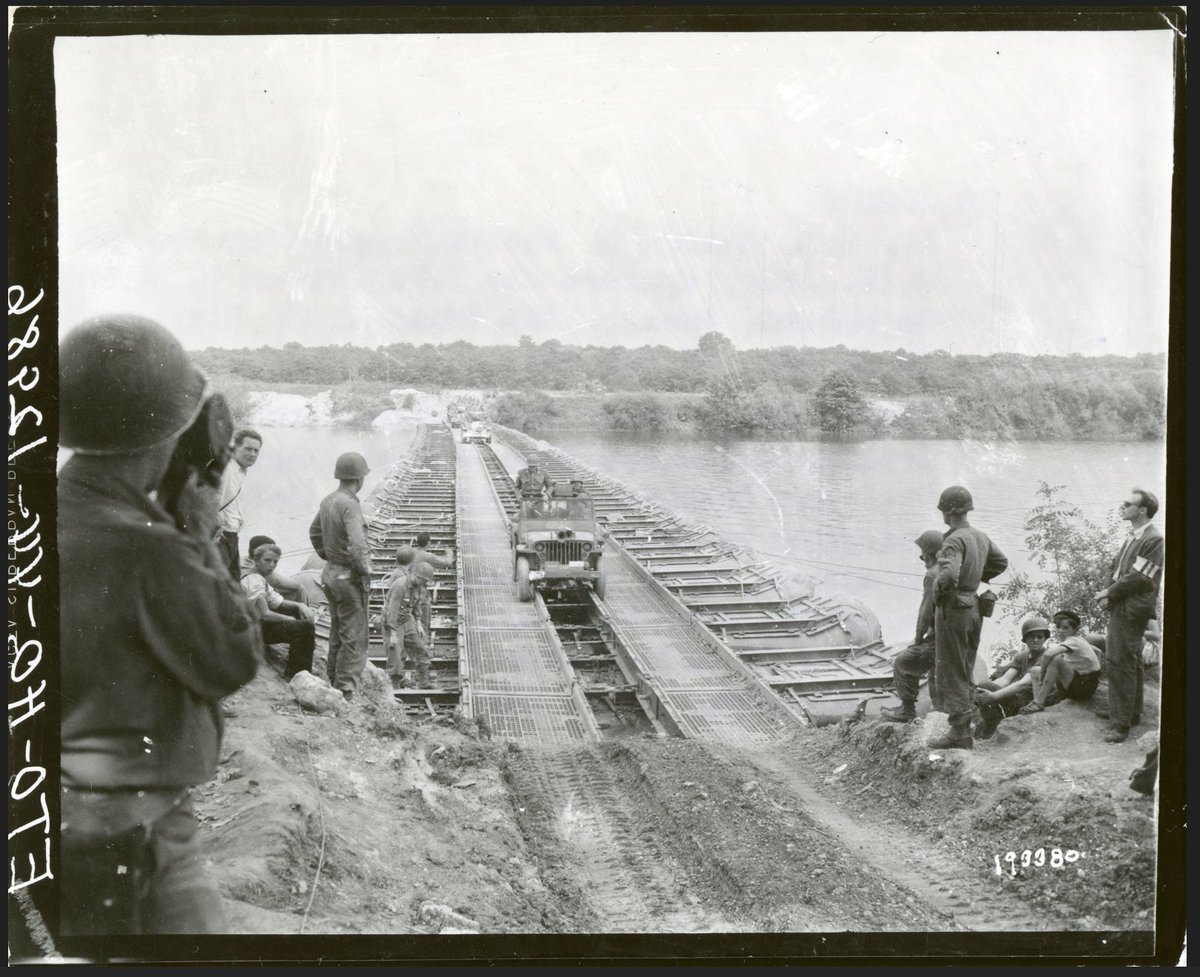
The Wehrmacht hoped the Seine would become the next barrier to the Allied advance. But Patton crossed it in an open Jeep, and became the first U.S. field army commander to do so!
August 26, 1944. Six nights earlier, infantrymen of Patton’s Third Army had crossed the Seine at Mantes-Gassicourt during a violent rainstorm. Engineers then built temporary bridges capable of carrying trucks, artillery and tanks.
Additional bridgeheads followed south of Paris. The river that German commanders hoped to transform into a defensive line was already being left behind.
Now Patton crossed it personally at Melun.
The Signal Corps had designated August 26 "A Day with General Patton." Reporters and cameramen followed him as he drove and flew between his advancing formations.
The original Signal Corps caption recorded Patton as the first U.S. field army commander to cross the river. It made a perfect publicity photograph. But it also captured Patton’s method of command: keep moving, appear at the front, and make yesterday’s seemingly impossible obstacle look irrelevant!
(Photo: US Nara)
For one day, the cameras were allowed to follow the most recognizable American general in France.
Patton made sure they had something to film!
On August 26, 1944, U.S. Army Signal Corps photographers and reporters accompanied General George S. Patton as he toured Third Army’s rapidly moving front.
The resulting photographs are more than portraits. They document Patton moving personally between his headquarters and forward formations as Third Army began its pursuit beyond the Seine.
Stay with us throughout the day as we retrace August 26, 1944, through a special series of posts, and spend a day with General Patton!
The future commander of Third Army wanted to see the battlefield from a different angle.
So he earned a pilot’s license and brought his own "Flying Jeep"!
During the large U.S. Army maneuvers of 1941, Patton used his personal aircraft - a Stinson Voyager - to observe the 2nd Armored Division’s movements from the air. Light aircraft proved so useful for reconnaissance, communications and command that exercise umpires eventually restricted their use to prevent them from giving one side too great an advantage.
The episode reveals that Patton’s interest in mobility extended beyond tanks: he recognized the command value of light aviation before the United States entered the war.
Follow @PattonOwn for more !
(Photo: US Nara)
Since someone asked: no, I’m not American. But yes, I deeply love America, and I have admired General Patton and his fighting spirit since childhood.
It is an honor to run this account, and I hope it will help many people discover the extraordinary life of this amazing soldier, and everything he accomplished to help freedom prevail.
I’m the only one calling the shots here and any a**hole who tries to drag General Patton’s memory through the mud will be blocked without warning.
Over.
An amazing photograph!
The German soldiers were hidden inside a French convent. Then a nun stepped out to negotiate their surrender!
Near Avranches on July 30–31, 1944, two French nuns approached an American patrol with an offer from German troops sheltering inside their convent.
One of the sisters negotiated with Captain Alfred J. Owen of Haugen, Montana, an officer of the 53rd Armored Infantry Battalion, 4th Armored Division. Owen accepted the surrender, and another photograph shows the Germans emerging with their hands raised.
The 4th Armored Division would soon become one of Patton’s most formidable spearheads, but here, a French nun secured the objective without another shot being fired.
Follow @PattonOwn for more stories from the life and army of General G.S. Patton.
By August 25, 1944, the day Paris was liberated by the 2nd Free French Armored Division and the 4th US Infantry Division, Patton’s Third Army already held four bridgeheads across the Seine and had forces nearly 80 miles beyond the French capital, having advanced with exceptional speed after the Normandy breakout!
Patton initially had two corps available south of Paris: XII Corps and XX Corps. Each contained one armored and one infantry division; Patton subsequently reinforced them with the 80th and 90th Infantry Divisions.
VIII Corps remained hundreds of miles away in Brittany, while XV Corps had not yet returned to Patton’s control.
Third Army’s speed therefore depended as much on infantry, reconnaissance, trucks and disintegrating German resistance as on massed armor.
Liberation!
Units of the French 2nd Armored Division and the US 4th Infantry Division pour into Paris.
Locals dismantle barricades that they had made to hinder German movement.
There is still heavy fighting, notably at the Palais du Luxembourg, Hôtel de Ville, Rue de Rivoli.
Patton’s advance had moved so far and so fast that feeding it required an airlift!
On August 25, 1944, 207 transport aircraft landed at Orléans carrying 507 tons of supplies for Third Army, mostly rations, along with a limited amount of gasoline.
Another 80 tons of medical supplies followed the next day.
The airlift kept Patton’s men fed and moving, but it could not deliver enough fuel to sustain an army already outrunning its supply lines from Normandy.
Follow @PattonOwn for more stories from Patton’s Third Army.
(Photo: US Nara)
Onward and upward!
Tanks and armored vehicles of the 7th US Armored Division ("Lucky Seventh"), assigned to Patton’s Third Army from August 5, 1944, push east, swinging south of Paris and driving hard toward Champagne, then Lorraine.
Between these tankers and the borders of the Reich there is almost nothing left - only a few weakened German units in full retreat!
Follow us for more!
These cavalrymen were not simply scouting the road ahead.
They became Patton’s eyes and ears, and carried his orders across an army advancing faster than its own communications could follow!
Before Third Army entered combat in France, Patton gave the 6th Cavalry Group an assignment unlike that of any other mechanized cavalry group in the U.S. Army.
Instead of using all its men for conventional reconnaissance, he transformed much of the group into his personal Army Information Service!
Under Plan Unicorn, the 6th and 28th Cavalry Reconnaissance Squadrons alternated between missions. While one performed more traditional reconnaissance and protected Third Army headquarters, the other scattered liaison detachments across Patton’s enormous command.
Operating in Jeeps, M8 and M20 armored cars, these patrols were attached to corps and divisions, and sometimes worked as far forward as regimental command posts.
They visited operations and intelligence officers, monitored radio traffic, observed units in contact with the enemy and transmitted reports directly to the 6th Cavalry Group headquarters, located beside Patton’s advanced command post.
The system shortened the normal chain of communication. During the pursuit across France, some Third Army formations operated nearly 100 miles from Patton’s headquarters, but the cavalrymen kept information flowing in both directions.
Not everyone welcomed them. Some commanders initially regarded the patrols as spies sent by Patton to watch them. That suspicion gradually disappeared. By the end of the war, some divisions were specifically requesting liaison patrols to accompany armored columns making deep penetrations.
Unofficially, they became known as "Patton’s Household Cavalry."
They were not simply scouting the road ahead. They became the eyes, ears and nervous system of an american army racing across Europe!
Follow @PattonOwn for more extraordinary stories from General Patton’s life and campaigns.