@paulosalbego@LatinXChem@SupraNano matrix, that for comparison and space purposes were omitted, but are readily available in the full papers. Thank your questions and the interest in our work ! (4/4)
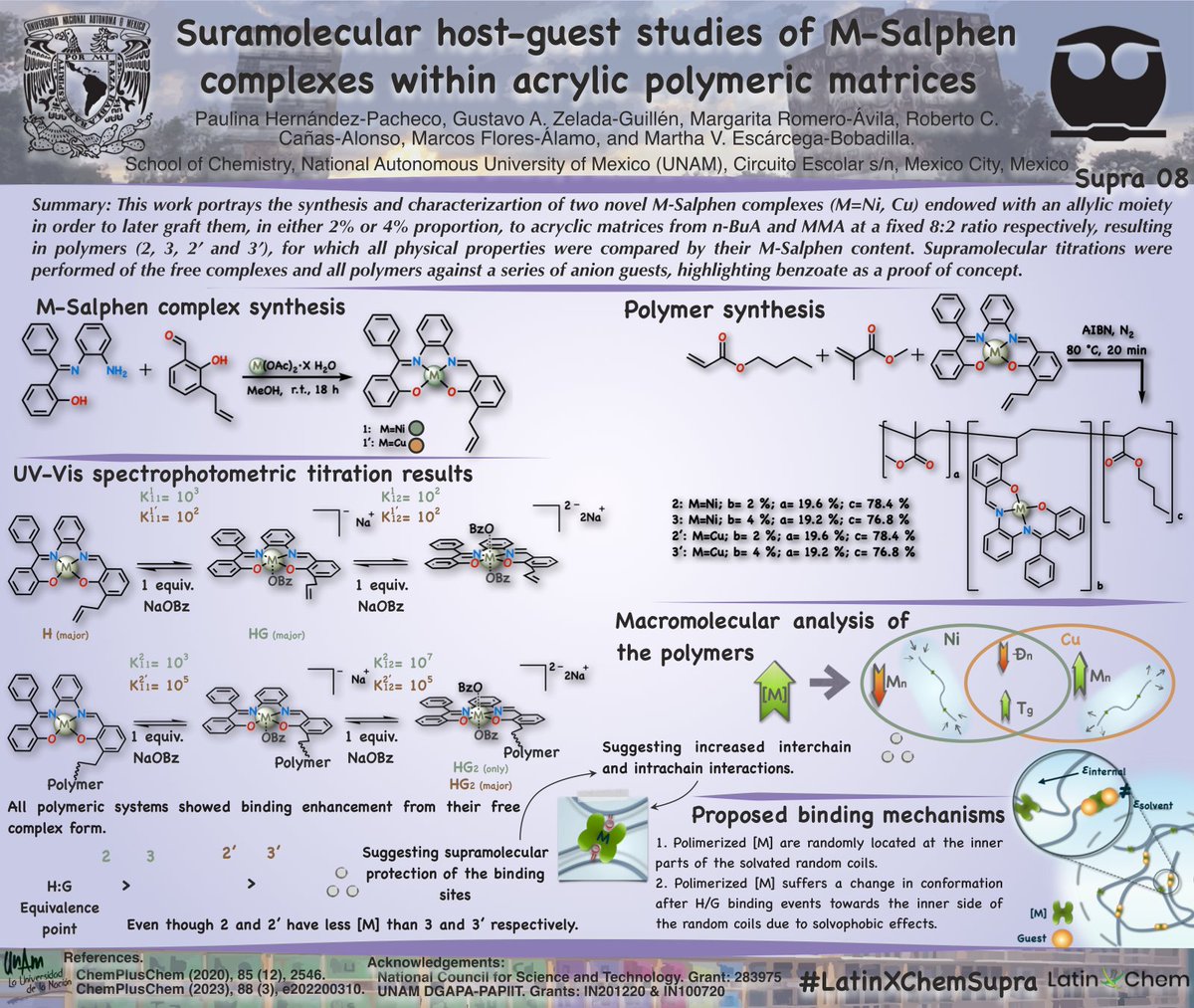
@paulosalbego@LatinXChem@SupraNano systems, we also studied the emission profile of the systems before and after binding, that also suggested an internalization of the guests species into the polymeric (3/4)
@paulosalbego@LatinXChem@SupraNano Hi Paulo ! What we can gather from comparing the results of the two studies is that the systems with a Ni 2+ metal center show more affinity towards benzoate ion, in both the free complex and the polymeric systems. And yes it would be possible, and could be interesting !
@Miguel_A_Soto_@LatinXChem@SupraNano *I meant the difference between benzoate alone and the ditopic or tritopic linkers, I've read it again and thought that part of the idea was unclear haha so I'd rather clear that out C: thank you!
@Miguel_A_Soto_@LatinXChem@SupraNano From benzoate alone, if achieved the cross-linking, first we would first notice a change in the binding stoichiometry from this new type of association within the polymer's random coils. C: thank you for your questions ! we are very happy to find so much interest in our work!
@Miguel_A_Soto_@LatinXChem@SupraNano We haven't tried ditopic or tritopic linkers for this systems, but it would be very interesting, since we might be able to achieve a cross-linking effect on the polymeric coils from the interactions with the binding units, probably modifying the characteristics of the material.
@Miguel_A_Soto_@LatinXChem@SupraNano host, but it does have to be introduced to the solvated polymer coils in order to interact with the M-Salphen hosts, which is also why we proposed the binding mechanisms presented, based on the results obtained from the analyses (2/3)
@TripletStateGuy@LatinXChem@SupraNano harder Lewis bases like for example, benzoate among other ones tested were found to have a much improved binding affinity, from the supramolecular titrations performed. Thank you for your question and please let me know if there is more you would like to know. 😁 (2/2)
@TripletStateGuy@LatinXChem@SupraNano Hi Ricardo! Of course, we used a series of anion guests with different sizes and Lewis basicity natures, where we found soft base, thiocyanate, did not have a good binding affinity, which makes sense given the mid to harder acid nature of the selected metal centers, whereas (1/?)
@Zanchet_UNICAMP@LatinXChem@nanoscale_rsc@SupraNano environment in which the binding sites now find themselves as they are now grafted with such a macromolecule, showing at the same time a monochromatic emission switch effect for this systems dependent of the nature of the guest.
(5/6)