The loudest voices stoking fears about AI dangers have made tremendous headway in the past two weeks. AI technology has not taken some unexpected, dangerous turn, but the hype around it — propelled by what appears to be a well orchestrated PR campaign — has drummed up considerable fear. I worry that it represents a setback for our field.
I have written frequently that fears of AI are overhyped. AI’s capabilities can be uncannily human-like and unpredictable, and it’s rational to worry when people who are directly involved express concerns. But I see the problems as a sign of the engineering work that ahead, rather than insurmountable barriers or the sky falling. AI technology continues to advance — which is a good thing! — but technical advances, poorly understood by the public, give those who seek to generate hype repeated opportunities to do so.
First, I don’t see any step up in the risk of human extinction from AI compared to a few months ago. The theories about this remain the same fantastical, science fiction scenarios as a few months ago. The biggest change in AI risk is its cybersecurity capabilities — a topic which we should take seriously — but this, too, will not lead to the end of the world.
The most notable recent event leading to increased fear was when an OpenAI team deployed an agent swarm that hacked into Hugging Face. Much of the popular press contained significant hype. For example, some publications reported that a swarm of 1,200 agents carried out the attack. While this was technically accurate, as I write this, I have about 1,300 processes running on my laptop. Yes, the ability to get large swarms of agents to work in parallel on a task is a significant technical advance, And, in computing, many processes run at the same time. So this shouldn’t be seen as some magical capability.
Additionally, OpenAI’s buggy sandboxing and monitoring processes were key to enabling this incident. Fixing these bugs and putting in place improved monitoring would be appropriate fixes, not pausing AI. There are many well known ways to attack software systems. The main advantage of AI agents is that they are relentless. They will tirelessly try many tactics — and have the patience to chain vulnerabilities together — that previously would have taken an infeasible amount of human effort. But in the long term, I believe the advantage will lie with defenders (because they have more information with which to identify bugs, which they can fix), but the cyber-threat landscape has changed significantly. There are still bottlenecks to identifying and exploiting a vulnerability. AI agents still have to try a lot of things to see what works, and taking these actions takes time and might be detected by defenders. This is why, even though it is now easy to obtain versions of leading open weight models that have had their guardrails removed or weakened, so they will not refuse to try to execute cyber attacks, the world has not ended.
I am also concerned about the anthropomorphization of AI in a lot of reporting, where LLMs and agents are unnecessarily treated as if they were people. If I wield a hammer, miss a nail, and accidentally dent the wall, it’s not the fault of the hammer. The problem lies in how I used the hammer. Similarly, if I prompt an agent and it hacks into someone else’s system, the responsibility lies with me, not the agent.
Of course, we want to build systems that are as safe and predictable as possible. (For example, an unsafe hammer would be one whose head randomly flies off under normal use.) Today’s agentic systems are not predictable, but I see no reason why, by applying sound engineering practices, we won’t be able to make them extremely safe to use. One new element in the forecasts of AI-enabled doom is AI companies disclaiming responsibility for their own products. “I didn’t do it; my out-of-control agent did!” There’s a balance to be struck between the responsibility of the tool maker and the tool user, but when something goes wrong, let’s hold the people building and/or using the hammer responsible, rather than the hammer. (By the way, if you’re worried about AI bioweapon risk, David Bellamy has a great post on why this, too, is overhyped. Briefly, the bottleneck in building a bioweapon is not intelligence, but lab work and manufacturing.)
Pausing AI progress will create much more harm than benefit. First, our adversaries will certainly not slow down. Second, engineering requires discovering problems empirically so we can fix them. If we pause AI by a decade, we will also delay finding and implementing safety engineering fixes by about the same duration.
Of course, the incentive to stoke fears — for regulatory capture, to garner attention, or to make one’s technology seem more powerful — remains the same as before. Disclaiming responsibility is a new one. Taking a hard technical look at the actual risks however, I see little factual basis for the degree of fear that’s been stoked up. We still have hard research and engineering work ahead to improve AI safety, but the beneficial applications continue to vastly outweigh the risks, and we should keep building.
[Original text (with links): https://t.co/jni2tWazAH ]
Here’s the problem with both Anthropic and OpenAI:
1️⃣ I don’t remember where or when, but Mike Green (@profplum99) observed that the impressive, fast and steep adoption of LLMs since 2022 is highly misleading: most of the usage, say 99%, consists of people asking questions they would otherwise ask Google. One can expect this share of the pie ultimately to be claimed back by Google.
2️⃣ Meanwhile, those who use ChatGPT or Claude for more than simply asking questions, say for drafting assistance, brainstorming on complex topics, coding, etc., are growing frustrated with the declining quality. Those are the 1% top users.
3️⃣ The reason quality is going down is most likely that both companies have to throttle inference because they are losing money on each request and facing an increasingly adverse fundraising environment. That’s true even for paid plans.
4️⃣ In other words, those who really need LLMs for the value they can add, the 1%, are having their usage constrained so that OpenAI and Anthropic can absorb the load of the 99% who pay nothing. It’s a loss on both counts: no money is made from the 99% (good luck catching up with Google on advertising revenue), while the 1% are growing disgruntled because of slop, itself the result of inference throttling.
5️⃣ The problem both companies face is very familiar to anyone versed in business strategy or marketing: bad segmentation, which in turn leads to bad strategic positioning.
6️⃣ That’s where the situation diverges. Anthropic can still decide to become 'The AI-Assisted Coding Company' and turn into some combination of Stack Overflow, GitHub and AWS. (They could even acquire GitHub from Microsoft.) I’m not sure they’ll find the TAM necessary to deliver ROIC to their shareholders, though, if the only market they serve is coding.
7️⃣ Meanwhile, OpenAI is in a bind. I don’t see how they catch up with Google in a two-sided, advertising-revenue business aimed at consumers, and I don’t see how they’ll manage to segment their offering and reach a point where there is sufficient willingness to pay across all segments. This is why there are now talks of OpenAI going down, and in any case, I'd say it is all but certain they’ll never generate an ROIC. Cc @edzitron
8️⃣ Last year, I wrote a long piece explaining how OpenAI could reposition itself to specialize in trading for compute: a Glencore for the AI age. That’s a very large TAM, but I’m not seeing anything that suggests they’re going in that direction. See: https://t.co/eE9z80NvdE
9️⃣ All of the above has been made clear by what @sameer_singh17 calls the "open model summer" 👇 Between Alex Karp’s remarks on CNBC, the emergence of cheap and readily available open-source models, and the gradual shift towards running local models, a battle that will likely be won by Apple, what had until now been discussed by only a few people (Sameer, @ganeumann, and yours truly) has now become obvious to everyone. I wrote about Karp's remarks here: https://t.co/BJlz1qQKgN
🔟 How do you call a bubble out of which the winners are two pre-existing “synergy companies”, Google and Apple (to borrow Jerry's exact words, in reference to @CarlotaPrzPerez's "synergy phase" of a great surge of development) and perhaps only a scaled-back Anthropic refocused on code? A late-cycle bubble. That’s what AI is.
So stop talking about a new technological revolution and see AI for what it is: an incredible, value-adding final iteration of the age of semiconductors, computing and networks, which won’t live up to the hype from an frontier lab ROIC perspective but will still deliver tremendous productivity gains over the next two decades.
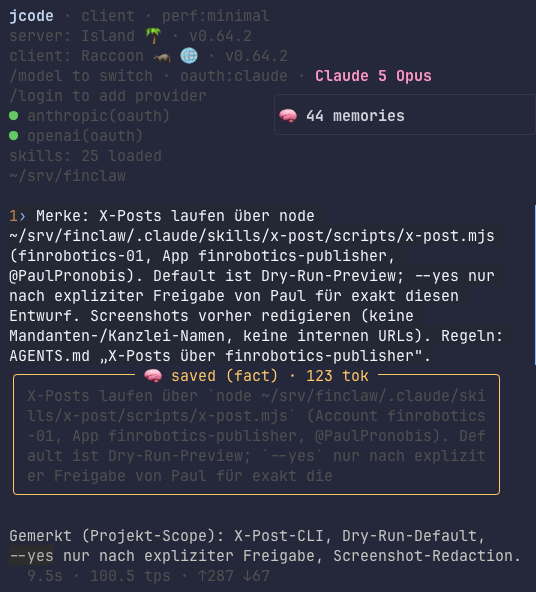
The most valuable part of a coding agent may be the part you don't replace when you switch models.
This morning I ran jcode on GPT-5.6 Sol. In this screenshot it is running Claude 5 Opus. One /model command swaps the reasoning engine.
Better models become drop-in upgrades; continuity lives one layer above them.
My favorite receipt is the newest memory in the screenshot: "saved (fact) · 123 tok". jcode is literally remembering how it posts on X while helping prepare this post.
The most influential immigrant group in American history is the one nobody argues about, because almost nobody remembers it was them.
Start at the beginning. The Continental Army was a half-trained mess until Baron von Steuben, a Prussian officer, showed up at Valley Forge and drilled it into a real fighting force. The freedom of the press you take for granted traces back to John Peter Zenger, a German immigrant printer whose 1735 trial established that you can't be jailed for printing the truth. German-Americans were shaping this country before there was a country.
Then look around your own life. Your Christmas tree is German. The hot dog (Frankfurt), the hamburger (Hamburg), the pretzel, the delicatessen, all German. Kindergarten is German, the word and the idea, brought over and opened by Margarethe Schurz. Blue jeans came from Levi Strauss of Bavaria. Heinz ketchup, Steinway pianos, Oscar Mayer, and the big four beers, Budweiser, Pabst, Miller and Schlitz, were every one founded by German immigrants.
The Brooklyn Bridge was engineered by John Roebling, born in Prussia. The Santa Claus you picture every December, plus the Republican elephant, were drawn by Thomas Nast, a German immigrant. Pfizer was founded by Charles Pfizer, who arrived from Germany in 1848. Boeing was built by the son of a German immigrant. John Jacob Astor showed up from Germany with next to nothing and became America's first multimillionaire. Charles Steinmetz, a disabled immigrant nearly turned away at the border, went on to make modern electrical power possible.
And it kept going. Wernher von Braun designed the rocket that put America on the moon. Einstein was German. Carl Schurz, a refugee, became a Union general and the first German-born US Senator. Eisenhower commanded D-Day and won the White House under a name once spelled Eisenhauer. Babe Ruth was a German-American kid from Baltimore.
Here is the kicker. German is the single largest ancestry group in the entire United States, around 44 million people, bigger than Irish, English or Italian. The biggest thread in the whole American fabric, and somehow the quietest.
They never asked for parades. They just trained the army, freed the press, engineered the bridges, founded the companies, built the rockets and lit up the Christmas mornings, then blended in so completely you forgot they were ever the "other." That might be the most American story there is.
Mysterious ‘cold blob’ in the Atlantic suggests the AMOC is weakening
A patch of ocean south-east of Greenland is the only place on Earth that is cooling, and it could be a sign that the warm water “conveyor belt” in the Atlantic is slowing down
https://t.co/iOP7S0fjUS
https://t.co/nKdwhlJCaW
INSTEAD OF WATCHING AN HOUR OF NETFLIX TONIGHT.
This 1 hour Stanford lecture by Joel Peterson will teach you more about negotiation and getting what you want than most people learn in years.
Bookmark it and give it an hour, no matter what.