I had the opportunity to work as a key animator on Digimon Beatbreak #46!!!
Thank you so much to the entire Toei Animation team for this amazing opportunity!
I hope everyone enjoyed the episode!
Thanks for watching!
#デジモン#BEATBREAK
❌⚠️FUNA / CALLOUT / BEWARE a VANIA (suupergirl) y JOSÉ BACHUR ⚠️❌
🧵Vania Bachur y su hermano, José Bachur, han pasado 4+ meses condicionando y reteniendo los pagos de sus animadores. José ha utilizado lenguaje agresivo y amenazas para evitar que salga la información a la luz.
@samotbaas Lo que hay que leer. Ojalá pudieras estar encerrado un mes sin ningún tipo de arte (ni películas, ni series, ni musica, ni videojuegos, ni libros, ni comics, ni diseño de ropa/muebles/informáyica/electronica) así aprendes a valorarlo. He trabajado en varias de esas, y son reales.
Once again, I had the pleasure to work on Episode #79 of Re:Zero!, thank you so much to the entire team for their trust!
I hope everyone enjoyed the episode!
I received permission to share part of my work!
#リゼロ
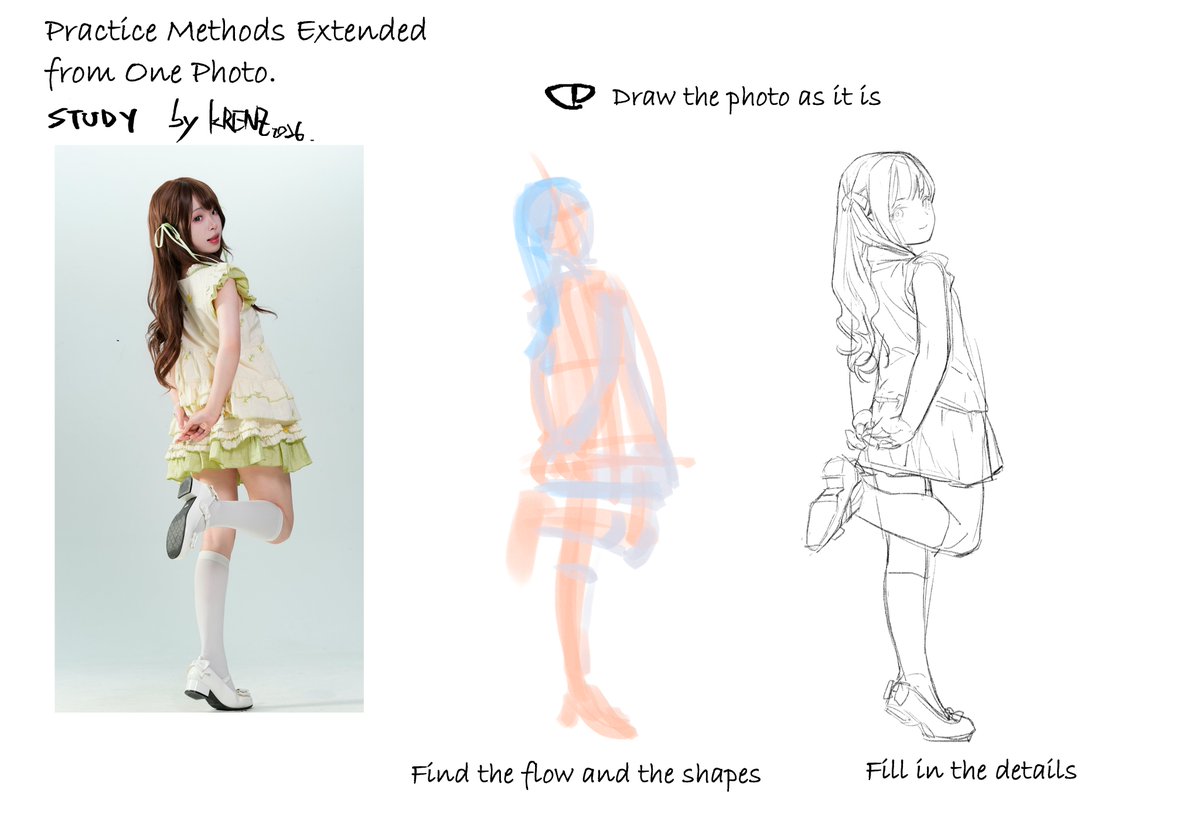
When our instructors at Krenz Artwork Academy practice from photo reference, they work in four different ways.
1. Straight extraction, normal proportions.
Read the gesture, the shape characteristics, the height and build of the figure. Then get it down as it is.
2. Change the camera angle.
Set up a space seen at eye level, turned 45 degrees, and draw a box with 2x2x4 proportions inside it. Rebuild the pose in that space, working from where the joints sit: shoulders, knees, the coordinates that hold the figure together. Turn the box and the figure inside turns with it. This is where perspective boxes do the work.
3. Same angle, different camera distance and focal length.
A mid-range shot and a wide-angle shot give you two very different images. This one is harder to control.
4. Extract the gesture, change the proportions.
Push it toward an American comics build, or toward chibi proportions.
One and four are flat translation. Two and three are spatial thinking. They ask for different skills.
Think about your own practice for a moment. If you only train flat thinking, copying goes fine, but the pose stops being editable the moment you work without reference. If you only train perspective, space, and boxed figures, your grasp of shape falls behind and the drawing comes out stiff.
Both sides need the work. That is how a drawing ends up with correct perspective and rhythm at the same time.