🎁 CONCOURS SEO DE L'ÉTÉ : LinkQuiver x Linkavista 🚀
À gagner :
👉 2 abonnements “Strike” d’1 mois à LinkQuiver (Valeur : 89€)
Pour participer :
1️⃣ Follow @Mattioo81 & @Linkavista
2️⃣ RT ce tweet 🔁
📅 Fin dans 48h - Annoncé le 22/06 !
Bonne chance à tous 🍀👇
📢 CONCOURS SPECIAL BLACK FRIDAY
+ 3000€ de LOTS à gagner pour booster ton SEO & ton business ! 🚀
Pour participer :
🔁 RT + ❤️ Like
💬 Commente le ou les numéros de tes lots préférés
👉 Tirage au sort le 18 novembre à 10h
Bonne chance à tous 🍀
@GuruTanuki_ Yo Guru, on voir des inflow massifs vers ETH via ETF en ce moment. Bien plus que sur BTC. Tu peux me dire où tu vois les outflow vers BTC stp ?
Execution
Extremely proud of the community and team for the smooth launch of the HyperEVM. The upgrade happened amidst billions of dollars of daily volume, where the majority of defi derivatives trade. There was no downtime, and no performance degradation after the launch.
The UX of trading is still so seamless that many users assume the HyperEVM is a separate chain! To be clear: the HyperEVM and the existing native Hyperliquid financial system are one composable state.
The safest way to upgrade this uniquely complex system is a gradual rollout. Precompiles and other L1 interactions will build upon the sturdy foundation of the initial HyperEVM release. This will unlock an entirely new class of performant defi applications, but more on that later.
Right now I want to focus on the execution of the launch. A bug in HyperEVM logic or an unoptimized code path would've crippled the entire blockchain, affecting hundreds of thousands of users and billions in open interest.
This was a massively challenging launch: a jet's engine was flawlessly changed mid-flight.
--
Philosophy
The HyperEVM launch stayed true to Hyperliquid’s “no insiders” principle. Hyperliquid has always embodied the original ethos of crypto: no investors, no paid market makers, no fees going to any company. The HyperEVM launch is yet another example that integrity and fairness are the pillars of Hyperliquid.
The tradeoff of a fair launch is that things are a bit messy to start. Tooling might not be there from day one. Builders need to familiarize themselves with the tech. But these short term obstacles are nothing compared to the long term value of fairness. No one had a head start or unfair advantages. I’m impressed that some teams deployed dapps, tooling, and analytics within hours of the HyperEVM release, a testament to the strength of the builders and community.
Hyperliquid will eventually be the credibly neutral infrastructure that houses all of finance. Looking back, the L1 launch, HYPE genesis, and HyperEVM launch will all be important milestones. Success is path dependent, and there can be no blemishes on the fair trajectory towards the final state.
The HyperEVM is a clean slate. The community is hungry for quality applications. Where else in the world is there such an imbalance between supply and demand for applications built? Fast, general purpose chains are nothing new. But on Hyperliquid, builders can plug into a mature, liquid, and performant onchain economy with real users.
I've noticed a pattern that builders, traders, and communities who "make it" on Hyperliquid are those who call Hyperliquid home. Legacy players don't win just because of their credentials. Newcomers have equal opportunity to win by challenging the status quo and seizing the opportunities. There are empires to be built on the HyperEVM, and the community welcomes builders with open arms.
Hyperliquid
1. What Is HIP-2 , HYPER LIQUIDITY?
HIP-2 is a built-in mechanism on the Hyperliquid L1 that makes sure new tokens (created under HIP-1) always have some buy and sell orders in their order book.
Think of it as an automatic market maker that lives inside the blockchain. It refreshes every few seconds, so the market won’t just sit there empty.
Key Ingredients:
startPx: The first (lowest) price the deployer sets.
nOrders: How many prices (levels) will be listed.
orderSz: How big each order is.
nSeededLevels: How many buy orders get “seeded” with USDC at the start.
2. Seeded Levels?
When you create a new token, you want people to actually buy and sell it. But if there’s no liquidity (no buy orders, no sell orders), nobody trades. That’s where seeded levels come in!
Seeded levels are the price levels where the deployer (you) decides to place buy orders funded with USDC.
The rest of the levels become sell orders, funded by the token itself. This ensures that right from the start, there’s at least some USDC to buy tokens (bids) and some tokens to sell (asks).
3. How the “Seeded Levels” work
Pick nSeededLevels: Let’s say you choose nSeededLevels = 2. This means the first 2 price levels out of the total will be buy orders using USDC.
Remaining levels are sell orders: If you have nOrders = 6 total, then the last 4 are sell orders.
startPx: The first price level is startPx. Each subsequent level is roughly startPx × 1.003 (an increase of ~0.3%).
Order Size (orderSz): Each level has an amount of tokens (for sell orders) or an equivalent amount of USDC (for buy orders).
When the system “seeds” your buy orders:
It multiplies the price by the orderSz to figure out how much USDC you must lock in for each buy level.
Those USDC funds cannot be withdrawn late, they’re locked to ensure permanent baseline liquidity.
4. Detailed example
Let’s say you launch a new token called $HYPE and you set:
startPx (Lowest price) = 1 USDC (to keep math simple)
nOrders = 6 (we want 6 price levels)
nSeededLevels = 2 (2 of those levels will be buy orders)
orderSz = 10 tokens (each level involves 10 tokens)
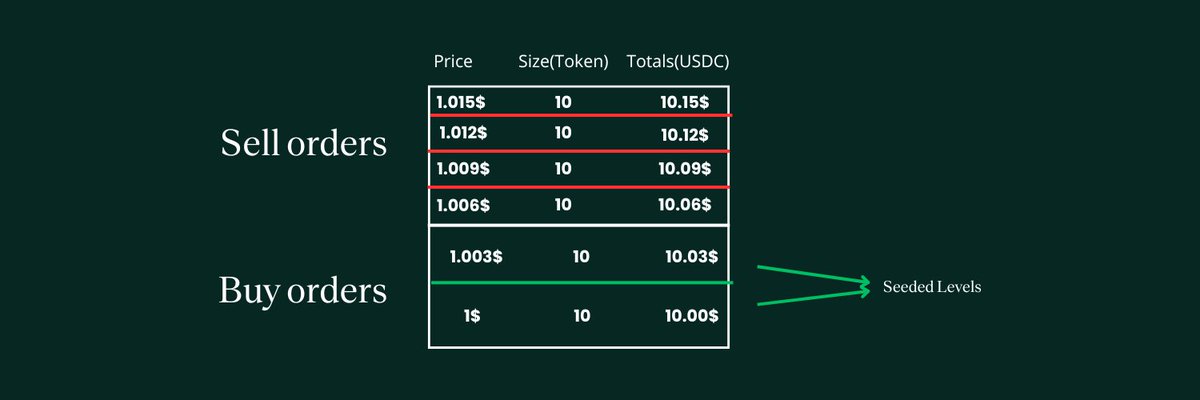
Here’s how it might look:
Price Levels
Level 0 (BUY): 1.000 USDC
Level 1 (BUY): 1.000 * 1.003 ≈ 1.003 USDC
Level 2 (SELL): 1.003 * 1.003 ≈ 1.006 USDC
Level 3 (SELL): 1.006 * 1.003 ≈ 1.009 USDC
Level 4 (SELL): 1.009 * 1.003 ≈ 1.012 USDC
Level 5 (SELL): 1.012 * 1.003 ≈ 1.015 USDC
Buy Orders (Seeded Levels)
Because nSeededLevels = 2, the first 2 price levels are buy orders.
Level 0: Price = 1.000, so the buy order is 10 tokens × 1.000 USDC/token = 10 USDC locked.
Level 1: Price = 1.003, so the buy order is 10 tokens × 1.003 = 10.03 USDC locked.
Total USDC locked for buy side = ~20.03 USDC.
Sell Orders
Levels 2, 3, 4, and 5 become sell orders, each needing 10 tokens locked.
So 4 (levels) × 10 (tokens each) = 40 tokens are locked on the sell side.
In total:
20.03 USDC locked on the buy side.
40 tokens locked on the sell side.
All of this is permanent for HIP-2, ensuring that no one can remove this liquidity entirely.
5. Automatic refresh (~Every 3 seconds)
HIP-2 checks the order book every few seconds:
If a buy level is fully filled (meaning someone sold tokens into it), the system tries to replace that buy order at the same price level or the next level up/down—as long as there’s still enough USDC left.
If a sell level is fully filled (someone bought those tokens), the system tries to replace that sell order with more tokens, if there are any left.
It keeps the price spread around ~0.3% (the multiplier of 1.003).
6. Liquidity locked and place your own orders
Because USDC and tokens are locked, the market can’t be left empty:
It prevents someone (the deployer) from withdraw out all the liquidity when the price goes up (common “rug pull” scenario).
Traders feel safer because they know there’s at least some buy/sell action waiting for them.
HIP-2 doesn’t force everyone to trade at exactly those seeded levels. Any user can:
Place additional limit orders at higher or lower prices.
Cancel or move those orders anytime.
This means HIP-2 is just the foundation; the community can build on top of it.
8. Potential pitfalls
Underfunded Buy Side: If nSeededLevels is too low or the deployer funds them poorly, a large wave of sellers can eat through the buy orders quickly.
Mass Sell-Off: If there’s a massive airdrop or distribution and everyone dumps tokens, it can overwhelm the buy side.
Tuning: Setting startPx, nOrders, and orderSz too high or too low might result in unbalanced liquidity.
Source:
https://t.co/ksTs9DzKUH
https://t.co/cClUzsUubH
https://t.co/UhTtZGSJmw
@ni2las A une époque c'était une folie de voir des tweets comme ça. On sortait nos meilleures prédictions et théories farfelues. Maintenant ça n'a plus vraiment la même saveur
Personne expert crypto dans la commu Sorare pour regarder de plus près le token $PAWEL de @PawelTrader_ et informer des risques ?
Quelle est la tokenomic ? Combien possède-t-il de son propre token ? Quels sont les mécanismes de celui-ci ?
Faites attention, renseignez-vous !
@GuruTanuki_ Bonne année Guru, je peux que te souhaiter de bonnes choses et de ré-ouvrir Obs pour nous gratifier de tes meilleurs streams (et NFT d'explications légendaires) !