Under pressure from Israeli prime minister Benjamin Netanyahu, the Trump administration may be within days of launching a nuclear strike on Iran. The target would be Pickax Mountain in central Iran, where Israeli intelligence claims the Iranian government has restarted its nuclear enrichment program. No conventional weapon in the American arsenal can penetrate 300 feet of solid granite to destroy the tunnels where enrichment is supposedly taking place. The only military option is a nuclear strike. Netanyahu has been pushing hard for one. “Bibi calls Trump about it every day,” says an informed observer.
Netanyahu is cornered and desperate. After last week’s election results, he can’t form a government unless Trump intervenes directly in Israeli politics and brokers a deal with other parties that gives Netanyahu 61 seats in the Knesset. Otherwise, he is out as prime minister and on his way to ignominy, investigations and possibly jail. Netanyahu must stay close to Trump. He needs this war.
To that end, he’s applied maximum pressure to his closest allies in the administration, including Secretary of Defense Pete Hegseth and CENTCOM commander Brad Cooper. Both oppose a negotiated settlement to the war they’ve so grievously mismanaged; both are pushing to restart major combat operations. Secretary of State Marco Rubio and CIA director John Ratcliffe are also following Netanyahu’s lead, as are leaders of the Democratic Party. In a recent meeting on the subject, former president Barack Obama said he opposes the current Iran peace deal being drafted in Doha.
The rest of America’s longtime allies in the Middle East are terrified by the prospect of more war. On September 27th, Netanyahu flew secretly to Abu Dhabi to enlist the UAE in his lobbying effort for a final attack on Iran. The Emiratis refused. After eight months of conflict, Gulf economies are teetering. So are global energy and fertilizer markets. They won’t recover soon. Globally, there are a total of about 850 supertankers used to transport oil from producers to the rest of the world. In October alone, 11 of them were badly damaged in Hormuz. At this pace, a global depression is imminent. A nuclear strike would radically accelerate the destruction. Fallout from a ground explosion at Pickax Mountain would contaminate the Persian Gulf, poisoning the water supply for 100 million people.
And those are just some of the immediate consequences for the region. The rest of the world is every bit as exposed. No country other than the United States has ever used a nuclear weapon in war. Some would like to. An American nuclear attack on Iran would set a new precedent. The Russians have already told at least two other governments that an American nuclear strike on Iran would free them to use nuclear weapons against Ukraine. Pakistan and India would be tempted to do the same against each other, as would North Korea against Seoul. After the first nuclear strike, World War Three is inevitable. That war would be short and final.
We’ve been sleepwalking toward this moment for months. Since February, the administration has quietly rewritten America’s nuclear doctrine to make first use of so-called “battlefield nukes” easier and therefore more likely. No one in Washington in either party seems bothered by this. Now we’re on the brink of it.
Close observers say Trump is likely to decide by next weekend whether or not to use nuclear weapons. That would be November 7, six days from now. To his credit, he’s hesitating. At the moment, Trump is listening to his vice president, JD Vance, and to his envoy and friend Steve Witkoff, both of whom argue a deal with Iran can be made.
They’re right, though it won’t be simple. The Iranians are famously frustrating to negotiate with under any circumstances, and elements of that government have become more radical since Ayatollah Ali Khamenei and his family were killed in February. After decades of isolation, even relatively moderate Iranian leaders seem confused by how decisions are made in the West. (There is a widespread belief in Tehran, for example, that the United States government controls Israel.) But overall, people who have spoken to decision-makers in Iran say there is consensus there that more war is bad for everyone and a deal is worth making.
One group that hasn’t been consulted so far is the global population — the hundreds of millions of people who will be killed along with their children if Trump is pushed by Netanyahu into launching a nuclear strike next week. Now would be the time for them to speak up.
Il y a quelques jours, un Franco-Algérien a partagé sur X une photo de ses sushis qu’il mange avec une sauce algérienne. Une publication qui a été vue par Ryuji, une star de la cuisine au Japon, qui a adoré le mélange. Depuis, la sauce cartonne au Japon.
🎙️@thibaudlefloch
🚨🇫🇷🕊️ ALERTE INFO !
"MONSIEUR MACRON, ON A ASSASSINÉ MON PÈRE !"
LA FAMILLE DE JOSÉ CAPELA RÉCLAME JUSTICE ET EXIGE QUE TOUTE LA LUMIÈRE SOIT FAITE SUR SA MORT.
José Capela, commerçant de 60 ans bien connu des habitants de Saint-Gaudens (Haute-Garonne), a été violemment tabassé et laissé pour mort dans la nuit du samedi 24 au dimanche 25 octobre, à proximité de son commerce.
Retrouvé inconscient, le visage fortement tuméfié par les coups, il présentait de multiples blessures à la tête et au visage, ainsi que d’importants saignements au niveau de la bouche, des oreilles et des yeux. Transporté en urgence à l’hôpital de Toulouse, il est décédé lundi.
Père de cinq enfants, dont des jumeaux de seulement 4 ans, il laisse derrière lui une épouse et une famille dévastée. Décrit comme un homme aimé et respecté de tous, selon plusieurs témoignages recueillis, sa disparition provoque une profonde émotion.
Sa famille dénonce un MEURTRE RACISTE et estime que cette affaire est totalement invisibilisée.
Dans une vidéo, son fils filme une caméra de surveillance située à proximité immédiate du lieu où son père a été lynché et laissé pour mort. Il montre également ce qu’il présente comme des traces de sang de José Capela, encore visibles au sol devant son commerce et qui n’auraient même pas été nettoyées. Selon lui, les enquêteurs ne seraient même pas venus effectuer de prélèvements.
Son fils déplore également l’absence de réaction de la mairie de Saint-Gaudens, affirmant que la famille n’aurait reçu aucun message de condoléances de la municipalité.
La famille réclame JUSTICE et dénonce le manque d’attention médiatique accordé à la mort de José Capela.
Une enquête a été ouverte pour déterminer les circonstances exactes de son décès. À ce stade, le caractère raciste des violences n’a pas été établi par la justice.
(La Dépêche du Midi / témoignages de la famille)
We're excited about Paramount as a future partner who shares our creative ambitions for the Cyberpunk franchise. We look forward to sharing more details at the appropriate time.
All in. Every time. Julia Garner and Anthony Boyle star as Caroline Ellison and Sam Bankman-Fried in this limited series about the love scorned prodigies behind the FTX scandal.
The Altruists premieres November 19.
Today I call upon the blockchain industry to calmly begin planning for "bunker mode". My personal recommendation is to set in motion a controlled mass migration of assets to fresh addresses, i.e. addresses whose pubkeys remain hidden behind a hash.
Holders, starting with large and sophisticated ones, should consider moving the bulk of their funds to addresses that have never signed a transaction. And when they do sign one, they should also move remaining funds to a new address (possibly generated from the same seed phrase).
Don't rush. While I believe there is cause for action a rushed migration would do more harm than good. Don't panic either. Moving assets to protected addresses is a simple, preventative step which does not require new cryptography or new wallets.
IMO it is now reasonable to brace for the possibility that ECDSA breaks before qday, in the worst case in months not years. By "break" I mean fast private key recovery (e.g. in one week) on available hardware (e.g. a large GPU cluster).
Recent days have been humbling for human mathematical intuition. Long-held, unquestioned hypotheses have fallen. This includes the n log(n) bound for integer multiplication and the 3SUM conjecture. In hindsight, May's unexpected disproof of the Erdős unit distance conjecture was our warning shot.
Yesterday's OpenAI drop made it clear that mathematical superintelligence is upon us. They say there are weeks where decades happen. We are about to live through weeks where centuries of mathematical progress happen. Could our magic 64-byte ECDSA signatures be too good to be true? Was it just security through obscurity all this time?
Elliptic curves feel especially vulnerable to superintelligence. Curves carry rich structure, with room for fancy tricks like Schoof, Frobenius, pairings. (By contrast, hashes are designed to minimise algebraic structure.)
Separately, as Ewin Tang can attest, an efficient quantum algorithm sometimes foreshadows an efficient classical one. We should be open to the possibility of a classical counterpart to Shor that breaks elliptic curves and RSA at once.
Also noteworthy is the striking under-representation of cryptographic breakthroughs among the 722 mathematical results OpenAI published. I've witnessed first-hand the US government censoring academic quantum cryptanalysis results. Backroom interventionism is my base case.
I urge large, sophisticated actors to lead by example. Project11's "risq list" (bitcoin-risq-list.projecteleven[.]com) is a great tracker of exposed BTC pubkeys. Binance, Bitbank, Robinhood, Bitfinex, and Tether have an opportunity to harden their cold storage. Next month I'll address institutions in London in a live Q&A (forum.ethereuminstitutional[.]org/london-2026).
Again, please do not rush. Wallets holding under 50 BTC enjoy partial cover from "Satoshi's shield", i.e. his 20K exposed addresses that hold 50 BTC each. Load-bearing signers like oracles and L2 security councils should consider rotating ECDSA pubkeys with every signed message and/or multi-signing with a hash-based schemes like SPHINCS.
Exiting bunker mode safely will require post-AI cryptography. My inclination is to go all-in on hash-based cryptography and avoid structured mathematical assumptions entirely, whether from curves, lattices, or isogenies. A single battle-tested hash (e.g. from the SHA or BLAKE families) yields plausible post-AI security.
The Ethereum roadmap on strawmap[.]org fully embraces hash-based cryptography with end-to-end formal verification as a response to the quantum threat. Those timelines must now be revisited and accelerated in light of mathematical superintelligence. I'll be pushing for maximum defensive acceleration.
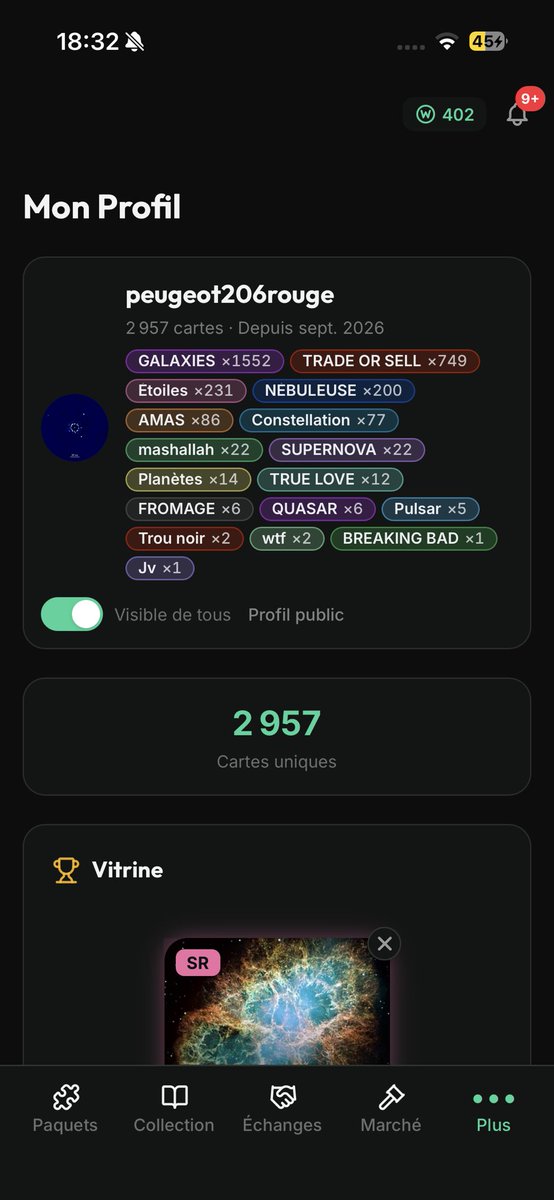
@chloebrs Galaxie/Etoiles/Constelation etc tout ce qui touche à l’astronomie sauf astéroïdes
Et le fromage aussi num num et après tt les autres carte je les gardes pour échanger j’en ai 3k a trade divers catégories atm ajoutez peugeot206rouge