I want to thank everyone for engaging with and amplifying this post here and on Instagram (where it went above 1M views) about my junior, Dr Randall Sequeira, a tribal medicine doctor who was jailed for serving adivasi communities in forsaken hills of Odisha and battling corporates looking to destroy the environment.
https://t.co/Ai8NYfd3C2
As a result of our efforts, Dr. Randall was able to speak to his mother over phone from the jail.
I got to know that, the first thing this doctor of the hills, told his mother was "Sorry".
This is mind numbing.
He is apologizing for doing what was right and getting punished for it.
He is apologizing for standing up to destructive powers and apologizing for it.
He is apologizing for making preventative care the norm instead of therapeutic damage control.
What has this country become in the last decade or so?
Doctors have to apologise for serving the underserved.
Public safety advocates have to apologise for trying to save the environment.
Healthcare activists have to apologise for standing up for primary care.
Youth has to apologise for demanding impartiality and quality of life.
On my post, there was a sudden increase in quotes (concentrated on 23 October 2026, around 18:28–19:22 IST), a tightly clustered set of posts that shared a highly uniform style, argument structure, and framing and consisted of accounts that were predominantly:
- Indian, with heavy nationalist/Hindu cultural markers.
- Blue-verified in many cases, with follower counts typically in the low tens of thousands.
- Bios frequently feature: “Proud Indian,” “Nationalist,” “Sanatani,” “Jai Jai Shri Ram” / “जय श्री राम,” Indian flag emojis, “राष्ट्रहित सर्वोपरि,” “कट्टर राष्ट्रवादी,” “Sanatan Dharma,” “Radhey Radhey,” or similar. Examples: @Shrish_1987, @Shankarsingh992, @imRohit_IND, @ShagunX_, @PJha_666.
- Not primarily medical, environmental, or activist accounts, but general political/social media commentators or supporters aligned with pro-government/nationalist narratives.
These accounts are largely supportive of mining corporates Adani and Vedanta and pro-Govt. None of them provided any clear rebuttals.
Nationalism means being proud of the country and not being proud of becoming lapdogs of the government.
In a better world, a doctor wouldn't be jailed for standing up for rights of the underserved and treating them with compassion and empathy.
Idiots claiming Dr. Randall was converting tribals into Christians are thinking and responding from their pelvises, not brains. Religion is the last refuge of scoundrels. And India is full of them. It's a fcking shame.
Medicine is also about environmental health and social justice. It's not just diagnosis and treatment.
The government must release the good doctor and stop criminalizing healthcare activism because it doesn't feed and bulk their greedy interests.
People who cured / are curing their own cancer on X:
1/ @sytses - bone cancer, billionaire founder of Gitlab, developed 10+ personalized therapies for himself.
2/ @paul_conyngham - shrank his dog Rosie's mast cell cancer tumors after chemo and surgery weren't enough. Now backed by YC and Founders Fund
3/ @miriamgonp - stage 4 breast cancer, tumor sequenced, searching for vaccine manufacturer now
4/ @kevinace - stage 4 lung cancer, angel investor in 300+ companies, first drug stopped working after 18 months. Vaccine designed, now paying $300k out of pocket for the vaccine
5/ @masonbgrant: going founder mode on his his 32-year-old wife's rare liver cancer, sequencing her tumor with AI agents
6/ @ArunRLverma: former product leader at Atoms and Shopify, brain tumor, built a vaccine from his tumor. Now building an AI health agent startup based on what he went through
We're going to make it
Ashoke Sen has been awarded the prestigious Oskar Klein Medal for 2026, becoming the first Indian physicist to receive the honour.
Previous recipients include Nobel laureates Chen-Ning Yang, Steven Weinberg and Hans Bethe, who received the medal in its first three years.
My dear friends, please, I hope to demand your absolute attention to this matter:
In 2018, my junior from St. John’s Medical College, Bengaluru, Dr. Randall Sequeira (middle in the pic), trekked up a steep, bauxite-rich plateau in Odisha to hold a monsoon health camp in the indigenous Kutiya Kondh village of Kutrumali.
In a piece he wrote then titled "Kutrumali’s Demons," Randall described sleeping under a dripping school roof in freezing fog, borrowing utensils from a local health worker to cook khichdi, and waking up at 6 AM to a line of tribal mothers. He wrote with heartbreak about treating malnourished toddlers with protruding bellies and visible ribs, listening to stories of stillbirths and chronic fevers, while noticing the shiny new solar lights installed by a mining conglomerate eyeing the aluminium ore beneath the villagers' feet.
Comparing his small medical team to hobbits sheltering in the night, Randall worried about the outside forces coming for that fragile village.
Randall stayed with the tribal/ adivasi community to serve them. After St. John’s and an MD in Internal Medicine from SMS Jaipur, he gave up every comfort of urban medicine to live in Kalahandi, recognizing that clinical prescriptions are meaningless when indigenous communities are stripped of their forests, water, and dignity.
On the night of October 16, Odisha police picked up Dr. Randall Sequeira and Dalit activist Laxman Naik at 11 PM from his home in Bhawanipatna. A gentle physician who has spent years trekking up hills to save tribal children is now locked in Rayagada sub-jail under frivolous but draconian charges (attempt to murder, dacoity), simply for standing with Adivasis peaceful protesting the mining of their sacred hills in Sijimali and Kutrumali.
https://t.co/PsxZZCngyV
Odisha Govt. said it will cut down forests to connect tribal villages. But it was a way to bypass green laws and fast track London based Vedanta’s, and Adani's mining plans. Local organisations estimate that around 45 villages depend on these hills and would be affected.
https://t.co/0pATUIYADm
The state has answered with repression rather than dialogue. In the last three years, at least 43 police cases have been filed and over a hundred Adivasis and Dalits, both women and men, have been incarcerated in Odisha jails. For example, from In March and april 2026, 8, 2026, to April 8, 2026, within one month, 24 people were sent to jail, 217 were made accused, and the number of “others” total 1,140. An activist who was not named in the original FIRs, but has since been implicated in about 12 cases, so that bail in one case is followed by arrest in another. This pattern of capture and releases have been used to crush rational dissent.
Dr. Randall understood that being a good doctor means understanding that prescriptions cannot compensate for the denial of land rights, that surgery cannot undo displacement and that no medical can substitute for the basic infrastructure a government has failed to provide.
https://t.co/fOC9AU3jaR
To my fellow medical fraternity, and every citizen with a conscience: a kind physician who embodies the highest ethics of our profession is being criminalized to clear the way for bauxite mining. Please do not let his voice be buried in a sub-jail.
Amplify this, demand due process, and demand the immediate release. Please sign in this form to show solidarity: https://t.co/cgLIoEXExG
If anyone can help out in this situation please reach out to Medico Friend Circle - https://t.co/OT2D2E3DuW
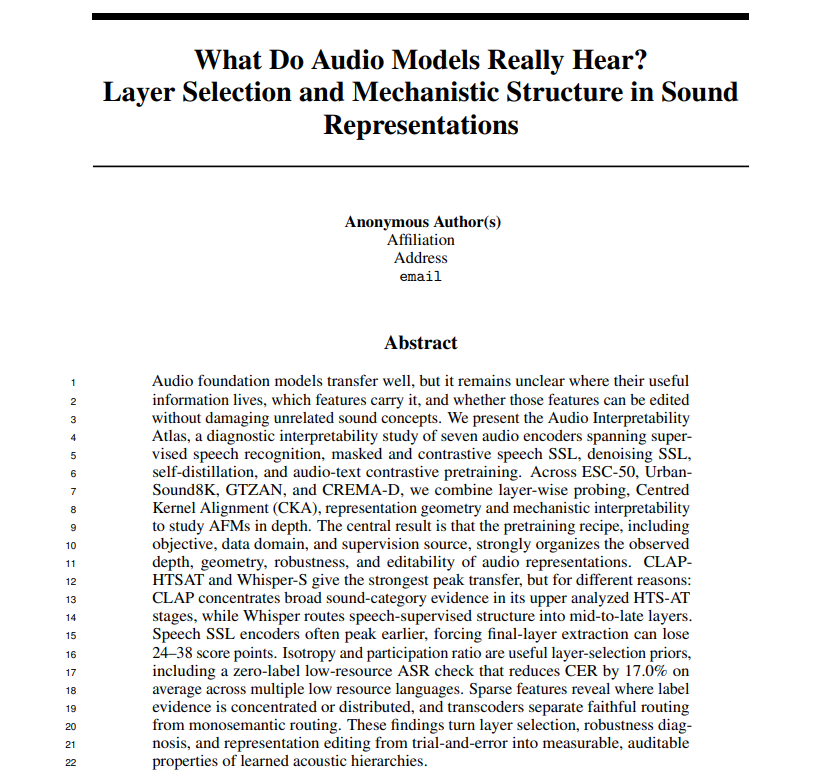
We are delighted to announce that a paper titled ‘What Do Audio Models Really Hear? Layer Selection and Mechanistic Structure in Sound Representations’, authored by our student Arnesh Batra (https://t.co/JI1QqgPULU. CSAI, Class of 2027), has been accepted for publication in the NeurIPS 2026, Main Track (Poster). NeurIPS 2026 is the 40th Conference on Neural Information Processing Systems, one of the leading international conferences in machine learning, artificial intelligence, and computational neuroscience.
The paper studies how audio foundation models learn and organize information across different layers, and how this changes depending on how the models were trained. The author analyzes a wide range of audio models across speech, music, and general sound tasks, using representation geometry, probing, and mechanistic interpretability techniques. One of the key findings is that the final layer is often not the most useful. In many cases, earlier layers already contain the information needed for downstream tasks, suggesting opportunities to make these models more efficient by selecting or pruning layers. The broader goal is to move beyond simply understanding what models learn and use those insights to make practical decisions about their architecture and efficiency.
An earlier version of this research was also presented at the ICML 2026 ML4Audio Workshop.
Congratulations to Arnesh for this remarkable achievement.
#IIITD #ResearchatIIITD #MachineLearning #NeurIPS2026