A history inventing AP and B2B payment automation, I am now a pioneer in applying AI, blockchain, and virtual credit cards to improve financial operations.
In finance, speed and clarity often matter more than complexity. @GraziadioAlumni John Toman (@payablesguy) shares why SMBs should rethink their reliance on traditional BI tools in his @BizCurrents op-ed:
https://t.co/p8lZvGIKur
Digital identity is no longer just a security issue — it’s the foundation of financial truth. Weak KYC/KYB doesn’t just cause fraud; it erodes trust across supply chains and payments. #DigitalIdentity#Fintech#InternetOfTruth#PayablesGuy
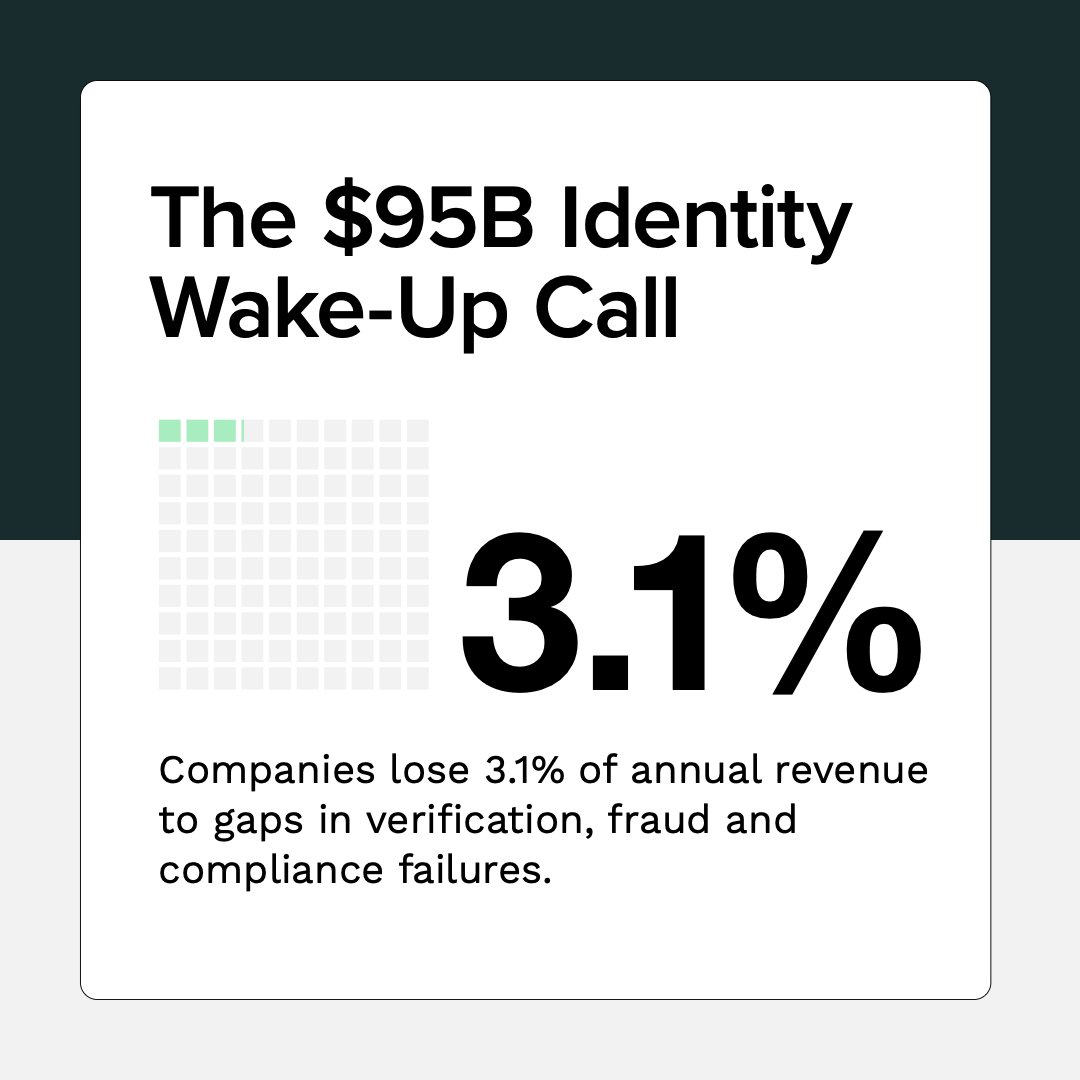
🔒 The cost of weak digital identity? About 3.1% of annual revenue, or $95B across global enterprises.
PYMNTS Intelligence and @trulioo reveal how firms clinging to “good enough” verification are losing money, trust and market share.
Find out how leaders are closing the gap. Download the report now: https://t.co/vEin28PLgu
Michael is right to point out that cloud outages remind us how fragile our digital foundation remains. The world built on centralized systems cannot become the Internet of Trust. The future will belong to networks that don’t just store data but prove its integrity independently of any single provider. That’s the kind of resilience every digital society will need.
In my quarterly contribution in @AccountingToday I write about the threat of AI-Generating receipts. #fraud#digitalreceipts#Blockchain
Tackling fraud in the age of AI-generated receipts https://t.co/RS8mvjrB4T
The AWS outage was a blindingly obvious outcome. So many have warned for years that a concentration of compute & data among a tiny few companies has left the internet with a dangerous interdependence of vulnerabilities.
Wiil lessons will be learned this time? Because, you know there ARE alternatives, and these will become vital as AI takes over the economy. (You think bottlenecks exposed Monday are big? Wait fo1 1 billion AI agents all trying to ping an OpenAI server farm on AWS.)
Solutions lie in the offerings of @AAI_Society members, which together form a stack of decentralized tech providing enterprises with much-needed “proof of control” over their computing and data. It's those corproate clients' path to freedom, freedom from dependency on these dangerously centralized solutions.
Read more about my thoughts on the lessons learned from Monday’s outage in this Medium post: https://t.co/jSeT8QHrZG
I find the prospects of the Nash equilibrium and the future of AI rather encouraging. I also appreciate the research Northwestern is conducting, as it will be valuable for my own work using machine learning in accounting.
#ai#ML#ethicalAI#BalancenotBatte#aiinaccounting
4. Well, the good news for @PayablesGuy’s idea is that there is already research exploring it. In this paper by computer scientists from Northwestern University, a study was made of the optimizing behavior among AI agents involved in a federated learning process, where there is a tradeoff between training their models on a global, network basis or doing it locally on their own devices and data. With an encouraging finding that “Nash equilibrium exists and coincides with the social welfare maximum strategy,” they propose “a myopic strategy that efficiently guides the system” in a way that “preserves privacy and requires minimal computational resources.” https://t.co/8ejOb1jNYp
What's cool here is that it's now so much easier to test these otherwise abstract theories because computers can be seamlessly deployed into experiments in trusted places like universities. I find this whole thing encouraging. It suggests that society can model out the kinds of rules, incentives and consensus mechanisms that will allow decentralized networks of AI systems to produce outcomes that are best for society.
3. And… one way of framing the optimization of such a multiparty solution is through the game theory concept of Nash equilibrium, named for the famous mathematician John Nash. It’s an idea that, as you’ll see in the next section, might suddenly gain traction. In this piece, @PayablesGuy draws from Nash’s conclusion that optimal outcomes arise not from unadulterated, zero-sum naked competition but when “players make decisions that account for each other's actions.” And he calls for an approach based on “balance, not battle,” in which companies work on strategic cooperation – since it is in their own self interest.
https://t.co/RuHRZv6d9N
The trick in this is to bring these elegant theoretical ideas into the real-world design of distributed computing and consensus mechanisms. It’s a governance trade-off challenge, one that various blockchain projects have had to confront, both those that over-emphasize the efficiency appeal of centralization and fall victim to capture by large actors or are too chaotically decentralized to render themselves ungovernable.
With its enhanced controls and scenario based purchasing features, virtual cards are ideal for the construction industry. They enable contractors to provide their subcontractors with virtual cards to pay for materials. This eliminates the need for subcontractors to cover material costs out-of-pocket and wait for reimbursement.
#payments #Construction #virtualcards #scenariobasedpurchasing
The construction payment crisis revealed: 77% of subcontractors fund materials from their own pockets while waiting for payment. This $280 billion industry problem is breaking workers' budgets and delaying projects.
See how digital tools are finally building solutions in our latest research with @AmericanExpress: https://t.co/w0jf8MqNnf
Embedded finance enables fintechs to build apps that integrate multiple financial services into a single, seamless experience. One of the biggest opportunities lies in business payments, where fintechs can leverage embedded finance to offer a unified app for payments, payouts, crypto, compliance, and more.
The payments space is consolidating. The winners? Platforms that do it all—payments, payouts, crypto, compliance. AI is pushing this shift. If you’re not automating, you’re already behind. Episode available tomorrow.
Today, @juniperresearch released a new study predicting that the value of virtual card payments will grow by 235% by 2029, rising from $5.2 trillion in 2025. This aligns with my research, which also indicates a rapid acceleration in commercial virtual credit card payments as organizations recognize the value of scenario-based purchasing enabled by virtual cards.
#virtualcards #b2bpayments #scenariobasedpurchasing
https://t.co/y8t4P2IbZo
I love how this @digitaltransactions article showcases the power of contactless payments. It highlights the growing trend of purchasers favoring digital payments over traditional physical credit cards.
Consider this: Over 80% of purchasers have used their smartphones or smartwatches for payments, and more than half prefer these digital payment methods.
#payments #contactlesspayments #virtualcards
@Leadersinpymnts AI plays a crucial role in detecting fraud, but achieving the best results requires a highly skilled team that knows how to apply it effectively. These teams are often part of organizations specializing in fraud prevention, detection, and remediation.
The government should consider virtual cards instead of P-Cards or corporate cards to reduce fraud. With scenariobased purchasing, virtual cards require users to request and get approval before spending. Each card has built-in controls—limiting spending, validity dates, and approved merchants—ensuring compliance and security. #virtualcards #fraud #scenariobasedpurchasing