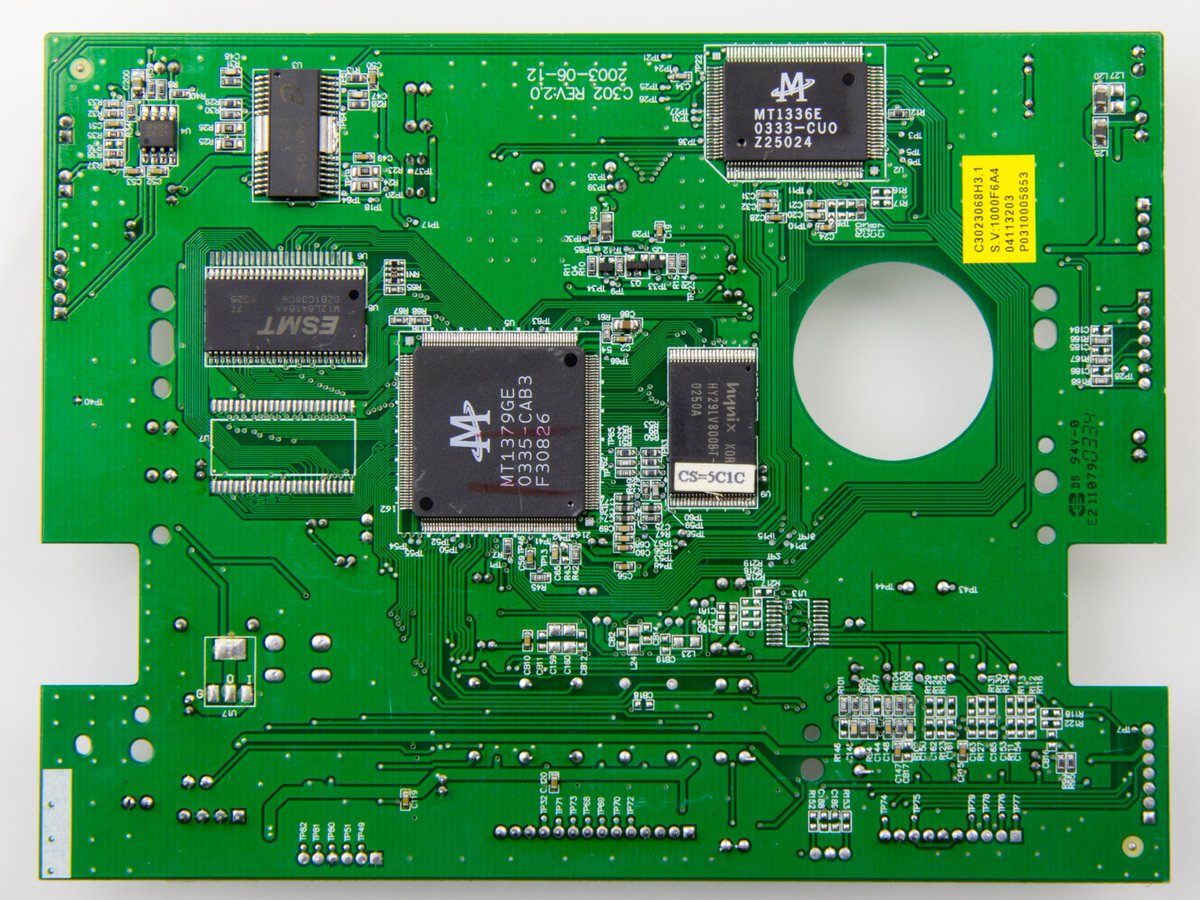
Once the insulation is applied, a circuit layer of copper, ranging in thickness from one to ten ounce, is applied.
This type of PCBs are used in LED applications like Traffic lights, high current circuitry, power supplies, automotive applications etc.
#pcbtypes#aluminumpcb
The aluminum backing is lined with thermally insulating material that is designed to have a low thermal resistance, meaning less heat is transferred from the insulating material to the backing.
#DaweiPCB#PCBs#pcbtypes#aluminumpcb
5) Aluminum-backed PCBs: are printed Circuit Boards that contain a thin layer of conductive dielectric material.
They are also known as Aluminum Clad, Aluminum base, MCPCB, IMS (Insulated Metal Substrate), Thermally Conductive PCBs etc
#DaweiPCB#PCBs#pcbtypes#aluminnumpcb
They often include FR4-grade glass-reinforced epoxy laminate, polyphenylene oxide (PPO) resin and Teflon.
This type of PCBs are used for signal transmission in a variety of devices including mobile, microwave, radio frequency etc.
#DaweiPCB#PCBs#pcbtypes#Highfrequencypcb
4) High-frequency PCBs: refer to a general PCB design element, rather than a type of PCB construction like the other models.
This type of PCBs are designed to transmit signals over one gigahertz.
#DaweiPCB#PCBs#pcbtypes#High-frequencypcb
They allow designers to replace multiple interconnected PCBs with a single board so you can cut down on wasted space and create a more effective design.
#DaweiPCB#PCBs#pcbtypes#rigidflexpcb
3) Rigid-Flex PCBs: consist of multiple layers of flexible PCBs attached to a number of rigid PCB layers.
They are multi-layer printed circuit boards, and has the qualities of both rigid and flexible interconnecting layers.
#DaweiPCB#PCBs#pcbtypes#rigidflexpcb
This type of PCB can be folded over edges and wrapped around corners.
They are used in devices such as calculators, cell phones, printers, LCD televisions, Cameras etc.
#DaweiPCB#PCBs#pcbtypes#flexiblepcb
They cost more for fabrication because of the fact that they are printed on a flexible material.
Flexible PCBs offer many advantages over rigid PCBs, with the most prominent of them being the fact that they are flexible.
#DaweiPCB#PCBs#pcbtypes#flexiblepcb
2) Flexible PCBs: are made of materials that can flex and move, such as plastic. They come in single, double or multilayer formats.
Made from a thin insulating polymer film with a pattern of conductive traces mounted and bonded onto the substrate.
#DaweiPCB#PCBs#flexiblepcb
Rigid PCBs also simultaneously allow communication between all of the many parts of the computer, such as CPU, GPU and RAM.
This type is some how the most manufactured type of pcb, possibly because of its great demand.
#DaweiPCB#PCBs#PrintedCircuitBoards#rigidpcb
Rigid PCBs; Rigid PCBs are printed circuit boards that are made out of a solid substrate material that prevents the board from twisting.
A common example of a rigid PCB is the computer motherboard which is a multilayer PCB designed to allocate electricity from the power supply.
PCBs also comes in various layers, ranging from Single-layer PCBs, Double-layer PCBs, and Multi-layer PCBs.
The number of layers of a PCB determine the its usage.
#DaweiPCB#PCBs#PrintedCircuitBoards
There are several types of PCBs, each with its own particular manufacturing specifications, material types and usage.
The notable ones are Rigid PCBs, Flexible PCBs, Rigid-Flex PCBs, High-frequency PCBs, and Aluminum-backed PCBs.
#DaweiPCB#PCBs#PrintedCircuitBoards
Multi-layer PCBs allow for much higher component density, because circuit traces on the inner layers would otherwise take up surface space between components.
Multiple layers PCBs are common these days, but they however make repair, analysis, and field modification difficult.
PCBs come in layers; they can be single layer, doudle layer or multi layers.
These layers are joint with additional copper layers between layers of insulating material.
#DaweiPCB#PCBs
Its conductive features include copper traces, pads, heat sinks, or conductive planes.
The mechanical structure is made with insulating material laminated between layers of conductive material.
The overall structure is plated and covered with a non-conductive solder mask.
PCBs mechanically support and electrically connect electrical or electronic components using conductive tracks, pads, and other features etched from one or more sheet layers of copper laminated onto or between sheet layers of a non-conductive substrate.
#DaweiPCB#PCBs
All the electronics we use have a PCB in it. In fact, PCBs are the basic components or engines that propel the electronic devices we use.
PCB stands for Printed Circuit Boards, and are the basic components of electronic devices.
#DawaiPCB#PCBboards