I'm excited to share that I've successfully completed the @cybernexusng Bootcamp and received my certificate!
The bootcamp gave me the opportunity to put what I've been learning into practice through hands-on labs and practical assessments.
I'm grateful to the team (@bangisDkhan, @BlackAnon22) behind Cyberstarter Nexus Bootcamp for providing this learning opportunity and helping me build my practical skills.
Receiving this certificate is a milestone, but I know there's still a lot to learn.
Of course, this only works when the content has already been sent to the browser and is simply being hidden on the page. If the server doesn't send the content in the first place, changing the HTML or CSS won't make it appear.
another interesting lesson from TryHackMe.
this time, I learned how browser Developer Tools can be used to inspect and modify a webpage's HTML and CSS.
The exercise involved a page with a premium notice blocking some content.
By inspecting the element and changing
display: block → display: none,
the notice disappeared and the content underneath became visible.
the change only happened inside my browser. It wasn't changing the actual website, and refreshing the page restored everything.
Je viens de tomber sur une tentative de hack la plus évoluée et vicieuse que j'ai vu. J'ai d'ailleurs failli me faire avoir
Un faux CAPTCHA Cloudflare, extrêmement bien fait
Décorticage de la technique. 🧵
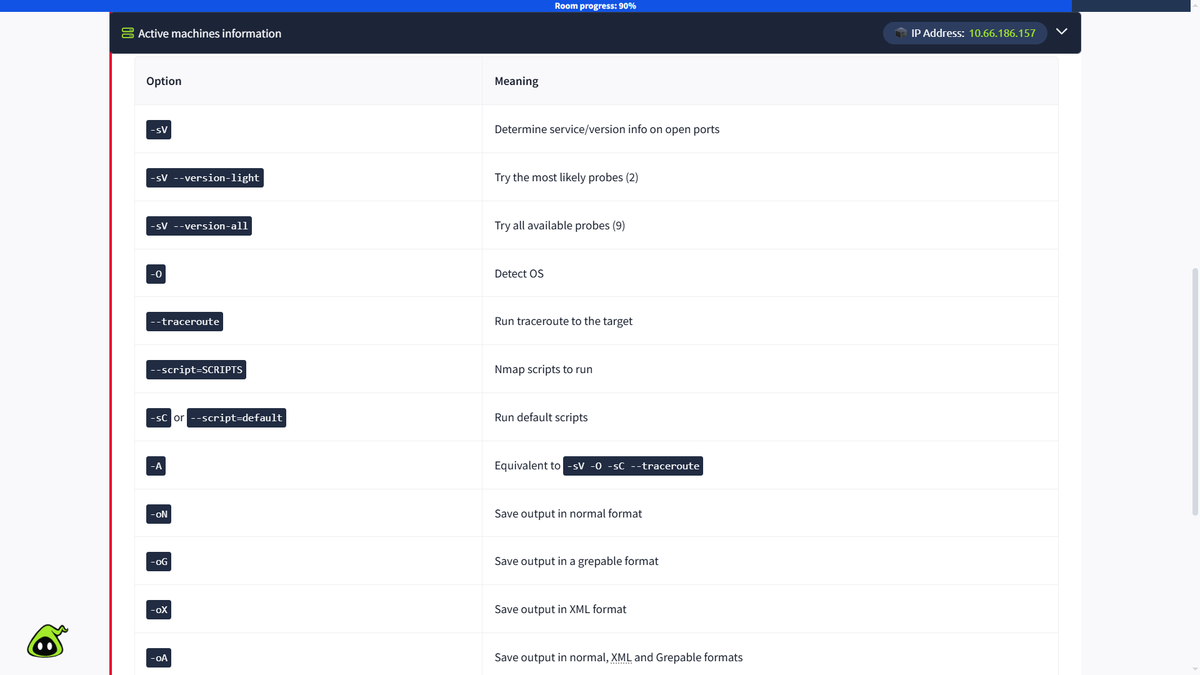
Finally, we covered the different formats for saving scan results for future reference. The table below summarises the most important options we covered in this room.
just finished the Nmap Post Port Scans on @tryhackme
i learned how to detect running services, their versions, and the host operating system. also learned how to enable traceroute and how to select one or more scripts to aid in penetration testing.
another Nmap room completed on @tryhackme .
this one was a little more challenging because it went beyond the usual SYN and TCP Connect scans.
learned how Nmap can manipulate TCP flags to perform different types of scans, including Null, FIN, Xmas, Maimon, ACK, Window and
custom TCP scans.
I also got introduced to IP/MAC spoofing, decoy scans, idle (zombie) scans and packet fragmentation.
The part that really caught my attention was the idea that Nmap can send TCP packets with unusual flag combinations and study how the target responds to
one thing i understood better was that port scanning isn't simply “checking if a port is open.” The way the probe is sent and how the target responds tells Nmap what state the port is in.
just finished the Nmap Basic Port Scans room on @tryhackme
learned the different approaches Nmap uses in scanning for ports, and each one works a little differently.
TCP SYN Scan (-sS) sends a SYN packet and checks the response without completing the full TCP handshake.
TCP Connect Scan (-sT) establishes a full TCP connection with the target.
UDP Scan (-sU) works differently from TCP since UDP is connectionless. Nmap looks at the responses it receives, including ICMP “port unreachable” messages, to determine the state of UDP ports.