The crime they see: 15,415 litres of water to produce one kilogram of beef. Every campaign, every documentary, every leaflet through the door since about 2012.
The crime they do: not reading the paper.
The figure is real. It comes from Mekonnen and Hoekstra at the University of Twente, and it is careful, peer-reviewed work. What the campaigns strip out is that the same authors split that number into three parts, because the three parts are not the same thing at all.
Green water is rain. It falls on the grass. The cow eats the grass. For beef, green water is about 94 per cent of that headline.
Blue water is the stuff that matters. Rivers, lakes, aquifers. The stuff that gets pumped, metered, fought over in court, and does not come back.
So here is the blue water, in litres per kilogram, from the same authors, same method, same units.
- Pistachios: 7,602
- Almonds: 3,816
- Walnuts: 2,451
- Dates: 1,250
- Cashews: 921
- Beef: 550
Read that last line again, then go and look at what is in your granola.
The 15,415 counts rain that fell on a Welsh hillside as a cost, against an animal that was standing in it, on land where nothing else grows, in a country where rain is the one thing we have never once been short of.
The pistachio is drinking fourteen times more of the water that actually runs out.
She is outside in the rain right now, getting blamed for it.
To say humans are adding carbon to the Earth is a physical impossibility.
What is actually happening is a change in 'where' the carbon is stored. We are told humanity is inflating the Earth's carbon budget, but geology tells us this kitchen cupboard has been sealed shut for billions of years.
We're not baking a 'bigger cake' by adding more carbon dioxide to the atmosphere; the planet is simply shifting its ingredients from the subterranean vault back into the biological engine — a state the Earth has vibrantly occupied for the vast majority of its history.
The attempt to regulate the breath of cattle and the outputs of agriculture is an attempt to regulate the eternal nature of the cake recipe itself.
Think of Earth's carbon reservoir as being split into distinct pantries: the atmosphere, the oceans, the soil plus every living thing (ants, antelopes, humans and forests). Carbon moves between these constantly. When you exhale, or a tree rots, it stays in this active loop. It is not adding a crumb.
Carbon that was taken out of active circulation millions of years ago and locked away in rock — is lithified in limestone, oil, coal and shale. When we use hydrocarbon fuels, we aren't creating any 'new' carbon; we're digging up carbon from the Deep Vault of time and throwing it back into the biological mix.
The hothouse worlds of the Miocene (and the Eocene and Cambrian) are the ultimate geological anchor. During the Miocene (roughly 5 to 23 million years ago), CO₂ levels were significantly higher than today, and the planet didn't experience runaway greenhouse death. Instead, lush ecosystems and massive biodiversity flourished.
Why? Because the cake was just being distributed differently. The atmosphere held a larger slice of the total carbon, driving a warmer, wetter, hyper-productive biosphere. The rocks prove that the system can handle vastly higher atmospheric carbon loads because that is the baseline state of a vibrant Earth. We treat global carbon accounting like a corporate ledger, but the largest active reservoir on Earth — the deep ocean — is virtually a black box. It's invisible to us.
The deep ocean holds roughly 45 times more carbon than the atmosphere. A microscopic shift in ocean temperature, deep-sea currents, or upwelling zones can release or absorb more CO₂ than humanity could ever dream of emitting.
Yet, we pretend we can calculate the global budget down to the decimal point based on surface surmising.
By the laws of the 'single cake' of CO₂, livestock and agriculture are completely carbon-neutral cycles.
A blade of grass plucks CO₂ out of the air. The cow eats the grass, processes the carbon, then releases it.
Within years, that carbon is right back in the atmosphere to grow more grass. It's a closed loop. No carbon leaves the vault.
The World Bank ranked every country on earth for practical solar potential.
Britain came second from bottom. Not second from bottom in Europe. On the planet. Out of everywhere they measured, the only place with worse conditions for a solar panel is Ireland. Norway is above us. Norway, where the sun clocks off entirely for part of the year, is a better bet than Lincolnshire.
The reasons are not a mystery. We sit at 53 degrees north, the same line as Edmonton, Alberta. The sun in December gets about as high as a first-floor window and then thinks better of it. And there's the cloud, which is not a detail, it is the national personality. A square metre of London gets 0.52 kilowatt hours of sunlight a day in December and 4.74 in July, so the panel does nine times less work in the month your heating is on than in the month it isn't. Across the whole of 2024, British solar ran at 9.5% of what it's rated at. The other 90.5% is a photograph of a power station.
Now the other column.
The ground we're bolting it to is Trent valley silt and Lincolnshire fen. Some of it took three hundred years to drain. It grows wheat at yields that most of the planet cannot get near, in a climate so reliably damp that grass grows here without anyone asking it to, which is the entire reason this island has cattle and cheese and a butcher.
So we are, measurably, one of the worst places on earth for sunlight and one of the best on earth for food.
And we've had a good long look at both of those numbers and gone with sunlight.
Somewhere in Namibia, which the same report ranked first, there is a patch of absolutely nothing, in full sun, wondering what it did wrong.
The heat capacity of the entire atmosphere is equal to just the top 3.5 meters of the world's oceans.
Below this surface lies Earth’s true thermal vault. Earth is a water planet, and the oceans cover 71% of the surface to an average depth of 2.3 miles. Global ocean currents carry warm waters from the deep tropics to the northern hemisphere, before returning after a round trip of 1,000 years.
Without these currents, northern Europe would be a glacial wilderness, just like Greenland.
The scale is colossal. Warm waters from the Roman warm period (240 BC to 400 AD) are still returning to the mid-latitudes. The atmosphere, by comparison, is a gaseous envelope that retains almost no thermal energy, holds a tiny fraction of the planet's carbon, and is largely controlled by ocean dynamics.
The deep Pacific itself is so massive that only now it is receiving the cold waters from the Little Ice Age. We aren't starting from scratch; we are mid-cycle in a 4.6-billion-year-old time machine.
We’ve also reinvented 'climate'. Once, it was a word for the local weather of robins and sparrows. Now it's a global ideological abstraction. We’ve lost our admiration for the natural world. We count CO₂ in parts per million while ignoring the satellite-proven greening of the Sahel.
It’s time to move past the light breezes and offshore winds and look into the ocean depths for answers. Ask yourself, is the 1.4°C warming since 1850 really an unprecedented crisis?
🚨 BREAKING: THE £38 BILLION LABOUR TAX RAID HAS JUST LEAKED.
Good morning to the millions of everyday, hardworking Brits waking up this Monday morning to an absolute financial slaughter.
Andy Burnham is preparing to launch a massive, unprecedented £38 billion tax raid the second he takes the keys to Number 10 this Friday. 🤡
This brings Labour's total tax grab to a staggering £104 billion every single year when combined with Rachel Reeves's previous business raids.
Reform UK has just exposed his planned torrent of new taxes that were completely hidden from the manifesto.
He is preparing to slap a 10% death tax on family homes, align capital gains tax with income tax, and hit landlords with National Insurance to drive up your rents.
He is even lowering the mansion tax threshold to just £1.5 million to drag ordinary middle-class homeowners into higher rates.
They are treating the British public like a bottomless ATM to fund their out-of-control, socialist spending spree.
If Burnham has the audacity to impose £38 billion of brand-new, undemocratic taxes on your family, he has absolutely zero mandate to govern.
We do not want a backroom coronation. We want a vote.
RT if you demand an immediate General Election to stop this robbery and take our country back! 🔁🇬🇧🔥
Humans have become the ultimate 'now-focused' species.
We demand instant answers for why it is hot one day, cold the next. We seem blissfully unaware that the deep ocean might be responding to the sun from as long ago as the 12th century.
To respect the ocean is to respect its natural inertia. It teaches us that the Earth cannot be 'fixed' or 'broken' by short-lived policies or computerized data. It is a ponderous, ancient global time machine. Its invisible clockwork does not care about our election cycles or social media trends.
We have mistaken the light breezes of the atmosphere for the powerhouse of the world. We stand on a slender rock, watching the air and counting in parts-per-million, while beneath us are the true masters of time — the oceans — circulating heat from a millennium ago.
To truly love the world is to acknowledge its sheer weight, its inertia and its indifference to our passing ideological storms.
We have traded the natural wonder of a robin's song for a globalised anxiety about what spreadsheets do.
It seems counter-intuitive to say, but on a geological time scale, Earth remains in a period of long-term cooling.
We are still in the Quaternary Ice Age, which began some 2.58 million years ago. Today's warm pulse is real, but it's temporary. Global temperatures remain significantly lower than the planet's deep-time geological average of 18–26°C.
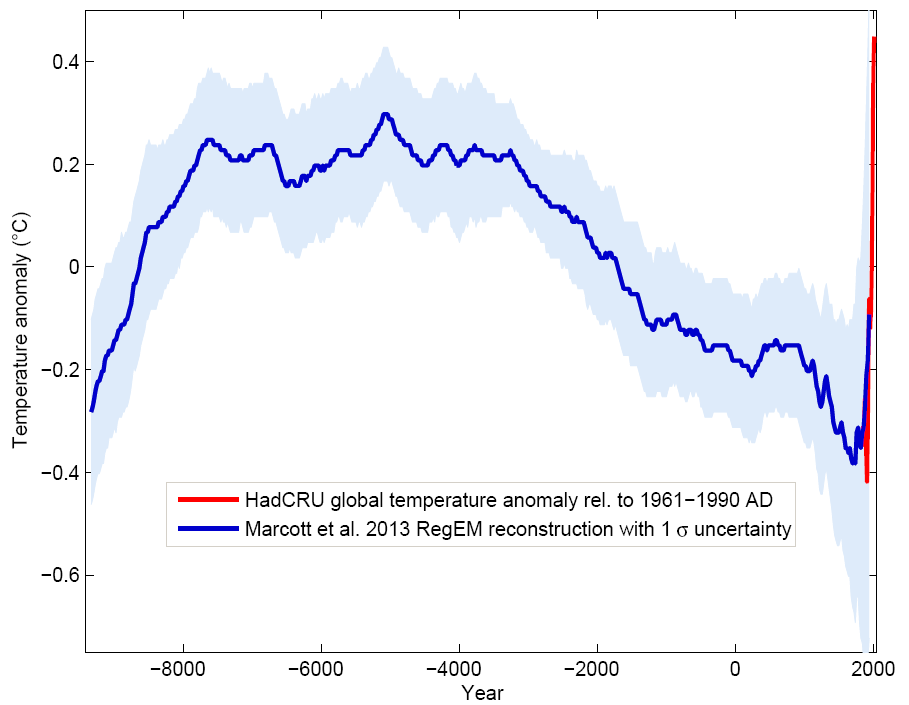
While warmth returned during our current Holocene interglacial, proxy records show temperatures peaked 9,000 to 5,000 years ago during the Holocene Thermal Maximum — based on the landmark Marcott et al 2013 synthesis of 73 proxies. From there, the trusty Milankovitch orbital cycles drove a gradual cooling of around 0.7°C, culminating in the Little Ice Age (c. 1300–1850 AD).
Industrial-era warming (about 1.4°C since 1750) has abruptly broken that multi-millennium cooling trend. This highlights the famous 'Holocene temperature conundrum': physical proxies show a warmer mid-Holocene, while computer models insist on an ongoing linear warming trend.
If history is to be our guide though, orbital cycles dictate that interglacials inevitably end and then the glaciations resume. The reality is that nature operates on her own mechanisms, which even our best computer simulations struggle to reliably forecast.
Greenland was ice-free 100,000 years ago, when CO2 was at pre-industrial levels. Scientists have known this for decades.
Nuuk, the island's capital, hasn't warmed in a century. Since the 1990s, the island has actually been cooling.
Back during the Medieval Warm Period, western Greenland was 2C warmer.
In fact, ice cores reveal Greenland is colder today than for most of the past 10,000 years.
Melt runoff is far lower than climate models claim, as much as 58% less. And most recently, snowfall during the 2024-25 season came in far above the long-term average.
Greenland's ice tells a story of natural cycles, not man-made catastrophe.
The world is sleepwalking towards a multi-trillion dollar abyss — a nightmare already underway.
It promises to be the ultimate graveyard story — the sine qua non of the illusion of free air and sunlight. By 2030, fully 85–90% of the 1.3 million (equivalent) turbines operating today (GWEC 2025) will reach the end of useful operations.
To just maintain the status quo, they will all need to be replaced in a 15-20 year window that straddles the 2050 net zero deadline. That’s roughly 35,000–40,000 turbines per year to be decommissioned, recycled (or graveyarded) and replaced. This will then lead to a second, even more costly build-out - on top of the one we’re still paying for.
At the same time, 5–10 billion solar panels (2 TW installed today) will also be retired, triggering hundreds of billions in scrapping, replacing, recycling and burying.
Wind decommissioning alone will cost $90–150 billion globally ($150–250 k per turbine, offshore will be double). New turbine costs (for 2025–2050) could easily hit $3–4 trillion — on top of what we’re already spending.
As for the composite blades, 1.5–2 million units - mostly non-recyclable - will be heading to landfill graveyards or incineration. As for critical minerals, each 3–5 MW turbine needs 2 tonnes of rare-earth permanent magnets (NdPr, Dy). Demand could triple while China still refines 80% of global supply.
All of this must happen as public subsidies fade, fossil-fuel restrictions tighten (diesel still powers 86% of mining equipment) and private capital becomes pickier, after years of thin or negative returns in renewables.
The coming 'replace-everything-again' phase will demand a WWII-scale industrial mobilisation with far less political goodwill.
To understand the complexities of climate, we should stop gazing up at the sky, but look down into the oceanic abyss.
Modern surface temperatures are an echo from the past. The Earth is an ocean planet, driven by a pulsating 1,000-year conveyor belt known as Thermohaline Circulation. We are witnessing a planetary memory in the oceans operating on a scale humans struggle to imagine — where deep currents are only now responding to thermal signals set in motion during the Roman Warm Period (250 BC–400 AD).
Indeed, a landmark study by Jake Gebbie (Woods Hole) and Peter Huybers (Harvard) found that the deep Pacific lags so far behind the atmosphere that it is still actively cooling from the later Medieval Warm Period, and only just beginning to digest the climate shift of the Little Ice Age.
The top 3.5 meters of the oceans hold the same heat capacity as the entire global atmosphere. The 3,700 meters below, is the Earth’s thermal vault of all retained heat energy. Oceanic inertia - or momentum - smooths out atmospheric hot and cold spikes.
The oceans absorb and retain 90% of the system's excess heat while the atmosphere is simply a gaseous envelope, thin and reactive, largely a passenger on the back of the massive oceanic flywheel.
The oceans rule from their silent depths.
Today, NASA satellites confirm Earth is greening dramatically. CO₂ fertilisation has added biomass equivalent to two continents of new forest in recent decades, boosting crop yields and ecosystems alike.
Oceans, holding around 50 times more carbon than the atmosphere, continue their ancient dance of absorption, circulation and outgassing under Henry’s Law.
The natural world keeps working its wonders. The real question isn’t whether CO₂ is 'pollution', but how we pursue genuine abundance and resilience while staying humble before these vast systems.
“I work the front desk at a small doctor’s office, and I wish people could see what happens on the other side of the phone.
Every day, older patients call us confused.
They are told to use the patient portal, upload documents, check lab results online, fill out forms before the visit, and confirm everything through a link.
Some of them do not know what a portal is.
Some do not have a smartphone.
Some have one, but they are afraid to click the wrong thing.
Last week, a man in his late 80s called about his test results.
He said, “Ma’am, I don’t mean to bother you, but the computer says I have a message and I don’t know how to open it.”
He sounded ashamed.
That broke my heart.
He should not have to feel ashamed for needing a human being.
Technology can be helpful. I understand that.
But when people who built this country are made to feel helpless because everything became a login and a password, we have gone too far.
Not everything needs to be an app.
Not every answer should be hidden behind a screen.
Sometimes people need a voice.
A patient person.
A real human who says, “Don’t worry, I can help you.”
Progress should not leave seniors behind.
Because one day, the world will move faster than us too.
And I hope someone is kind enough to slow down.
~Unknown
One who seeks equity must do equity
To receive equitable relief, the petitioning party must be willing to complete all of its own obligations as well. The applicant to a court of equity is just as much subject to the power of that court as the defendant. This maxim may also overlap with the clean hands maxim (see below).
https://t.co/THAa85Whhc
maxims,equity,fairness,remedy,jurisdiction,law,
What happens when two people have an equal claim to the same property or right?
This maxim of equity teaches that when ownership rights are equal, fairness requires an equal division. Rather than assuming one person has greater entitlement than another, equity begins with the presumption that each party owns a distinct and equal share. This principle helps courts resolve disputes by focusing on justice, balance, and the true intentions of the parties involved.
The maxim also reflects equity’s preference for partition, allowing jointly held property to be divided when co-owners can no longer practically share it. At its heart, this rule reminds us that equity seeks practical solutions that honor fairness and prevent one party from gaining an unjust advantage over another.
https://t.co/THAa85Whhc
@OPanterra@panterravida
maxims,equity,fairness,remedy,jurisdiction,law,
Equity aids the vigilant, not those who slumber on their rights
Vigilantibus non dormientibus aequitas subvenit.
A person who has been wronged must act relatively swiftly to preserve their rights. Otherwise, they are guilty of laches, an untoward delay in litigation with the presumed intent of denying claims. This differs from a statute of limitations, in that a delay is particularized to individual situations, rather than a general prescribed legal amount of time. In addition, even where a limitation period has not yet run, laches may still occur. The equitable rule of laches and acquiescence was first introduced in Chief Young Dede v. African Association Ltd
@OPanterra@panterravida
https://t.co/THAa85Whhc
maxims,equity,fairness,remedy,jurisdiction,law,
"We've actually got to replace the people that are really running things."
Former UK PM Lizz Truss warns that a "blob" of unelected bureaucrats is running the UK from behind the scenes, above the level of prime minister.
She advocates dismantling the current system by building a movement to remove this unaccountable bureaucratic class.
"We have an elite in this country that believe in open borders. They believe in Net Zero. They believe in woke ideology like transgender ideology. They don't care what people think."
"We need to build a movement that is actually going to change not just the political layer in this country, but the entire bureaucratic class, the BBC, the mainstream media. It all needs to change."