🚨 ¡Alerta! Temblor sacude territorio nacional durante esta noche de martes
El epicentro se registró en el departamento de Sacatepéquez
https://t.co/f77MKL0hbg
Incomprensible el circo de la toma de posesión, no estoy ni a favor ni en contra del candidato, pero totalmente innecesario el show político que solo demuestra nuestro tercermundismo
I've always liked this model of situational leadership.
direction vs. support
At different times, PMs can find themselves in any of the 4 quadrants, though high direction and low support should definitely be limited.
@gastonreyno To to to tonga reyno sean va para rato y strickland jugo a lo que tenia que jugar, matar o morir, no es lo mismo llamar al león que verlo venir
Here’s a simple vision for FP&A Managers:
- Reporting should be automated
- Forecasting should be accurate
- Analysis should uncover root causes
- Consulting should drive action
Every month, evaluate what you can do to move 1 step forward on each.
Why is Budgeting important?
I have done multiple budget seasons and they can be frustrating.
But with the experience, you will notice why a budget is important.
Here are the 10 main advantages of implementing budgets:
1. Planning
It helps plan financial decisions and allocate resources.
Imagine you want to grow by 50% your activity... how can you do it if you don't plan a correct headcount ramp up?
2. Control
It enables monitoring and controlling of expenses and revenue.
Budget is a reference against which you can track your financial performance. Without a budget, you will have a harder time setting benchmarks.
3. Coordination
It coordinates the different departments and teams towards common goals.
For me, the budgeting period is where you take time to look at the future and how you will realise your objectives with the other teams.
As a finance person, you need to coordinate and facilitate these discussions.
4. Prioritization
It prioritizes spending on essential items and limits non-essential expenses.
This is the time when managers can decide where to spend the money and give instructions to their team.
5. Forecasting
I didn't put it first, because you could forecast without having to do step 1 to 4.
For me, the financial figures should not be the only end goal of a budget, but more "how are we going to get there".
6. Decision-making
It facilitates data-driven decision-making.
Because this is one of the only period in the year where you set time aside to build business case on which you can make decisions.
7. Accountability
It assigns accountability for expenses and revenue to the different stakeholders.
If done well, budget is a great management tool to drive performance!
8. Performance evaluation
Most of the companies use budget as a way to assess the performance of their teams and units.
From there will be the bonus calculated.
9. Risk management
It helps identify and mitigate financial risks by looking into the future.
10. Investor relations
Whether you are a listed company or a small company, your investors still need to know where you are going.
Having a budget helps build trust and confidence with investors by demonstrating sound financial management.
👉 What is the most crucial reason for having a budget?
10 CFO KPIs
(Retweet to spread the knowledge)
1/ Revenue Growth
Description:
Measures the increase in revenue from one period to another
Formula:
(Current period revenue - Previous period revenue) / Previous period revenue
2/ Gross Profit Margin
Description:
Measures the percentage of revenue that remains after accounting for the cost of goods sold
Formula:
(Revenue - Cost of Goods Sold) / Revenue
3/ Net Profit Margin
Description:
Measures the percentage of revenue that remains after accounting for all expenses
Formula: (Net Income / Revenue) x 100
4/ Return on Investment (ROI)
Description:
Measures the return on investment for a particular project or investment.
Formula:
(Gain from investment - Cost of investment) / Cost of investment
5/ Earnings per Share (EPS)
Description:
Measures the amount of net income attributed to each outstanding share of common stock
Formula:
(Net Income - Preferred Dividends) / Average Outstanding Shares
6/ Customer Acquisition Cost (CAC)
Description:
Measures the cost of acquiring new customers
Formula:
Total Marketing and Sales Costs / Number of New Customers Acquired
7/ Customer Lifetime Value (CLV)
Description:
Measures the total value a customer brings to the company over their lifetime
Formula:
(Average Annual Revenue per Customer x Average Customer Lifespan) - Customer Acquisition Cost
8/ Employee Engagement
Description:
Measures the level of employee satisfaction and commitment to the company
Formula:
Based on a survey
9/ Employee Turnover
Description:
Measures the rate at which employees are leaving the company
Formula:
(Number of Employees who left during the period / Average Number of Employees during the period) x 100
10/ Cash Flow
Description:
Measures the cash inflows and outflows of the company during a given period
Formula:
Operating Cash Flow + Investing Cash Flow + Financing Cash Flow
Financial planning & analysis is one of the 10 most important areas of responsibility for CFOs.
Forecast accuracy is one of the ten most important KPIs for FP&A teams.
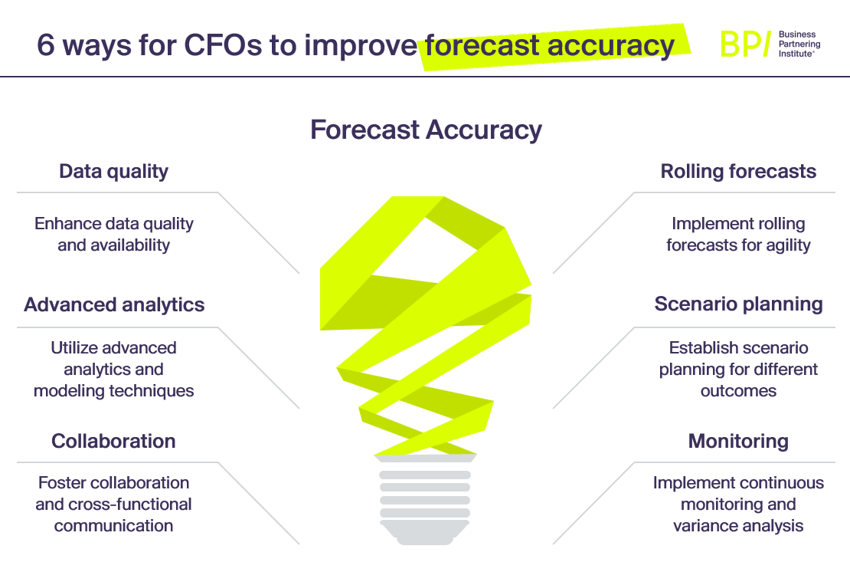
Here are 6 ways for CFOs to improve forecast accuracy 🧵.