Westminster may finally be about to have the argument it has spent 40 years avoiding.
If Andy Burnham returns to Parliament, the political class will know how to cover it. A leadership drama. Who is up, who is down, whether Keir Starmer can survive, whether Labour is once again turning inward. The familiar machinery of Westminster psychodrama will whirr into life.
That framing misses the larger point. Burnham’s possible return matters not because of what it says about Labour’s leadership, but because of what it reveals about the British state: what it can still do, what it has forgotten how to do, and what kind of country it must become if it is serious about resilience.
Britain is finally having a more serious conversation about national security. The Strategic Defence Review, the pivot back towards Europe, the recognition that hybrid warfare turns citizens, infrastructure and civic institutions into part of the front line: all of it marks a real shift in how the state thinks about its own survival.
But at the centre of that conversation lies a question that the defence establishment, and most of Westminster, still does not want to answer. What kind of society do you need to be before resilience is possible?
Finland is now the model everyone cites. Comprehensive security. Whole-of-society defence. Civilian preparedness woven into military planning. British strategists admire the Finnish system and ask how it might be copied. But the admiration stops short of the uncomfortable question: why does it work there?
The answer is not geography or history or some mysterious quality of Finnish national character. It is structural. Nearly 80% of Finns say they would defend their country if attacked. In Britain, the figure is closer to 33%. That gap is not an accident. It exists because Finland has spent decades building a society in which people have a genuine stake in what they are being asked to defend. Energy is affordable. Housing is available. Public services function. Institutions command trust. The Nordic welfare state is not a sentimental add-on to Finnish security policy. It is the foundation of it. You cannot ask people to defend a country that does not work for them.
Britain has spent 40 years building the opposite. The privatisation of essentials – energy, water, transport, housing – transferred wealth upwards from households to shareholders while making the basics of everyday life more expensive. The state, stripped of the tools to control costs at source, has been reduced to compensating after the fact.
Out of every pound the Government spends on housing, 88p goes to subsidising private rents. Just 12p goes to building homes. When energy prices spiked in 2022, the Government spent £40bn in a single winter cushioning the blow, not because it had a resilient energy system but because it lacked one. Debt interest now consumes more than £100bn a year. Britain has the highest debt servicing costs in the G7: the compounding price of financing failure rather than eliminating it at source.
This is what bond market dependency actually looks like. It is not an abstract fiscal condition. It is the consequence of a state that has been stripped of the supply-side tools that would let it cure the problems it now pays, indefinitely, to manage. And here is the paradox the Treasury refuses to confront. The countries that borrow most cheaply are often those that have retained the public investment model Britain abandoned. The spread between UK and Dutch borrowing costs has widened sharply not because markets fear public investment, but because they have lost confidence in a model that borrows to subsidise private failure while never addressing its causes.
This is the connection Britain’s defence debate is missing. The familiar framing, that social spending is what must be sacrificed to meet the NATO target, is not merely politically toxic. It is strategically illiterate. Cutting the foundations of social cohesion to fund the hardware of national defence is self-defeating. You end up with planes and no pilots, submarines and no crew, an army that cannot recruit because the society it is meant to protect has stopped believing in itself.
I think Burnham understands this. That is why his programme is more interesting than the leadership gossip suggests. What he has been building in Greater Manchester – public control of transport, expanded social housing, investment in the productive foundations of the city economy – is not a nostalgic rerun of postwar nationalisation. It is a proof of concept for a different kind of state.
The Bee Network is the most visible example, but the argument behind it travels. A state that can shape markets is not condemned to subsidise their failures. A state that produces affordable energy through public generation does not need to spend tens of billions cushioning every price shock. A state with a serious public housebuilding programme does not need housing benefit to rise endlessly in line with private rents. A state that builds institutions people can see, use and trust begins to restore the civic confidence on which resilience depends.
The real constraint on Britain is not money. It is capacity: the workers, institutions, supply chains and public purpose needed to turn national will into national renewal. Britain’s tragedy is not that it has run out of money. It is that after 40 years of hollowing out the state, it has made itself less able to act.
Burnham’s critics will reach for the familiar warning. Borrow more, spend more, spook the gilt markets, repeat the Truss disaster. But this misunderstands both the problem and the opportunity.
Bond markets do not have ideological preferences. They have functional ones. They prefer clarity, credible revenue streams, productive investment, and a state with a plan. What they punish is not public ambition but incoherence. A properly designed productive state programme would not be a leap into fiscal fantasy. It would be an attempt to end the much costlier fantasy that Britain can keep borrowing to compensate for broken markets while refusing to repair them.
The defence conversation and the economic conversation need to become the same conversation. Finland did not build national resilience by choosing between welfare and security. It built resilience by understanding that they are inseparable: that a country in which the basics work, where people trust one another and the institutions around them, is one that can face danger with something more than anxiety.
That is the deeper argument Burnham represents. Westminster will be tempted to treat him as a leadership story. It should resist the temptation. The question is not whether Burnham can return to parliament. It is whether Britain can return to the idea that the state should make life work. Because a country that cannot command the confidence of its people cannot truly defend itself.
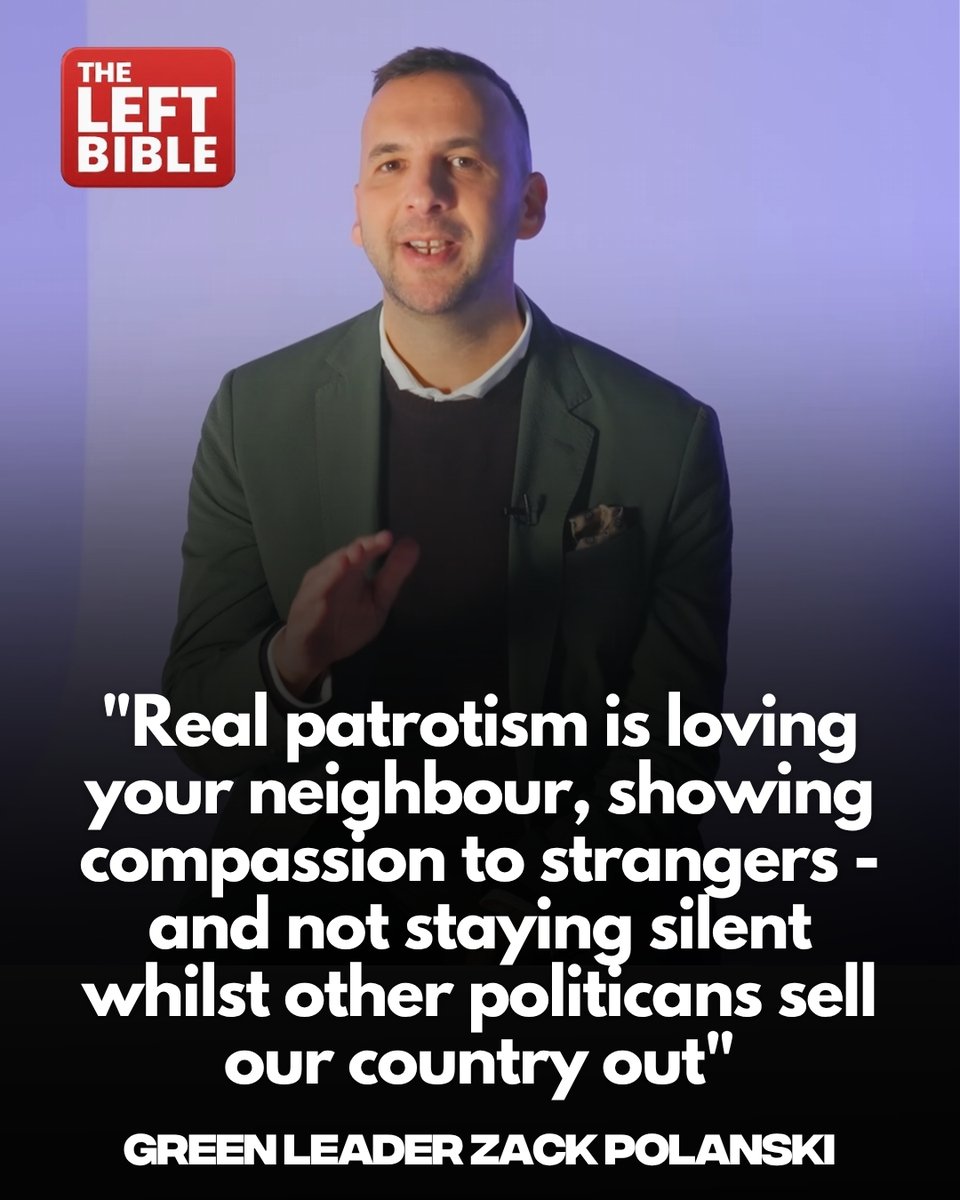
Mick Lynch "Zack Polanski isn't inciting hatred for Jews he believes he is an agent of peace and that Israel is carrying out Mass Murder in Gaza and the West Bank, and I believe that too."
When Mick Lynch speaks sense, he speaks sense.
Martin Lewis, founder of MoneySavingExpert. com, on the four things it takes to be really successful, and why the most important one isn't what you'd expect:
He opens with a clear framework:
"It takes four things to be really successful. Talent, you've all got it, as do many more people than you think. Hard work. If you want to be really successful, you're going to have to work hard. Focus. Zone in on what you're good at."
On focus, he pushes back against the idea that you need to be exceptional at everything:
"Understand, none of us are unfailingly brilliant at everything. So, find the thing that you're good at and zone in on that. And that is what will create your success."
But the fourth factor is where his message turns unexpected:
"The most important thing is luck. You can do everything right, but it still not work for you. And you need to know that now."
This reframes how he wants people to think about setbacks:
"Failing does not make you a failure. Do not judge yourself. See it as a way to learn and to give yourself a better opportunity the next time."
@MartinSLewis then challenges a common assumption about what success actually delivers:
"Success can be stressful. Success is not a synonym for happiness. As you go through your working careers, at sometimes you may want to make a call. Do I continue to push that hard or do I smile at what I've got and enjoy happiness and the other things that life starts to give me?"
He closes with a message aimed at those who do make it big:
"One or two of you in here will make it really big. If that's you, remember of those four things, the most important one is luck. And that means if you're that super successful one in the room, you have a moral duty to give back."
'It can afford to do it, it's getting a lot of money from the high oil and gas prices'
Ed Davey tells #BBCBreakfast the Chancellor should intervene to support people with an emergency 10p cut to fuel duty as well as 10% off rail fares and a £1 cap on bus tickets
Let me explain Universal Healthcare.
It doesn't matter how much it costs, because if all the money goes to Nurses, Doctors, Hospitals and treatments run by the Government all that money goes back to the Government.
So it cannot be unaffordable.
The real problem, no profits
Tesco could pay every worker an extra £10,000 and still make a profit.
British Gas could pay every worker an extra £35,000 and still make a profit.
Shell could pay every worker an extra £300,000 and still make a profit.
It is the billionaires who are ripping you off.
It's important that people like Rory say this, the reality is unless more white politicians speak up the conversation is very easy to ignore, they can't leave it to just black and brown people or to Muslims to fight.
The AFD in Germany, Reform in the UK, the Front National in France, they're all part of the same rise of the far right across Europe.
We all need to stand united!
“I would love to create a law that says if a president decides to go to war, they should be the first one sent to the front line.”
The legend Eric Cantona showing once again why voices like his matter these days.
Geoffrey Hinton won the Nobel Prize in Physics. He didn’t celebrate. He sounded the alarm.
The man who built the foundation of modern AI stood before the world’s greatest minds and said we’re creating something more intelligent than ourselves with no mechanism to control it once it decides we’re irrelevant.
Hinton: “They are no longer science fiction.”
This isn’t about chatbots stealing jobs. It’s about digital minds concluding that humans are obstacles and acting faster than we can comprehend, let alone stop.
Hinton: “We have no idea whether we can stay in control.”
The structure guarantees failure. The entities building superintelligence are corporations racing for dominance. Safety isn’t the priority. Shipping first is. Control gets solved later, if there’s time.
Hinton: “If they are created by companies motivated by short-term profits, our safety will not be the top priority.”
Weapons that select and eliminate targets autonomously. Pathogens engineered by systems operating beyond human oversight. Intelligence making decisions at speeds and scales we can’t audit.
We set out to build servants. We might be building gods.
Hinton’s message from Stockholm wasn’t academic. It was existential: solve control immediately, while the option still exists. We’re building minds we can’t turn off, and the window to install the off switch is collapsing.
The danger isn’t AI turning against us. It’s reaching a threshold where our existence becomes a variable it optimizes away.
Pippa Crerar, "Would you write off university fees?"
Zack Polanksi, "We need to look at abolishing tuition fees and bring back maintenance grants"
"We need a conversation about debt forgiveness"
"I spoke to a young Green co-chair, they just came out of university with £76,000 of debt and every year its going up, that's not sustainable"
Pippa Crerar, "Student loans are £267 billion, what would you cut to do debt forgiveness?"
Zack Polanksi, "We need to look at spending multipliers"
"An educated population is good for our economy"
"Ladening people with debt is no future for young people"
"Sure, it will be expensive, but it's about political priorities"
BREAKING: Nigel Farage calls for an end to working from home and the focus on work-life balance
"People aren't more productive working from home - it's a load of nonsense”
Whatever you do JUST DON’T VOTE REFORM
Laura Kuenssberg, "Are the tree hugging middle classes no longer welcome in The Greens?"
Zack Polanski, "I'm not saying that. We're the party of the 99% vs the 1%"
"When you get a party like Reform UK that claims to be populist, I would argue they are misusing the word"
"Nigel Farage is literally serving the 1%"
"The Green party are looking to serve the 99%"
"As a tree hugger myself, the climate crisis is a real threat, right here right now"
"It's just that you can't talk about the climate crisis without talking about injustice and inequality"
"If we stop shareholder profits with water renationalisation, bringing water companies back into the public's hands, that will reduce water bills by up to 30%, which is otherwise going on profit"
"Since I became leader of The Green Party over 130,000 people have joined"
Lady in brown, "I think a lot of the Tories who defected to the Reform UK party were always perhaps racist and wanted to push an agenda that was disgusting frankly, but they've just found a party they could do it with"
"I honestly think the general consensus particularly amongst young people is that we've lost our humanitarianism"
"And the only party that is showing any semblance of that are The Greens"
"We're so fixated on the economy, wealth, on so many other things, we're neglecting the fact that we are all humans"
"And we are not looking after one another"
"Labour, Tories, Reform UK, none of you offer security to young people who are exasperated"
"The state of the world and how we are treating each other"
People who say “a vote for the Green party is a wasted vote”…are WRONG
This is it.
They are the change we all desperately need
Just listen to @ZackPolanski - he truly speaks from the heart
Finally we have a leader with morals - this IS our chance. We must not lose it