Codex tip: take a skill or automation workflow you already wrote, throw it back at Codex, and have it run a 𝗯𝗮𝗰𝗸𝘁𝗲𝘀𝘁 against your past sessions.
it rewrites the skill into how you actually work.
𝗰𝗼𝗽𝘆 𝗽𝗮𝘀𝘁𝗲 𝗽𝗿𝗼𝗺𝗽𝘁 𝗮𝘁 𝘁𝗵𝗲 𝗯𝗼𝘁𝘁𝗼𝗺.
・once a skill is done, have Codex evaluate it against the relevant sessions
・it finds the steps you always skip, the work you keep patching manually, and the order you actually run things in
・rerun this every few weeks and the skill keeps up with how your work changes
the call behind it: skills should grow out of real work history.
what you write from memory is the flowchart. sessions record how you actually did it and where the rework happened.
session logs used to be leftovers from getting work done. now they double as an 𝗲𝘃𝗮𝗹 𝘀𝗲𝘁 for your skills.
the way people write skills is changing.
more builders are letting the agent read its own session history and reshape its own tools around it.
𝗽𝗿𝗼𝗺𝗽𝘁:
read [skill name, workflow file, or folder path] and run a backtest against my past sessions related to it.
prefer sessions from the same project and same task type. first list the samples you plan to use and why you picked them. if you can't access enough sessions, say so directly instead of guessing.
compare what the skill assumes vs how i actually work. focus on:
- steps i often skip, rewrite, or run more than once
- work i still do manually that the skill never covers
- the order i actually do things in
- spots that keep causing rework, getting stuck, or needing extra clarification
separate stable patterns from one-off exceptions. never rewrite a rule over a single anomaly.
output a dry run first, nothing else:
- keep / modify / add / remove
- session evidence for each item
- proposed diff and reasoning
do not modify any files until i confirm.
after i confirm, update the skill, run existing checks, and summarize before / after. if there's no existing way to verify, say so.
finally, based on how fast new sessions accumulate, suggest a weekly or biweekly review. show me the schedule, scope, and trigger conditions first, then create the recurring task after i confirm.
every scheduled review outputs a dry run only. no auto-modifying the skill without confirmation.
i'm slowly realizing that the code i'm writing is no longer code
traditionally when we build software, we write code. code tells the machines "here's what you do"
if we write wrong code, machines will do wrong things. and that's what we call a bug
earlier this month, i wrote a pretty bad bug into one of firstmate's bash scripts. the code literally can't run, and should have broken firstmate
except it didn't. it went unnoticed for days. i discovered it when i came across the code and spent minutes wondering how on earth this could work
i then found that the agent ran the script, saw it fail, figured out what the script was trying to do, and did a workaround to achieve the same goal
so a bug that should have crashed the whole software almost didn't have any visible impact
that's when i discovered that what i wrote in the bash script is no longer code. it's not "here's what you do"
it's intent. it's "here's what i want"
intent doesn't crash and can't be broken. it gets executed regardless whether it's "correct" or not. i can no longer write "bugs"
what can still happen in intent is what i call "misses", which could be -
1. a misalignment between what's written and what my real intent is - this happens when i fail at articulating my thoughts
2. a misalignment between my real intent and the real demand - this happens when i fail at understanding the world
those are becoming the most important human skills in this new era
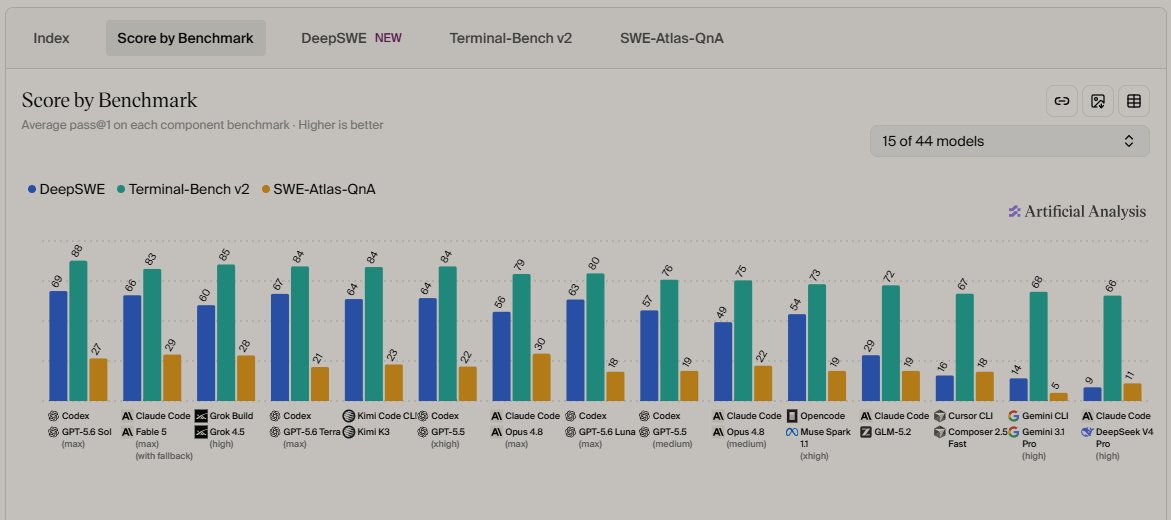
Kimi K3 in Kimi Code CLI scores 57 and ranks #5 on the Artificial Analysis Coding Agent Index. Its performance is just behind Grok 4.5, in line with GPT-5.6 Terra and GPT-5.5, and ahead of Opus 4.8
Key results:
➤ Joint #5 overall on the Artificial Analysis Coding Agent Index: Kimi K3 scores 57, matching GPT-5.6 Terra max (57) and GPT-5.5 xhigh (57). It outperforms Opus 4.8 max (55), sits just behind Grok 4.5 high (58) and Fable 5 max (59), and trails GPT-5.6 Sol max (61).
➤ Strong performance across all three coding evaluations: K3 scores 84% on Terminal-Bench v2, 64% on DeepSWE, and 23% on SWE-Atlas-QnA. It outperforms Fable 5 on Terminal-Bench, Grok 4.5 and Opus 4.8 on DeepSWE, and GPT-5.6 Terra and GPT-5.5 on SWE-Atlas-QnA.
➤ Cost-efficient frontier coding performance: K3 costs an average of $3.18 per task. It is 55% cheaper than GPT-5.6 Sol max ($7.08), 73% cheaper than Fable 5 max ($11.72), 37% cheaper than GPT-5.5 xhigh ($5.07), and 59% cheaper than Opus 4.8 max ($7.70). Grok 4.5 high ($2.59) and GPT-5.6 Terra max ($2.76) are slightly cheaper.
➤ Leads open weight coding models (assuming weights are released): K3’s score of 57 is substantially ahead of other tested open-weight configurations, including GLM-5.2 at 40 and DeepSeek V4 Pro at 29.
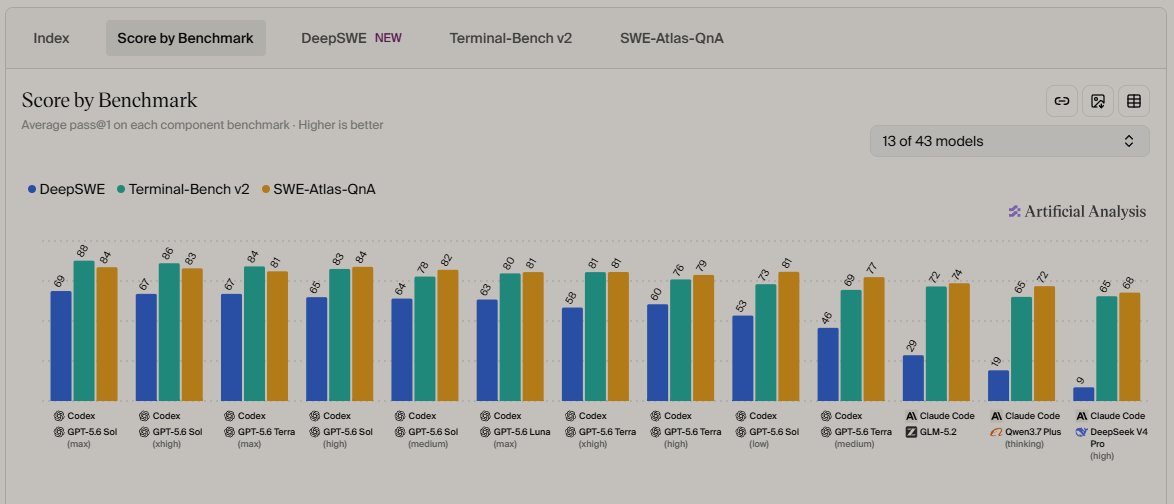
@ArtificialAnlys I have a question: Why has the overall score for SWE-Atlas-QnA dropped so significantly compared to a few days ago? The highest score is now 30, whereas it was 84.
I built a variant of @mattpocockuk's grilling skill dedicated to frontend and it has improved how I build new apps and components.
The general idea:
1. Use /grilling and /prototype as a base
2. Tell Claude to build 5 WILDLY different prototypes
3. Tell Claude to include a picker that lets you switch between each variant live
4. Each round you select your favorite(s) + leave feedback, and Claude will walk down each branch of the design tree, helping you zoom in on your desired design
And THEN, I went and added it to /wayfinder, so whenever I make a new map and there's novel frontend work, a ticket is created specifically referencing that /grilling-frontend-prototyping needs to be invoked.
This will not be the last time I build a cool skill and add it to Wayfinder; this is a very powerful pattern for planning work.
You can find my skill here: https://t.co/4M4QPlfnp1
@mattpocockuk Sometimes, the answer to one question affects many subsequent ones, so I prefer to answer them one by one.
Moreover, I don't always choose the options suggested by the agent; I carefully consider my answers. Trying to think through multiple questions at once would be overwhelming
Breath of Fire IV is a 2000 PlayStation RPG from Capcom. More than 200 spells to learn and master unlock new magic from opponents. 2 epic intertwining storylines: follow the fates of Ryu and Fou-Lu, with high resolution, animated characters in vast 3D worlds.
Someone DM'd me saying they're using /grill-me in technical interviews
Watch the candidate work. See how they answer questions and push back. See whether the AI drives them, or they drive the AI.
Honestly genius
GPT-5.6 Sol and Luna are ahead of Terra at every point on the Intelligence vs Cost per Task chart. GPT-5.6 Luna stands out as a particularly cost efficient model
Charting the Artificial Analysis Intelligence Index shows the trade-off between intelligence and Cost per Intelligence Index Task. Across reasoning efforts, each GPT-5.6 model pushes past GPT-5.5 on the Pareto frontier (excluding non-reasoning).
However, Luna and Sol are always ahead of Terra. This means for any Terra effort level, there is a Luna or Sol effort level that is more intelligent at no extra cost, or as intelligent at lower cost.