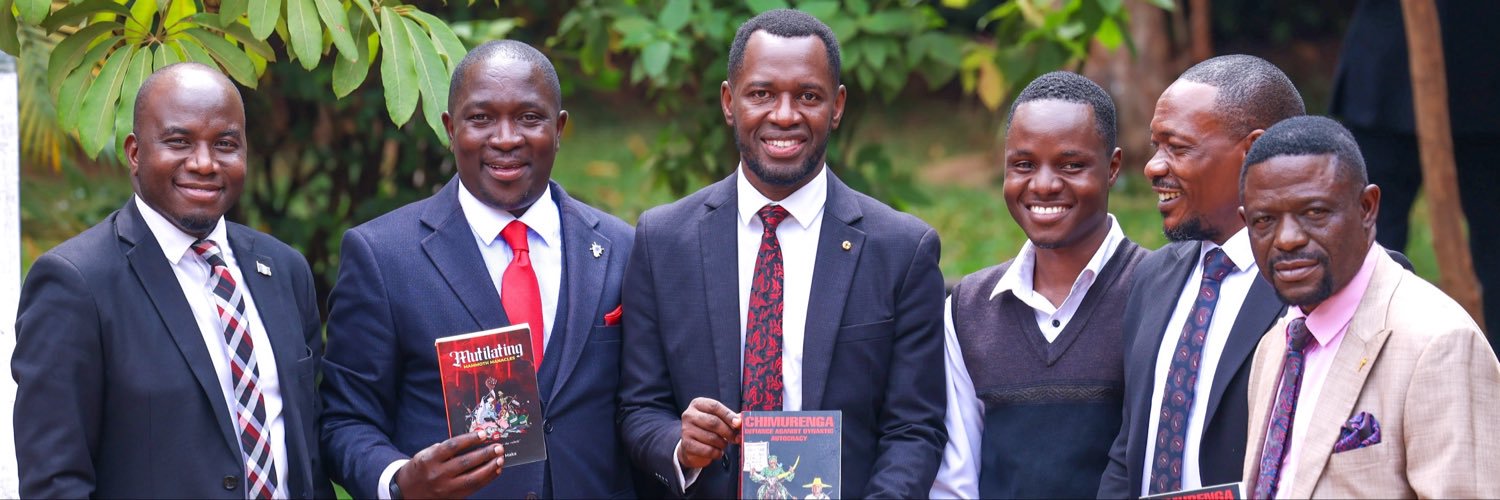
I'm thrilled to announce that my second book, CHIMURENGA, will be published by @ElTablaz in 2025!
CHIMURENGA, which means ‘struggle against oppressive rule' in Shona, exposes politicians who enrich themselves at the people's expense, only to face purges when the regime falls.
I am gay to finally announce that my maiden novel, MUTILATING MAMMOTH MANACLES, will be published in 2024 by @ElTablaz.
So grateful for everything that led up to this moment.
[ Cover & more details soon. ]
It is betrayal, precisely timed, that this revelation only visits me at twelve beers, the same way our politicians discover their patriotism only every five years, at campaign season, kissing babies and digging boreholes they will forget by the second rainy season. Election night, they receive the Holy Spirit of the People’s Cause. By morning, they wake up as though nothing happened the night before, and the poor voter like the girl at Capital Pub is left to dress in the dark and find her own way home.
Poor girl. I cannot save you. No single sinner buying his conscience back with sixty thousand shillings can save what an entire republic has decided to keep selling.
Uganda, you must liberate yourself. Not through my guilt, not through my beer-soaked sermons, not through a Good Shepherd who only remembers the flock when he is drunk enough to weep for it, but through the deliberate, sober, daylight work of people who refuse, finally, to be for sale.
The bar will still be open next Friday. The question the republic has never answered is whether it intends to remain one.
Twelve Disciples for Sixty Thousand: A Sermon from Capital Pub, Kasanga.
Every Friday after toiling for my daily bread like a slave because that is what wage labour under a republic of directives has become, dignified toil for a master who signs your payslip and your death warrant with the same pen. I roll over to Capital Pub, Kasanga. It is a lowkey, China-made Las Vegas: neon the colour of borrowed money, speakers coughing Afrobeat over a generator’s hum, and waitresses moving between tables like civil servants moving between ministries, serving whoever pays first and pays most.
I go there to take beers from the shelf and feel good vibes from the birds. It is my Friday ritual, observed with the precision of a Catholic priest saying the Holy Mass, except my liturgy has no absolution at the end, only a bill.
I order four Nile Specials. It is patriotic, after all, to drink any brand wearing Uganda’s flag as a label. We have been taught patriotism is a label you consume, not a practice you perform. Wave the flag, drink the beer, vote the party; the label does the loving for you.
Then my eyes land on her: a young, splendid, tall, brown-skinned Rwandese girl, seated the way power always sits in this country: visible, unbothered, waiting to be bid for. I order four more Nile Specials. Confidence booster. Her body was an argument no theology could counter, and in a room full of demons in tucked-in shirts and government lanyards, she looked like the one angel who’d wandered in by mistake. A lamb loose in a den of lions. And I, merchant of beer money and self-pity cast myself, absurdly, as her Good Shepherd, ready to lead her to bed in the name of rescue.
Because remember: everything in Capital Pub is for sale, the same way our parliamentary seats, our ministerial dockets, our local council chairs are for sale. You need not be qualified. You need only be the highest bidder.
Politics is dirty, and the world is thick with ugliness, but her presence, for one drunk minute, insisted there was still beauty left standing in it. I believed that until she took off her black shades.
There was no innocence in those eyes. What I saw instead were shade-cups of tears, decanted nightly onto pillows in motels whose names she has long stopped bothering to remember, in brothels with better lighting than the district hospital. Many things lead a man into sin. I am only a fool who parts with his money for pleasure on command. But what troubles led her here? What debt, what child, what dead husband, what collapsed harvest, what government that built no factory in her village delivered her instead to mine?
I ordered four more Nile Specials.
Twelve disciples, it turns out, cost only sixty thousand shillings.
A revelation descended on me the way the Holy Spirit is said to have descended on the apostles at Pentecost, except mine arrived by way of Nile lager, and mine did not send me out to preach the Good News. It sent me out to write this instead, which may be the closer relative of truth.
I had tears in my eyes, but I was not weeping for the girl. I wept for Uganda. Because by my twelfth disciple, the revelation was complete: she is Uganda, and I am the politician. She does not sell her body by choice. She is a single mother with children to feed and a landlord who does not accept prayers as rent. She has no factory, no cooperative, no pension, no functioning clinic, only a body the market still finds negotiable. And I, comfortable, employed, patriotic-because-labelled exploit her the way the state exploits every citizen who has nothing left to sell but themselves.
“The purpose of leadership is not to create people who remain indebted to you. The purpose of leadership is to increase the amount of good those people are capable of bringing into the world. Those are fundamentally different objectives. One is centred on recovering value. The other is centred on creating value.”
#FDLC
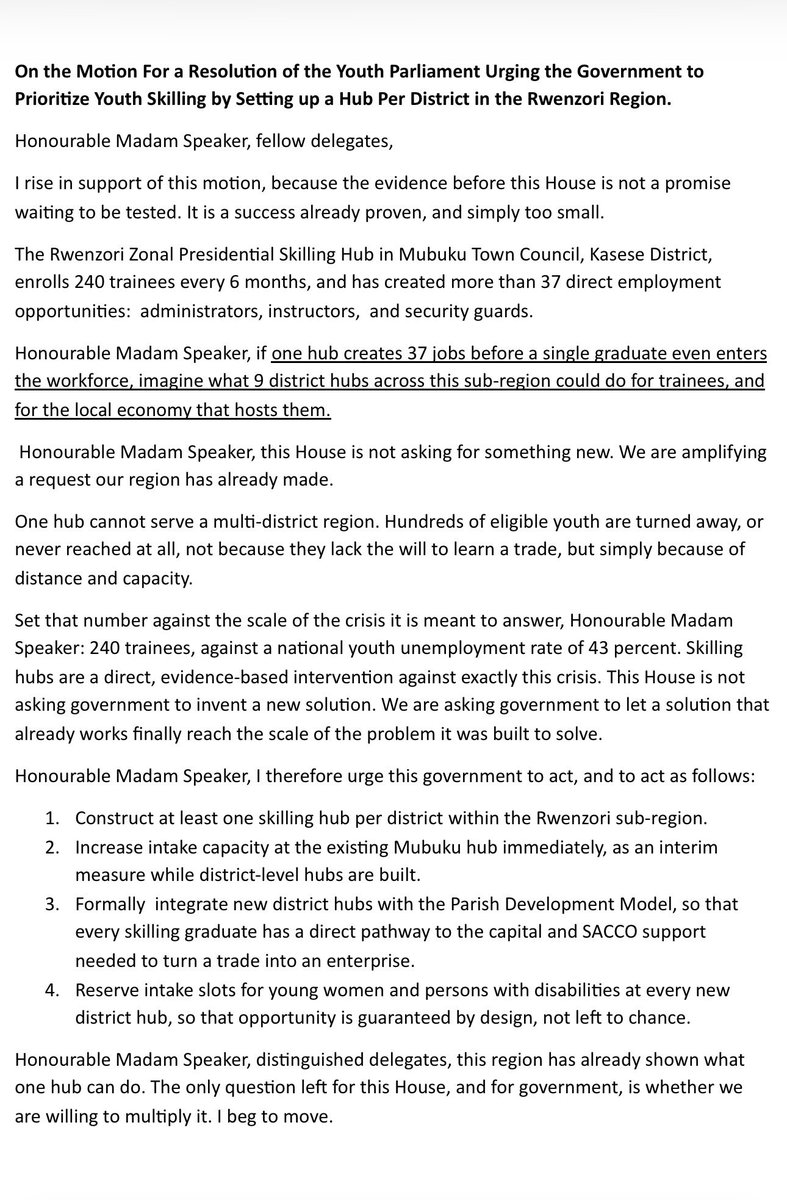
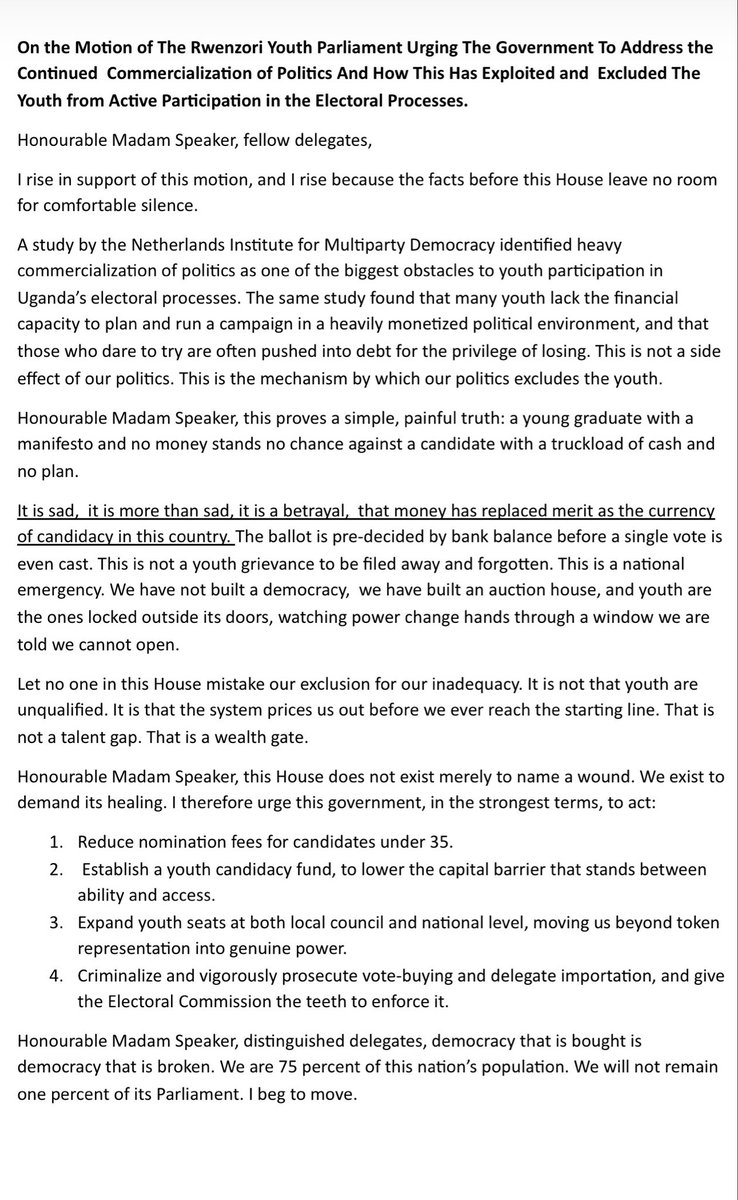
Honoured to have contributed to today’s 2nd Sitting of the 8th Sub-National Youth Parliament Rwenzori Region proceedings.
#SNYP2026#YouthParliamentUG#SUPA
Before the gates of Murchison Bay opened for me on bail earlier this year, I did my time as a lodger of some standing in Ward C4, not by choice, but by the peculiar hospitality of the state.
It was there, among Uganda’s most involuntarily patriotic citizens, that I learned the ward’s constitution runs on a hierarchy as rigid as any regime’s: the RP Boma sits at the apex, sovereign of the whole institution, followed by the RP Ward, custodian of lesser fiefdoms. Democracy, alas, ends at the prison gate.
Male Mabirizi in short order, has set a new precedent: from newcomer to Chairperson of Luzira Murchison Bay Prison, as if the institution itself has no choice but to promote him. Whether by force of personality, sheer persistence, or the kind of stubbornness that gets a man arrested in the first place, the legend grows faster than the verifiable details. In a place built to strip men of distinction, a rumour of distinction survives at all, and climbs to the very top of the ward’s own constitution, is perhaps, the real satire.
Dear Joyce,
I believe heaven is a better place to live. Singing hallelujah with the angels must be beautiful. I know you are happier now.
But here on Earth, life is hard without a sister’s shoulder to cry on. I have no memories of you, only photographs, and the quiet ache of imagining the stories we might have shared, had the Lord not called you home before I was even born.
Perhaps you watch me from the skies. If you do, I pray you be my guardian angel. On a day when others celebrate the women they love, I choose to celebrate you.
In the end, every leader must step ashore. The title will pass. The office will belong to someone else. The applause will fade. But the mission continues, like a river that never stops flowing. The river never belongs to the boat. It simply carries it for a while. Perhaps the greatest measure of leadership is not whether people remember our names, but whether the current of our influence helped others move farther than we ever could alone.
MATOOKE NATION: The Swept Street.
There is an old trick power plays on the governed: when it cannot solve, it stages. A nation drowning in cholera does not need a broom; it needs an inspector who visits the market on a Monday and closes the stall selling rotten fish. But the inspector is invisible. The broom is not. So the broom becomes the government.
This is the politics of the visible. Power, when it has abandoned the discipline of governing, retreats into the aesthetics of governing. It performs cleanliness rather than enforcing hygiene, because cleanliness photographs and enforcement offends. To enforce a health law is to accuse someone: a town clerk, a market master, a councillor’s cousin who owns the abattoir. To declare a national cleaning day is to accuse no one. Everyone sweeps; no one is guilty. The genius of optics is that it converts a failure of institutions into a festival of citizens.
There is something almost theological in it. The state, unable to be a shepherd, becomes a choreographer of penance. It cannot give you clean water, so it gives you a ritual of cleanliness: a single day of collective ablution that substitutes for the eternal, boring, unglamorous work of maintenance. Rituals are for sins already committed and forgiven in a moment. Institutions are for sins prevented, day after unphotographed day. A country that prefers ritual to institution is a country that has decided repentance is cheaper than reform.
TikTok did not invent this. It only gave it a faster metabolism. Before the algorithm, there was the parade, the foundation stone, the ribbon. What has changed is the unit of political time: it now must be shrunk to the length of a clip, and a clip cannot hold an accountability process; it can only hold a gesture. So governance adapts to the medium, not the disease. The health law dies in committee, unglamorous and unwatched, while the cleaning day trends by evening.
The danger of this is not merely wasted effort. It’s epistemic. A citizenry fed spectacle long enough forgets what solving actually looks like, and begins to mistake the appearance of effort for its substance... begins, in effect, to grade its government on production values.
#NationalCleaningDay
#HoldInstitutionsAccountable
#UgandansDeserveBetter
#StayAtHome
@ShamimNambassa
It takes courage to stand before an audience and recite a poem, and it takes rare talent for a writer to also be a compelling orator. To dismiss Uganda’s poetry space as “shit,” and to do so on the strength of a single Food and Food Systems poetry competition, is not criticism; it is laziness wearing the mask of judgment. One competition is a sample, not a verdict. A person who claims to love poetry enough to critique it owes the space more rigor than that.
And branding and inspiration are not the chicken-and-egg riddle you presume. Branding is a business skill, a craft of packaging, positioning, timing, audience. Inspiration is something else entirely: it is shaped by environment and by moral conviction, by what a person has seen, suffered, or refused to look away from. One is strategy; the other is soul. Confusing the two is how a critic ends up mistaking a poet’s marketing for their meaning.
As for writing about “everything,” what exactly is the charge? Poetry is like food: today the craving is beans, tomorrow it’s chicken. A poet who writes love today and land tomorrow, elegy this month and satire the next, isn’t undisciplined, rather they’re alive to a world that doesn’t hold still. Range is not the crime. Contempt dressed up as critique is.
Football doesn’t move like the weather, but the signs are just as readable. When you see the nimbus clouds gathering, you know rain is coming.
Crystal Palace already see Diomande as a young player with serious upside. An ambitious Arsenal, backed by superior facilities and infrastructure, could take that raw potential and turn it into the real thing.
@Arsenal have never been in the business of buying stars, they build them.
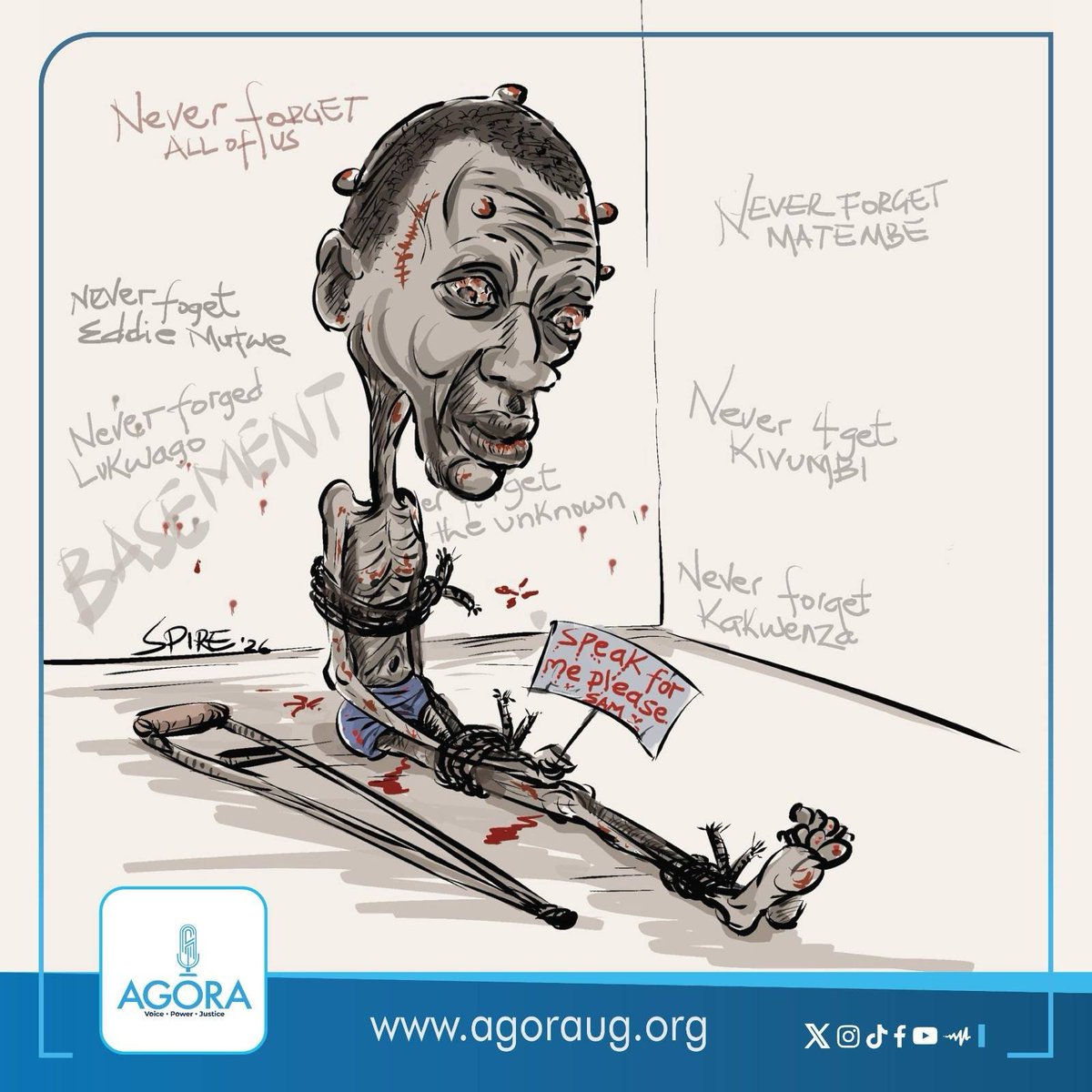
Muhoozi Caged the Lion, Not the Roar.
You can lock a lion behind iron, but you cannot lock away its roar, that travels where the lion cannot. Captivity does not mean surrender; it means the lion is thinking. A caged lion does not forget it is a lion. It counts the bars, studies the hour, and waits for the moment the cage forgets to be strong.
And a lion is never truly alone in captivity, because somewhere beyond the bars, its cubs are listening. Every roar is a lesson passed from father to the pride: this is what it sounds like to refuse. The paws of cubs are small today. But paws grow into the very force that reshapes the ground beneath tyranny.
Besigye is that lion. Not a man merely surviving behind bars, but a principle that bars cannot hold. Wherever freedom is contested: in courtrooms, in streets, in the silence forced upon a nation, he is already fighting, because the lion’s spirit does not require the lion’s freedom to move. His roar is not a cry for pity. It is a summons.
So let every patriotic Ugandan become a cub of that roar. Let his voice, however caged, become the drumbeat that gathers the pride. Unite. March. Refuse to look away from what has been done to him and to every political prisoner who shares his cage. A lion was never meant to kneel, and neither were his people.
#NeverSurrender
@AndrewMwenda said, “As for me, I can never betray the cause of liberty. Liberty is an ideal for which I am willing to live for, work for to see strengthened and if needs be, it is an ideal for which I am prepared to die.”
Dear “grandpa” of the revolution, did liberty die, or did you just trade her in for a seat closer to the throne and a photo with the crown prince?
A river that is dammed does not disappear, it only waits, gathering the weight of everything it was denied, until the day it remembers it was never meant to be still. Mwenda, you were once such a river: restless, unbending, cutting through the granite of power because you believed no stone was permanent. But a river that lets itself be diverted into the courtyard of the very palace it once threatened to erode is no longer a river, it is a moat, guarding what it swore to flood.
The tragedy is not that you changed course. Rivers always change course. The tragedy is forgetting that a river’s memory lives in its bed, in the dry ravines and cracked earth of everyone who waited for you to return and wash away what stood on their graves. They will ask, one day: was he redirected by wisdom, or by gravity toward the lowest, easiest ground?
And perhaps that is the only question worth asking of any man who once vowed to die for something larger than himself, not whether the river still moves, but whether it still remembers where it was going, and why.
#TheRiverAsksMwenda
Money means different things in different places. UGX 5M in Kampala barely covers a few months of city rent and bills. That same UGX 5M in a village could buy land, or start a business that lasts years.
So who’s richer: the person with cash that evaporates fast, or the person whose money stretches into real assets?
Poverty isn’t just “how much you have.” It’s what that amount can actually do for you where you are. That’s why we measure it in two ways:
Absolute poverty; a fixed line, same everywhere
Relative poverty; measured against local cost of living
But it’s not just about cash either. Health, education, clean water, access to opportunity, all shape what “poor” or “rich” really means.
The herdsman has a responsibility to guide the cattle; he is liable for what his cattle do.
When you are fighting a herdsman’s cattle, do you aim at the beast or the herdsman? If I were you, I would aim at the herdsman!
For the cattle will always be replaced with new cattle, but the fight ends instantly the moment you confront the man who drives them.
So too with those who waste their fire on Museveni’s children while leaving Museveni untouched. State agents like you @DaudiKabanda are the goad, and unlike his family, goads can be swapped out at will. It is Museveni who wields them, Museveni who permits the rot to spread, and Museveni who should feel the weight of every blow. Strike the herdsman, not the beast he grazes.
Politics is optics. Leadership is a working prescription.
Museveni isn’t just Uganda’s cancer, he’s the tumor that’s been mistaken for a national landmark. Forty years in, and doctors keep “treating the symptoms”: a new campaign slogan here, a rebranded party youth wing there, chemotherapy administered exclusively to the opposition.
But at this stage, chemo won’t cut it. You don’t negotiate with stage-four malignancy. You don’t ask it to retire gracefully. You don’t offer it “dialogue” or a seat at the table it’s been squatting on since 1986.
You amputate.