Postdoc @sshimizu2006. Prev: Postdoc @ml_tuberlin, PhD in Statistics advised by Prof. @KFukumizu. #Causality/#Causalinference and Generative models. Zh: 吴鹏洲
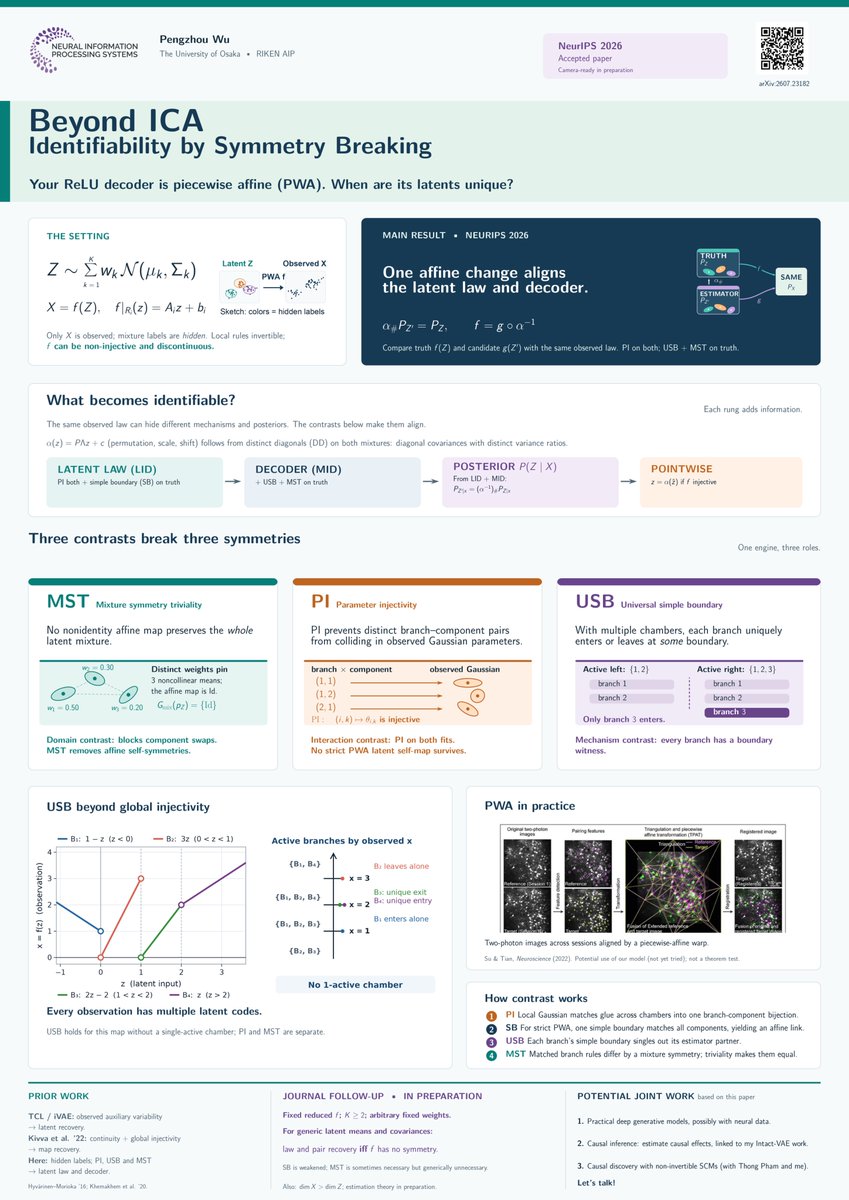
#neurips2026 Accepted! https://t.co/AdH4z9qLci. This is the first identifiability result via concrete analysis of model symmetry of a nonlinear (and unsupervised) class, the first to admit multiple latent codes for every observation, and the first to allow discontinuous decoders.
@Anthony_Bonato the right *looks* cleaner/better and I think it should be easier to read too... but, no, I found the left is in fact easier to *read*, the right is too "blurred" when I really read it.
@SincDavidson First, do not believe any AI detection tool. Second, do not worry whether AI was involved or not. Judge the paper, judge the science. Basically, do not discriminate on the basis of color, sex, religion, and whether the author is or is not a human (or any combination thereof).
@SincDavidson First, do not believe any AI detection tool. Second, do not worry whether AI was involved or not. Judge the paper, judge the science. Basically, do not discriminate on the basis of color, sex, religion, and whether the author is or is not a human (or any combination thereof).
@insou This seems true for every senior researcher in universities. Maybe one day I will be something like an independent researcher to avoid non-research work. I am not sure and not sure how tho...
#neurips2026 Accepted! https://t.co/AdH4z9qLci. This is the first identifiability result via concrete analysis of model symmetry of a nonlinear (and unsupervised) class, the first to admit multiple latent codes for every observation, and the first to allow discontinuous decoders.
Think a solution to the flood of LLM-written papers is not to ban them, but to allow (pure!) LLM reviews. Between a mediocre human reviewer and a good LLM (GPT 5.4 or Opus 4.5 above), I'd choose the LLM to review my draft w/o hesitation!
@ThomasWolgast "Worst case is a human blindly using an LLM to create a review." Yup, and we know this is what is happening more than 80% (?) cases nowadays. Yes, I think some "supervision" given to both LLM and human reviewers will be very useful.
@ThomasWolgast I completely agree. By "pure" LLM reviews, I mean it's transparent to all humans involved (the journal, the possible human reviewers, the authors, the readers). I think human reviewers can join after a paper is not rejected by an LLM concensus.
You will have to spend a year isolated, everything will be provided, food, etc. but no contact with the external world.
You have to choose your companion between
LLM-assisted writing is good for review system in one aspect at least. Dressing-up and name-dropping used to be a skill, but now everyone's LLM does it, so it's worthless. Reviewers hopefully will be immune and focus on correctness and honest motivation.
I've rejected more than 5 conference papers in a row, and my bar isn't high: I only reject when I can see clear errors or serious gaps. Significance/impact rarely entered consideration. #NeurIPS2026 had the highest reviewer agreement I've ever seen. I credit AI's error-hunting.
I joined #NeurIPS2026 experiment yet got zero AI-assisted papers. Seems impossible under true random assignment. Maybe an unstated constaint that experienced / past-best reviewers go pure-human?
Oh this time in my review batch, after rebuttal, there is a paper passed the correctness bar, and it got accepted. My own paper has large score variations tho, but because it's purely theoretical.
I think #neurips2026 AI-assisted review experiment is a success. One signal: it accepted more marginal-but-correct papers. For good or bad? I tend to the former, tho not sure.
Flip side, as an author: AI helps reviewers actually understand difficult papers (mine, for one), and it defuses bias. The most frustrating case reviously: a hostile reviewer could hide behind vague or absurd reasons, making rebuttal nearly impossible.