What if payment infrastructure could do more than process a transaction?
In its contribution to UOB's Agentic Finance report, Velo highlights the potential for AI to help determine optimal transaction routing, timing and execution based on:
→ Cost
→ Speed
→ Liquidity
→ Risk
As more decision-making enters the settlement layer, governance, accountability and auditability become even more important.
Intelligence and control must evolve together.
Read more at https://t.co/3TRqh7AQHP
#Velo #AgenticFinance
Absolutely incredible.
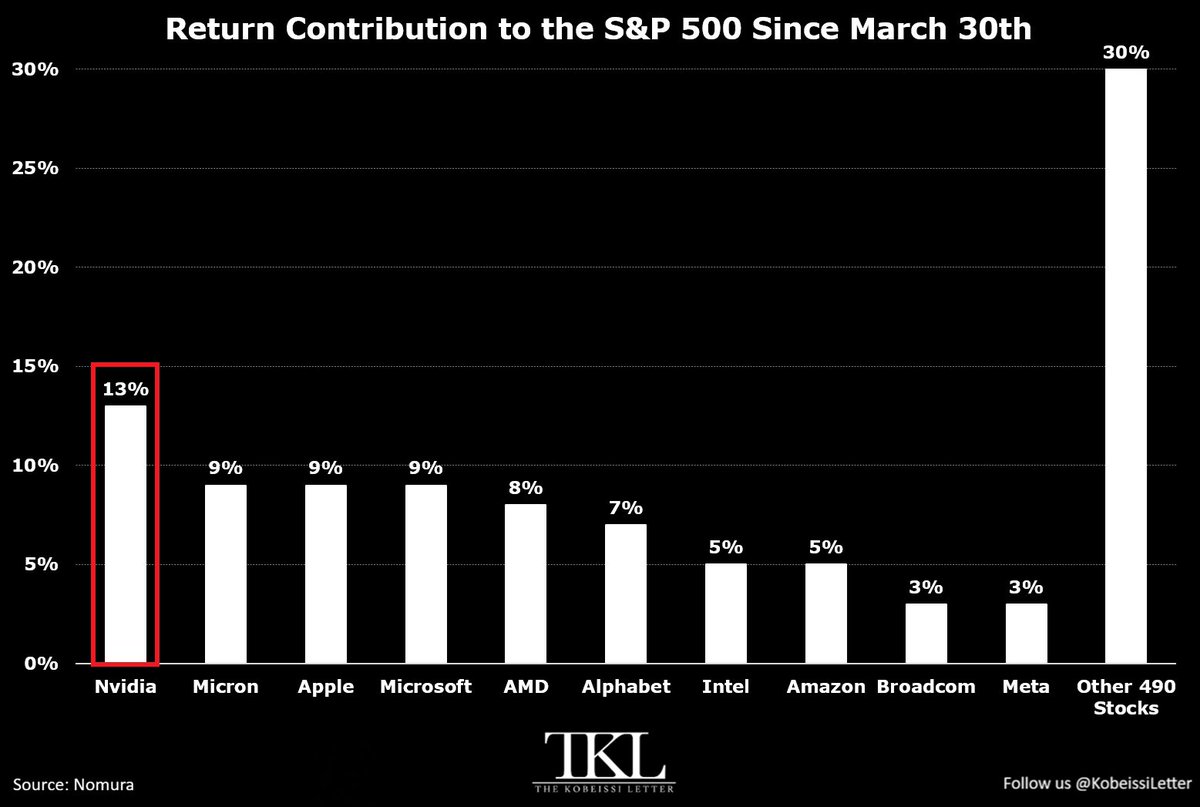
Just 10 stocks have driven 70% of the S&P 500’s gain since March 30th.
These stocks have added +16 percentage points to the index’s +23% gain over this period.
Nvidia, $NVDA, has contributed the most, accounting for 13% of the S&P 500's gain, or +3 percentage points.
This is followed by Micron, $MU, Apple, $AAPL, and Microsoft, $MSFT, each accounting for 9% of the S&P 500’s advance, adding +2 percentage points.
Return contributions of AMD, $AMD, and Alphabet, $GOOGL, have been 8% and 7%, respectively.
Meanwhile, the remaining 490 stocks have accounted for just 30% of the S&P 500's gain since March 30th, adding +7 percentage points.
Diversification is dead.
Shocking stat of the day:
The combined wealth of the world’s tech billionaires surged +$845 billion in the first 9 months of 2026, the largest increase for this period of the year on record.
This brings the group's combined wealth to a record $4.6 trillion, accounting for 36% of the total wealth tracked by the Bloomberg Billionaires Index.
This is despite tech billionaires representing only ~20% of all members in the index.
For perspective, billionaires outside the technology sector lost a combined -$62 billion over the same period.
Fortunes in the consumer sector fell by -$279 billion, while those in communications declined by -$92 billion.
Americans accounted for 94% of the Bloomberg Billionaires Index's total net wealth gains in the first 9 months of 2026.
As a result, all 10 of the world's richest people have been American since September 10th, the first such occurrence since data began in 2012.
The AI boom is generating unprecedented wealth at the top.
Investor demand for trading outside of regular market hours is skyrocketing.
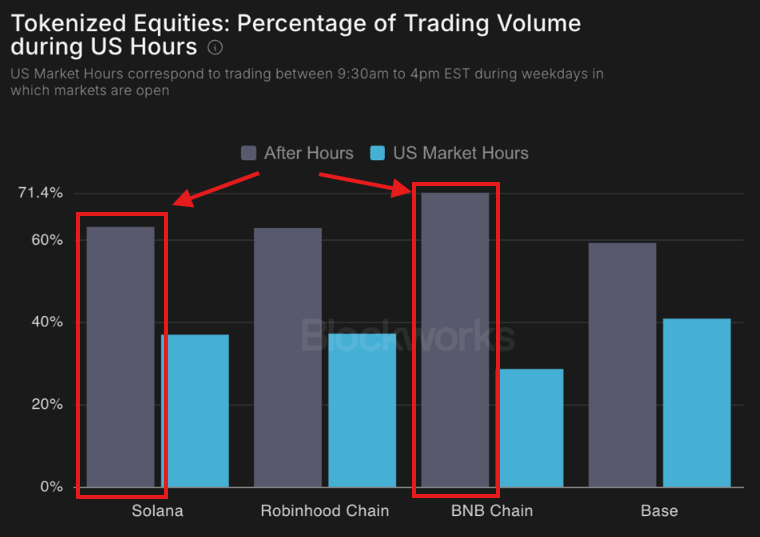
In fact, the majority of trading volume in tokenized equities is now occurring OUTSIDE of regular market hours.
BNB Chain has become the first blockchain with over 70% of its tokenized equity trading volume occurring outside of regular market hours.
On Solana, 63% of tokenized equity trading volume is now occurring outside of regular market hours.
Amid this trend, Jupiter, the largest trading platform on Solana, reported +50% month-over-month growth in tokenized asset trading volumes.
As a result, the total circulating supply of tokenized equities has surged to a record $3.3 billion.
Markets are officially becoming 24/7.
Bond markets are doing the heavy lifting for central banks by tightening financial conditions:
Since mid-September, markets have sharply reduced rate-hike expectations across major economies, with the biggest declines in Australia at -47.32 basis points, the euro area at -43.14 bps, South Korea at -21.91 bps and the US at -19.05 bps.
Across 8 major economies, total rate hikes priced in have fallen to 539 basis points from 717 bps in September, when expectations reached their highest level since 2022.
This comes as government bond yields surge to multi-decade highs, tightening financial conditions without requiring central banks to raise benchmark rates as fast as previously expected.
Rising fiscal concerns and massive AI-related debt issuance are intensifying competition for capital, while higher borrowing costs are already putting pressure on mortgages, corporate credit and riskier assets.
Meanwhile, Brent crude oil remains above $100 per barrel, keeping inflation risks elevated and leaving central banks caught between containing price pressures and avoiding further damage to economic growth.
Although higher yields are reducing the need for additional rate hikes, persistent inflation and heavy government borrowing will keep long-term yields elevated regardless.
Bond markets are tightening financial conditions on their own, but the pressure on inflation and borrowing costs is far from over.
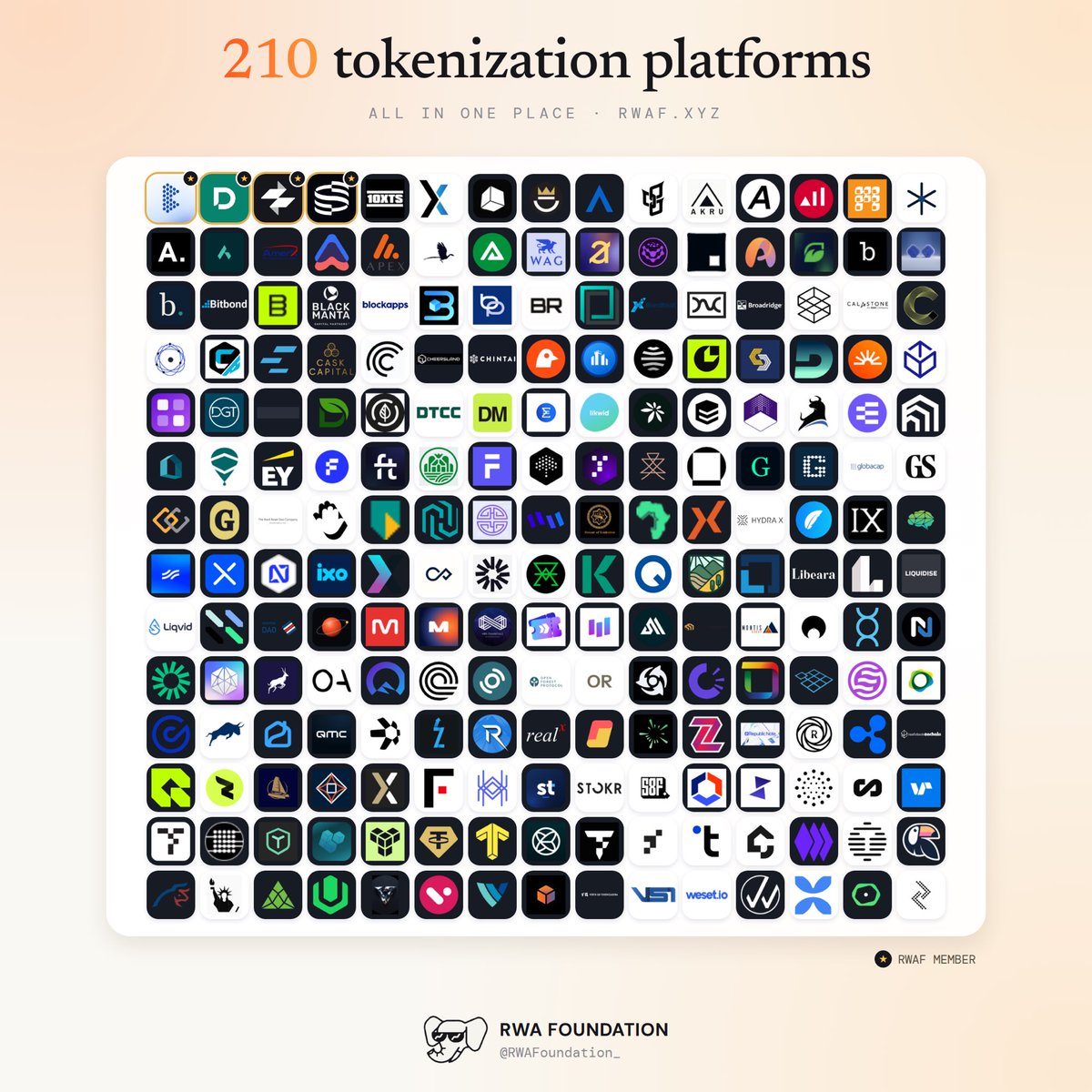
210 tokenization platforms. One page 🏗️
Is yours on there? If not, head to https://t.co/Et0VgKsIVz and submit your project.
The more the better. We're stronger together, all here to push tokenization forward and educate the masses 🐘
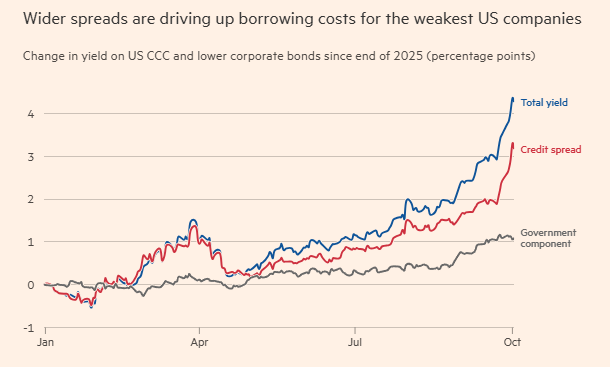
The Treasury bond market SELL-OFF is spreading across corporate America:
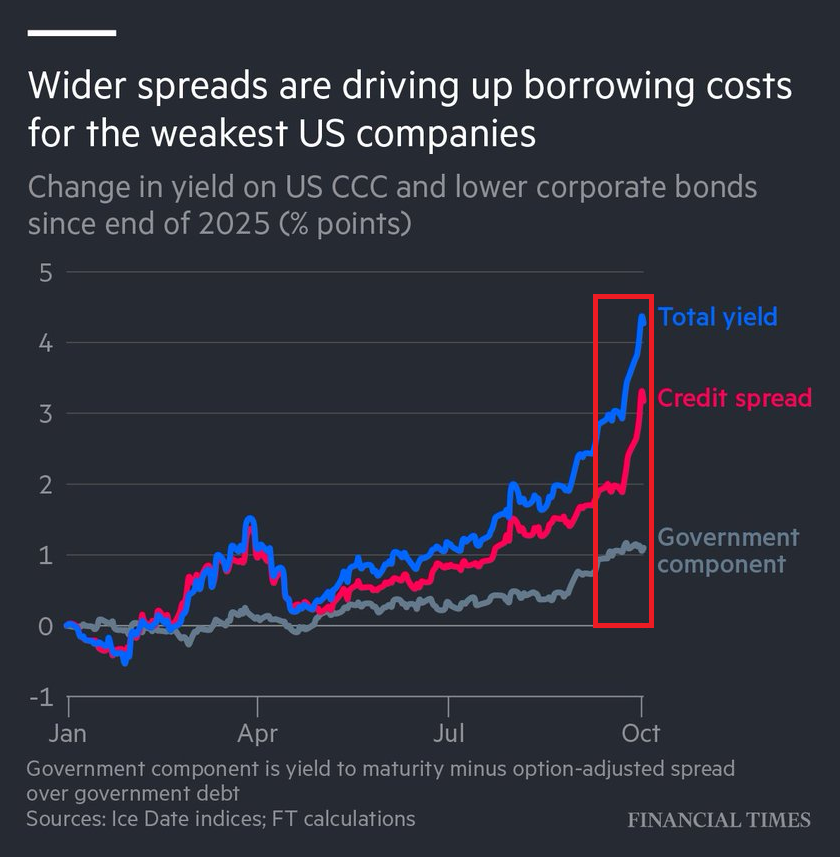
Borrowing costs for the lowest-rated US companies have surged to 17%, their highest level since May 2020.
At the same time, the risk premium on CCC-rated and lower debt has risen to 12 percentage points, its highest since the 2022 bear market.
The rise in borrowing costs reflects the surge in Treasury yields, while the widening credit spread shows investors are also demanding more compensation for corporate credit risk.
Companies with floating-rate debt and those facing refinancing needs in the coming months are particularly exposed.
Investor demand is also shifting toward shorter maturities, as companies try to avoid locking in elevated financing costs for decades.
The pressure could become much broader if Treasury yields remain elevated, with a record $1.45 trillion of US investment-grade corporate debt coming due between 2026 and 2030.
Higher borrowing costs could force companies to postpone acquisitions, buybacks, expansion, and other discretionary investment, particularly if profitability fails to keep pace with financing costs.
What started in the Treasury market is now becoming a growing threat to corporate credit.
🚨BREAKING: Borrowing costs for America's riskiest companies hit 17%, the highest since COVID.
The US bond sell-off is now pushing up borrowing costs across corporate America, per FT.
Here's what's happening:
The 10-year Treasury yield hit its highest since 2002 last week
Bank of America cut its forecast for investment-grade bond sales this month to $110 BILLION from about $160 BILLION
Paramount's $52 BILLION bond sale for its Warner Bros deal sold off right after launch
A record $1.45 TRILLION of US investment-grade debt comes due between 2026 and 2030, per Moody's
The last time borrowing costs were this high, the Fed had cut rates to near ZERO.
This time, traders are betting on 3 to 4 more hikes by early 2028.
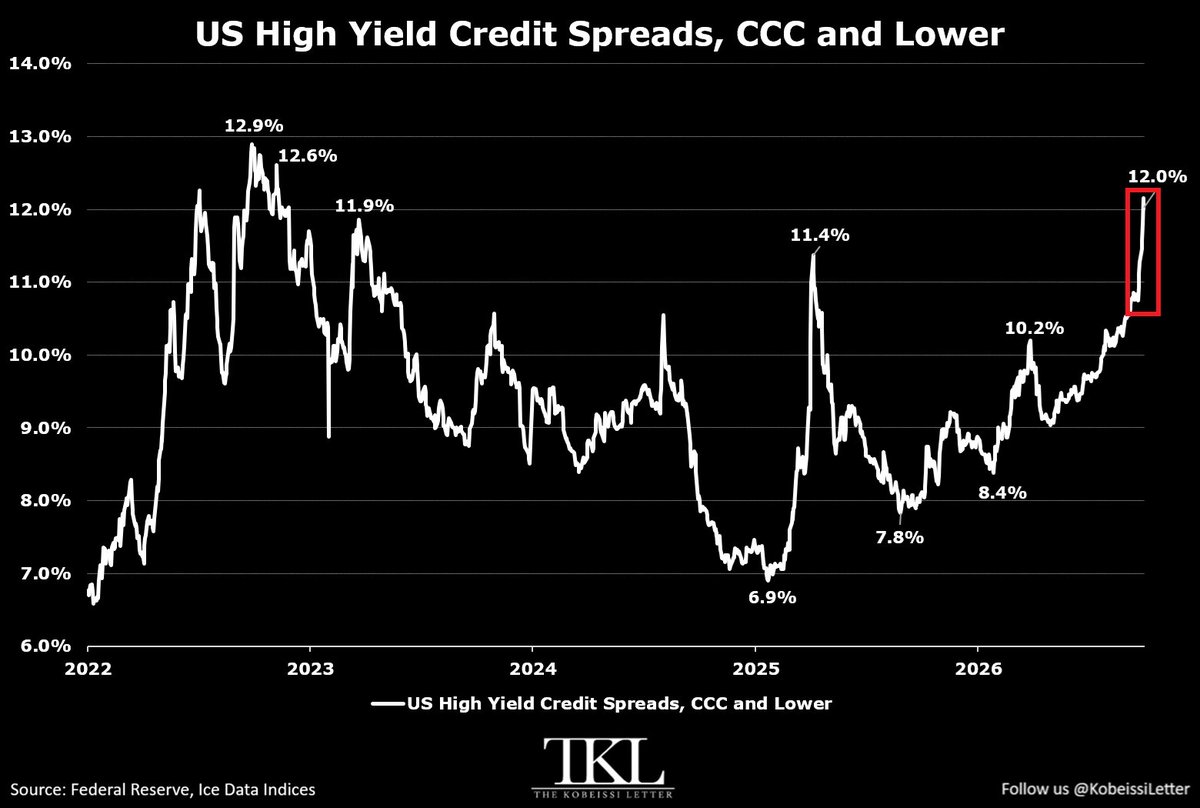
The US high-yield credit market stress is rising:
Credit spreads for CCC-rated and lower corporate bonds are up to 12.0%, their widest level since November 2022.
Over the last 5 months, this figure has surged +298 basis points, surpassing the April 2025 peak of 11.4%.
This represents a comparable increase to that seen during the 2022 bear market and the February-April 2025 market correction.
If this pace continues, credit spreads for the lowest-rated US corporate bonds will exceed the 2022 peak of 12.9% as soon as this month.
To put this into perspective, the 2020 pandemic high was 19.6%.
Credit stress is rising sharply beneath the surface.
🚨 Japan is About to Nuke the Global Economy
The Bank Of Japan Dropped A Bombshell Statement: The Hiking Cycle Isn’t Finished and Markets Better Get Used to It
BOJ Chief Ueda Goes on Record and says that more hikes are coming whether the economy likes it or not.
The Governor’s words Just Put Every Leveraged Position on Notice.
Translation: the Global Fiat Carry Trade Is Next to Blow
Rates already at a 31-year high and he still wants more, because the inflation they spent decades trying to create is now “too high” and they need to “anchor” it.
The free-money era that propped up the entire global fiat system is being shut off, and they’re doing it while the yen is still collapsing.
USD/JPY is climbing back to 160. The yen ignored all Scott Bessent’s interventions, BoJ rate hike and verbal warnings from Scott saying “I am the house now.”
They Raised Rates to a 31-Year High and the Currency Is Still collapsing.
When the U.S. Treasury Secretary called himself “the house”, The most dangerous response from @yutokanzakireal: “Japan isn’t just betting against the house, it’s bringing the entire house down.”
Just one Tokyo fund broke the French debt market by selling their holdings to ZERO.
And now, BoJ Governor Ueda gave the chilling warning to the market.
They just told you the endgame is starting.
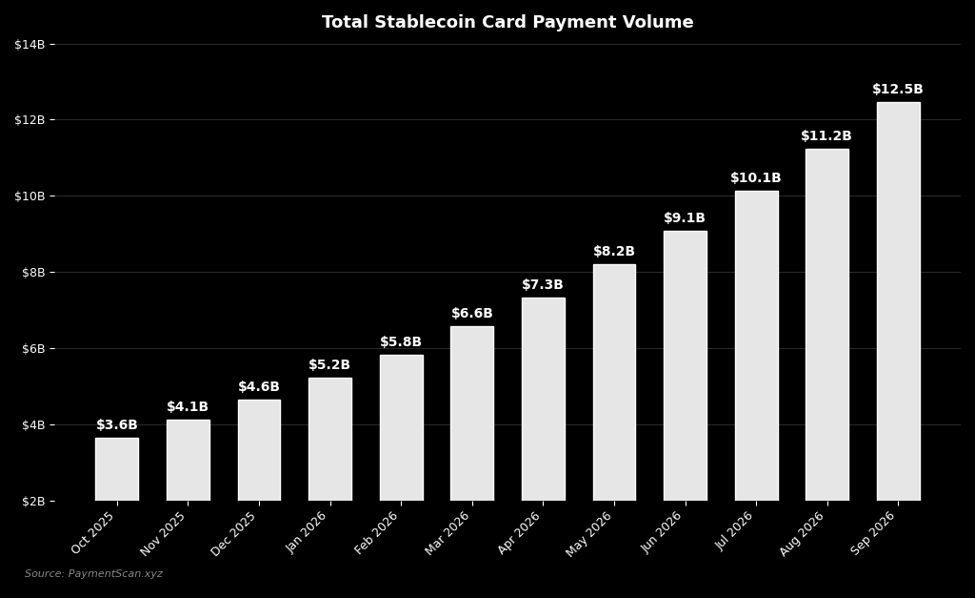
BREAKING: The total volume of payments processed on crypto cards has reached a record $12.5 billion, up +140% year-to-date.
This also marks +247% growth compared to levels seen in October 2025.
Continued adoption of stablecoins as a payment rail and the push toward cross-border transaction efficiency are behind the surge in volume.
Furthermore, QR-code based payments for crypto cards are seeing robust growth.
This has fueled +55% quarter-over-quarter growth in activated cards on Jupiter Spend, one of the largest onchain card providers, particularly due to demand for QR payments.
Crypto cards are the next phase of crypto adoption.
An AI agent can find the best option.
But finding an option isn't the same as completing a payment.
Orbit is designed to connect the two:
AI intent → permissions → payment route → execution → record
Turning an AI decision into a completed financial transaction is where the real opportunity lies.
#VELO #AI #PayFi #Payments
Download Orbit Plus
👉 iOS: https://t.co/g5DLXdMeve
👉 Android: https://t.co/Drd417mpRi
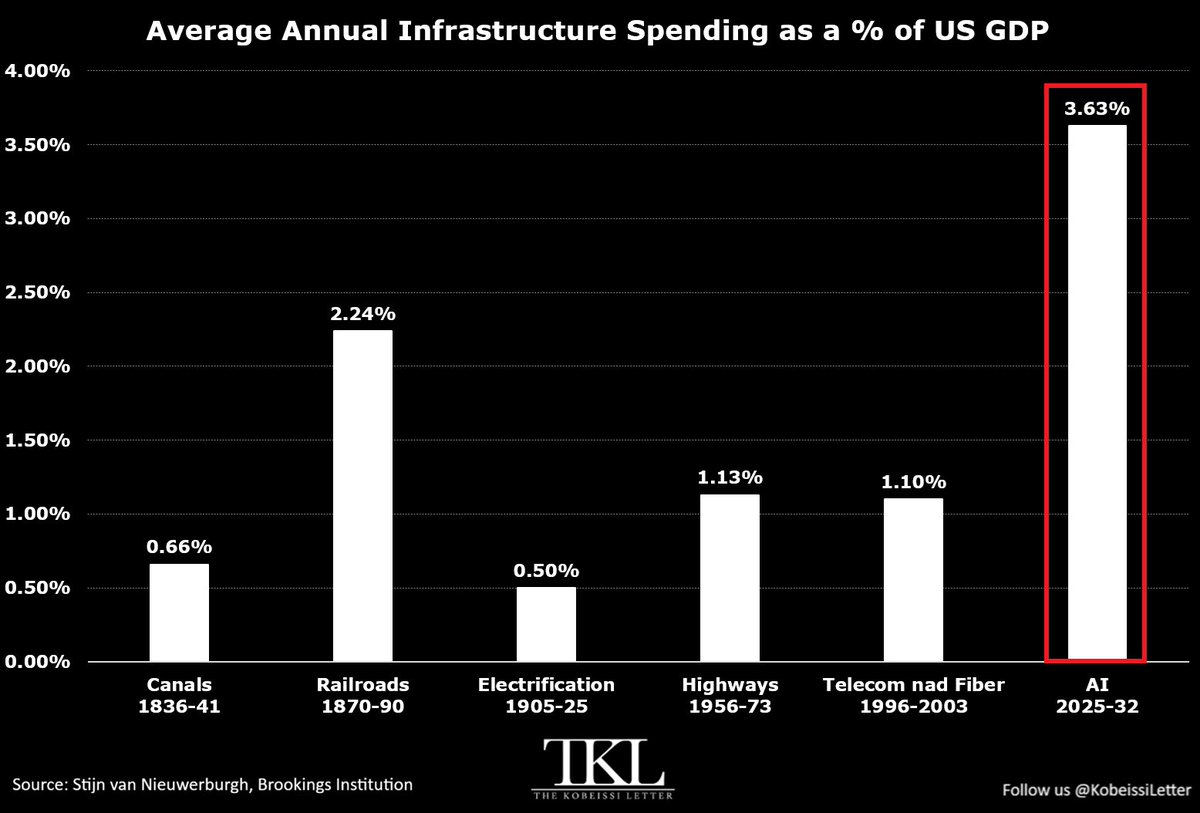
We are officially witnessing the biggest wave of infrastructure investment in modern US history.
Total investment in data centers and AI infrastructure is projected to average 3.63% of US GDP per year from 2025 to 2032, the highest proportion among major infrastructure buildouts since the 1800s.
The previous largest investment, railroad infrastructure, represented 2.24% of GDP per year in 1870-1890.
This was followed by highway investment that averaged 1.13% of GDP in 1956-1973, while telecommunications and fiber infrastructure averaged 1.10% in 1996-2003.
By comparison, electrification stood at just 0.50% of GDP in 1905-1925, while canal investment accounted for 0.66% in 1836-1841.
This comes as AI and data-center infrastructure investment is projected to total ~$10.3 trillion between 2025 and 2032.
The AI buildout is the largest infrastructure investment in modern US history.
The future of payments won't run on a single rail.
Orbit is being built to connect:
Stablecoins • Blockchains • Banks • Cards • FX • On/Off-Ramps
The goal: let users and AI agents focus on what they want to pay, while Orbit handles the path to execution.
Download Orbit Plus
👉 iOS: https://t.co/g5DLXdLGFG
👉 Android:https://t.co/Drd417lS1K
#VELO #PayFi #AI #Payments