Why the Peptides Calculator is more powerful than it looks:
• Reduce simple but costly mistakes
• Keep prep consistent from one session to the next
• Save material by getting it right the first time
• Let you focus on the actual work instead of the calculator
The GHRP story is a quiet lesson in engineering. The field kept refining the hunger out of these peptides until it reached Ipamorelin, the clean one, then realized the hunger it removed was occasionally the useful part. Selectivity is a feature, not always the aim.
GHRP-6 is a reminder that a side effect is only a side effect relative to the goal. Its intense hunger is a nuisance if you want clean growth hormone, and it is the reason to choose it if the research model depends on driving appetite up.
GHRP-2 and GHRP-6 are close cousins split by one thing: hunger. GHRP-2 gives strong GH with modest appetite. GHRP-6 gives slightly less GH but triggers intense hunger within 20 minutes, a drawback in most research and the entire point in underweight models.
The MK-677 versus Ipamorelin choice is really convenience versus precision. MK-677 is one oral dose a day with more side effects. Ipamorelin is clean and selective but asks for multiple injections. Neither is simply better, they solve different problems.
MK-677 is the growth hormone secretagogue you do not have to inject. One oral dose holds GH and IGF-1 elevated for close to 24 hours, which is the appeal, but the tradeoff is real: more appetite, more water retention, and a possible dip in insulin sensitivity.
The obvious move in metabolic research is to stack more GLP-1. The more interesting one pairs a GLP-1 with an amylin analogue, combining two separate fullness signals instead of amplifying a single pathway. A different lever aimed at the same outcome.
@BiotechHannes We always advise on correct sourcing, but you're right that eliminating errors and saving people's time is the biggest benefit of our calculator!
This calculator takes the steps people usually do manually and puts them in one place:
💙 You enter how much pep is in the vial
💙 You enter how much liquid you’re adding
💙 You choose the dose you want
Correct math, every time.
https://t.co/OXHz0Sdhiz
Tirzepatide is the compound that made people stop calling everything a GLP-1. It hits two receptors instead of one, GLP-1 and GIP, and the effect appears synergistic rather than additive, since each pathway seems to sensitize tissues to the other.
The metabolic space moved from single agonist to dual to triple in about four years, and each added receptor pushed the weight-loss numbers higher. The more interesting question is not how high they climb, but whether there is a ceiling at all. So far, nothing suggests one.
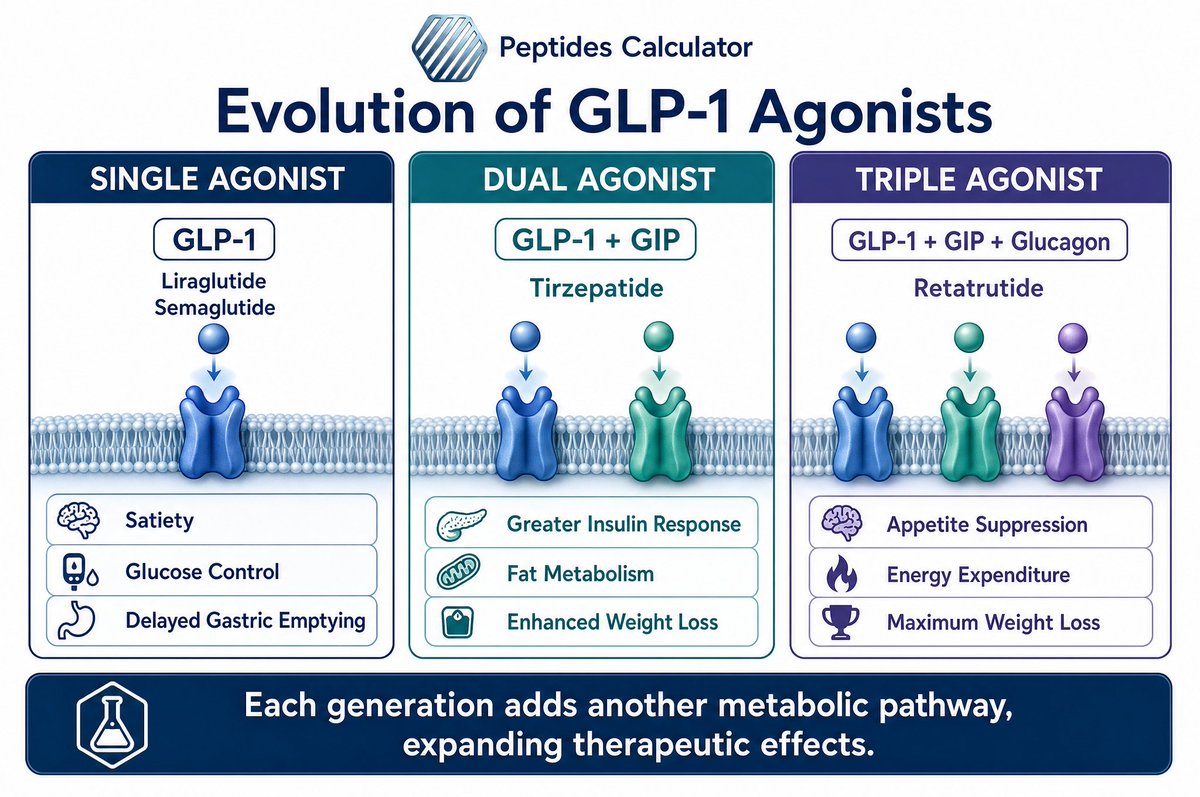
The weight-loss peptide space has advanced faster than almost any area of research, and the pattern behind it is simple: each generation adds another receptor.
It began with single agonists. Liraglutide, then semaglutide, both acting on the GLP-1 receptor to curb appetite and slow gastric emptying. Semaglutide alone reached roughly 15 percent of body weight in trials, a figure the field had never seen.
The dual agonist followed. Tirzepatide adds the GIP receptor on top of GLP-1, and activating both pushed average loss to around 20 to 22 percent.
Now the triple agonist, retatrutide, adds glucagon as a third target, with early trials approaching 24 percent, in part because that third receptor may raise resting energy expenditure.
Single, dual, triple, each step adding a mechanism and lifting the ceiling. Combination strategies are already branching off in another direction, pairing a GLP-1 with an amylin analogue rather than adding receptors to one molecule. There is little sign the field believes it has found the limit.
The most overlooked compound in the metabolic space might be the least dramatic one. AOD-9604 is the fat-metabolizing fragment of growth hormone, isolated so it drives lipolysis without moving blood sugar or IGF-1. Targeted by design rather than broad by accident.
GLP-1s and tesamorelin both get called fat loss, but the mechanism could not be more different. A GLP-1 lowers how much you eat, so fat comes off everywhere. Tesamorelin never touches hunger, it sends growth hormone after visceral fat specifically. Same goal, opposite roads.
One peptide is FDA-approved for a job almost nothing else targets on purpose: reducing visceral fat, the deep fat around your organs that actually drives metabolic risk, without touching appetite or the fat you can see. Tesamorelin is a scalpel in a field full of shotguns.