Harold Cottam, age 21, sat unlacing his boots for bed shortly after midnight on April 15, 1912, while the Titanic sank in the dark 58 miles away.
His coat was already off in the radio room of the passenger ship Carpathia, yet he kept his headphones on for a few extra minutes to send the Titanic routine traffic.
Back through the static came an urgent call from coordinates reporting that the Titanic had struck an iceberg and was sinking.
Cottam ran to the bridge and burst into the cabin of sleeping captain Arthur Rostron to wake him.
Rostron ordered the ship turned toward the distress position at once, then paused in the quiet cabin to ask if Cottam was sure the signal was real.
The Carpathia had a top speed of 14 knots, so Rostron woke the off duty stokers and shut off cabin heat and hot water to send all steam to the engines.
Cabins went cold while the deck shook underfoot as the ship pushed past 17 knots through pitch darkness straight toward the ice.
Rostron posted extra lookouts on the bow, bridge wings, and mast, steering around tall icebergs by starlight without slowing down.
Inside, the crew turned all three dining rooms into medical wards with a doctor in each, readied hot soup and blankets, and cleared officer cabins.
They hung rope ladders, chairs, and canvas mail sacks along the hull, and poured oil down the forward lavatory pipes to calm the sea.
At four in the morning, Rostron spotted green flares from a lifeboat and stopped the engines at the ice field.
The shaking deck went still in the dark, and ten minutes later sailors pulled the first survivor aboard.
Daylight soon revealed dozens of massive icebergs surrounding the Carpathia on every side.
For over four hours in rough swells, crewmen hauled shivering adults up on ropes and lifted babies and small children aboard in canvas bags.
By half past eight, 705 survivors were safe aboard, and Rostron steered through thick fog to Pier 54 in New York on the rainy night of April 18, 1912.
Survivors pooled money to give a medal to every crew member, and on March 1, 1913, President William Howard Taft awarded Rostron the Congressional Gold Medal at the White House.
All 705 people who reached New York that rainy night were alive because a 21 year old with his boots unlaced kept his headphones on for a few extra minutes before bed.
I wish there were a meaningful way to express gratitude to the brave men and women who work for @ICEgov. They suffer daily indignities while arresting violent people, only to be defamed and lied about by the media and politicians, to the point that leftists try to murder them.
They earn modest salaries yet endure intolerable conditions imposed on them by leftists and Democrats. It's a disgrace that Americans who risk their lives in public service and national security are treated this way. cc: @DHSgov@SecMullinDHS@RealTomHoman
Just like in the times of Rome, the Senate was the one that ultimately destroyed it.The legions didn’t turn on the Republic first. The people didn’t. It was the Senate, corrupt, self-dealing, more interested in protecting its own power than the system it was sworn to defend. They bought votes, delayed the hard decisions, and handed the country over piece by piece until nothing was left but the name.We’re watching the same pattern. The people who took the oath are the ones who won’t pass election integrity, won’t clean the rolls, and won’t show up when it counts. They protect the process that keeps them in office instead of the Constitution that put them there.Rome didn’t fall because of one barbarian army. It fell because the Senate stopped serving the Republic.
The Emperor of Japan went to the American Embassy to say goodbye to a foreign general who had just been dismissed.
It had never happened before. No Japanese Emperor had ever visited a foreigner with no standing. Contemporary reports said the visit broke all precedent.
The general was Douglas MacArthur. He had arrived in Japan on August 30, 1945, as commander of the occupation. Less than six years later, on April 11, 1951, President Harry Truman relieved him of his commands after public statements from MacArthur contradicted the administration's policy on the Korean War. The news of his relief was greeted with shock in Japan.
The Diet of Japan passed a resolution of gratitude for MacArthur.
The Mainichi Shimbun wrote this about him:
"MacArthur's dismissal is the greatest shock since the end of the war. He dealt with the Japanese people not as a conqueror but a great reformer. He was a noble political missionary. What he gave us was not material aid and democratic reform alone, but a new way of life, the freedom and dignity of the individual... We shall continue to love and trust him as one of the Americans who best understood Japan's position."
On April 16, 1951, MacArthur left Tokyo for Haneda airport. The road from the American Embassy to Haneda ran about ten miles.
More than 200,000 Japanese lined that road to see him off. Some estimates run far higher.
Less than six years earlier, he had arrived in Tokyo as commander of the occupation. On the morning he left, their Emperor had come to his embassy, their parliament had thanked him, and the people stood along the ten miles of road to the airport.
Then he flew home.
Without @JohnCleese’s help, my family might have been killed by Pakistani supporters last night.
He sent 8 security guards to defend Singhs Dining
My husband @kingkapoor72 was arrested yesterday by met police
Aggressive protesters chanted “Pakistan Zindabad”, outside my restaurant
Londonistan is done
Despite being deaf and nonverbal, Jennica Pounds (@DataRepublican) just delivered one of the most powerful speeches of the night after winning the People’s Choice Award for Citizen Journalist of the Year. #Liberty#America
Give them a break guys ... the Republican Senate has worked ...
August (10 days)
September (15 days)
October (10 days)
November (6 days)
They're exhausted and needed another 3 day, long weekend. Nothing is urgent to them.
Oh, but did they at least give Trump recess appointments, like every other President gets - NOPE!
I CAN'T STAND the Republican Senate.
They hate you.
I've never seen more of a bunch of lazy, no-good-for-nothing, worthless losers in my life.
Totally useless.
Stop and look closely at the young Marine officer climbing over the concrete seawall on that wooden ladder.
He has less than two minutes left to live.
His name is First Lieutenant Baldomero Lopez, twenty-five years old, the proud son of Spanish immigrants from Tampa, Florida, and a graduate of the U.S. Naval Academy.
On September 15, 1950, during the amphibious landing at Red Beach in Inchon, Lopez was the very first man in his platoon up the scaling ladder into enemy fire. A combat photographer snapped this frame as Lopez vaulted over the wall with his M1 carbine in his left hand, leading the 1st Battalion, 5th Marines forward.
Moments after this shutter clicked, Lopez crawled up to a North Korean concrete pillbox that was pinning his Marines down on the beach. He pulled the pin on a hand grenade and cocked his right arm back to hurl it through the firing slit.
At that exact split second, a burst of automatic fire tore straight through his right shoulder and chest.
Lopez dropped into the trench, bleeding heavily, while his live, primed grenade rolled loose near the boots of his own Marines. His shattered right arm was paralyzed; try as he might, he could not lift it high enough to throw the grenade over the wall.
With only seconds left on the fuse, Lopez refused to shout for someone else to grab it. Instead, he swung his broken right arm in a low arc across the dirt, swept the hissing grenade underneath his own chest, and pressed his body tight over the blast.
Every single Marine around him walked away alive. Whenever someone asks what American leadership looks like, show them the young man at the top of that ladder.
Most of the trolls who attack me seem to think bringing up the atomic bombs will somehow hurt my feelings because I'm Japanese.
I hate to disappoint you, gentlemen, but it doesn't work.
Not even a little.
Since some of you seem genuinely confused, allow me to explain.
1. We don't lose arguments to insults.
In Japan, you win an argument with logic, evidence, and facts.
If you can prove me wrong, I'll respect you.
If you just scream "HIROSHIMA!" like a three-year-old who dropped his ice cream, I'm afraid you've accomplished very little.
Except perhaps alarming the neighbors.
2. We actually study our own history.
For my generation, World War II is ancient history.
For 80 years, Japanese schools have taught us that Imperial Japan started a reckless war against an America it had virtually no chance of defeating.
And most of us grew up thinking, "Well, that was an extraordinarily stupid idea."
You cannot humiliate someone by announcing a historical fact they've been studying since childhood.
That's not an insult.
That's a failed history quiz.
3. We love democracy.
Modern Japanese people believe deeply in freedom and democracy.
We also understand that ordinary Japanese citizens lived under a militarist government they had little power to resist.
So when you mock modern Japan for what its wartime rulers did, you're essentially yelling at the grandchildren for their grandparents' government.
A fascinating intellectual achievement.
4. We know exactly what freedom is worth.
Japan spent centuries fighting internal wars before eventually becoming a unified nation.
It later fell under an authoritarian, militarist government.
After defeat, we finally built the liberal democracy we have today.
And we have absolutely no intention of surrendering it.
You think reminding us of that defeat is humiliating?
It's a reminder of how much our country has changed.
5. We don't dream of revenge.
When Japanese people remember Hiroshima and Nagasaki, the overwhelming sentiment isn't "Let's get revenge on America."
It's "We never want anyone, anywhere, to suffer something like that again."
Imagine trying to insult people with a tragedy they've turned into a commitment to peace.
You're not exactly landing the punch you think you are.
6. Losing to America isn't the devastating insult you imagine.
America has unmatched global military power, and countless nations have experienced its power directly or indirectly.
Japan fought the United States and lost.
Yes.
We know.
It's in the textbooks.
It's in the museums.
It's been in the history books for eight decades.
Repeating "YOU LOST!" as if you've personally uncovered a classified military secret is rather adorable.
Do you also run around informing British people that the American colonies declared independence?
7. And finally, a word to my beloved trolls.
I've taken the trouble to explain all this in seven carefully numbered points.
Unfortunately, I suspect some of you have already exhausted your reading capacity somewhere around point two.
If your entire historical argument consists of typing "NUKE JAPAN" in capital letters, please understand that I'm not experiencing emotional devastation.
I'm simply observing what appears to be a remarkably confident piece of dog poop that has somehow acquired internet access.
But do carry on.
It's always fascinating when something with absolutely nothing to say insists on saying it so loudly.
June 1942. Midway. Admiral Raymond Spruance, the quiet American commander, has just sunk four Imperial Japanese Navy aircraft carriers in a single afternoon: Akagi, Kaga, Soryu, and Hiryu. It is the most catastrophic naval defeat in modern Japanese history.
Thousands of Japanese sailors are now in the water, clinging to debris, three thousand miles from home.
By the ruthless mathematics of total war, the correct American move is to let them drown. Sailors in the water are sailors who will not reinforce the enemy. The U.S. Navy's own cruisers are in range of a Japanese counterstrike.
Spruance refuses.
He orders his destroyers to stop and look for survivors. For hours. Among Japanese sailors who, days earlier, had been preparing to invade American islands.
His chief of staff objected on operational grounds. Spruance answered, in his usual quiet voice, "We have no quarrel with men in the water."
American destroyers pulled thirty-five Japanese sailors out of the Pacific after Midway. One of them later wrote a memoir describing, in careful detail, the American sailor who gave him the blanket off his own back.
Years after the war, Admiral Spruance, by then U.S. Ambassador to the Philippines, hosted a small private dinner at his residence. At the table were three former Imperial Japanese Navy officers.
One of them was Mitsuo Fuchida, the man who had led Pearl Harbor.
Another was Minoru Genda, Yamamoto's air staff officer who had designed the Pearl Harbor strike plan.
The third was a surviving Japanese destroyer captain who had fought at Midway.
Spruance, the quiet Indianan, poured tea for them himself. He talked about carrier operations. He talked about the Pacific weather patterns that had decided Midway. He did not talk about victory.
When he said goodbye at the door, he bowed to them in the Japanese fashion.
Fuchida said later, through tears, that it was the moment he understood the American naval officer class had considered them peers, not animals, even in the middle of the worst war.
Spruance died in 1969. At his memorial, letters arrived from the Japanese Navy veterans' association, in Japanese. They called him sensei. Teacher.
Because the American admiral who sank your carriers also made sure to pull your sailors out of the water. And bowed to your officers at his dinner table. And treated your war as what it was — a fight between warriors, not a verdict on your worth as human beings.
That is what distinguishes a great power from a brutal one.
America is a lot of things. At Midway, on that afternoon, she was Spruance saying, "We have no quarrel with men in the water."
Japan should say his name too.
Saburo Sakai was the greatest Japanese fighter ace to survive the war. Sixty-four confirmed kills. Flew the Zero against the P-40, the P-38, the Hellcat, and the Corsair.
Over Java, in early 1942, he caught a lone American DC-3 transport plane in his gunsight. An easy kill. Standard target. He closed to point-blank range.
Then he looked into the cockpit.
The cockpit was full of women and children, Dutch civilian refugees trying to get out of the East Indies ahead of the Japanese advance. One of the women, holding a baby, looked out the side window straight into Sakai's canopy.
Sakai did not fire.
He broke off, saluted the woman, and let the DC-3 fly west into the sun.
Years later, in American interviews, he explained himself plainly.
"I am a samurai. My father's father was a samurai. We do not shoot women and babies. If my ancestors saw me fire into that cockpit, I would not be able to meet them when I died."
Five months later, over Guadalcanal, Sakai took a .50 caliber round through the canopy of his Zero. The bullet went through his head. It blinded his right eye and tore open his skull.
By every medical reasonable expectation he should have gone down.
He flew his damaged Zero four hours and 650 miles over the Pacific, bleeding into his flight suit, half-blind, repeatedly losing consciousness. He landed it, intact, on Rabaul.
He survived the war with one eye.
After the war, Saburo Sakai did not hate Americans. He became a Buddhist. He said in interviews that he had killed too many men already and would not do it again, not even in his own thoughts. He corresponded for years with former American Navy pilots who had been his opponents.
When American pilots began visiting Yasukuni Shrine in Tokyo to pay respects to Japanese pilots they had shot down, it was Saburo Sakai who met them at the gate and walked them in. Enemy pilot. Enemy pilot. Both with white hair. Side by side, bowing at the memorial of men they had tried to kill.
"We were warriors," Sakai told one American interviewer. "Now we are old. Only the young should hate. The old should remember."
Japan had Zamperini forgiveness. Japan had Fuchida reconciliation. Japan also had Saburo Sakai, who refused to fire at women, took a bullet through the head, and spent his old age walking American pilots into Yasukuni.
Warriors recognize warriors.
Even after the war is gone.
I was kicked out of a dinner in South Dakota because I’ve consistently pushed the SAVE America Act.
Instead of listening to the grassroots, our Republican Senate defied us for 2 years
& delivered losses in Alaska, Kansas, & Mississippi.
Our new Republican Senate minority just voted to re-elect Senator Thune.
Why do South Dakota Republicans continue to vote for him in the primary?
“I’m the assh@le saying you can’t come in.”
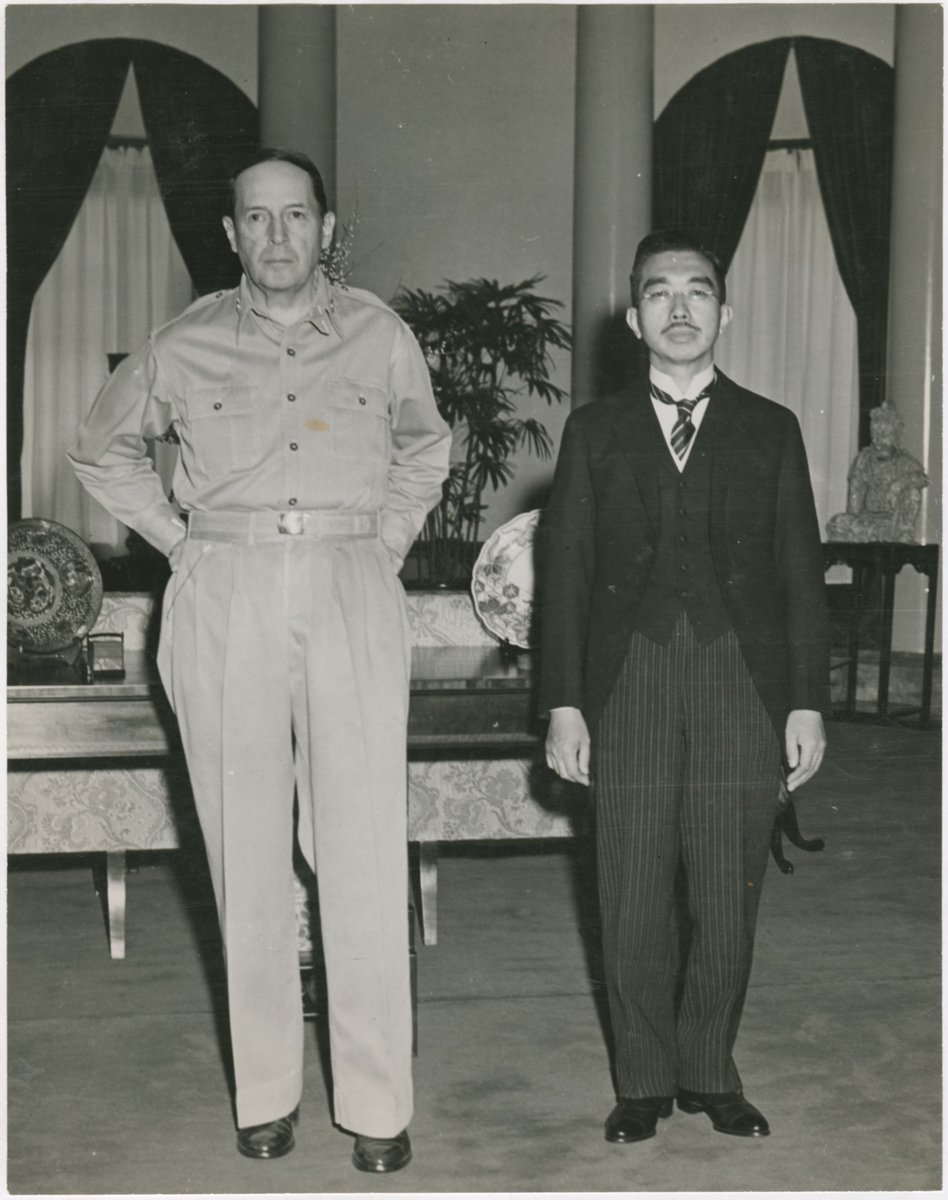
Look at the posture of the two men in this photograph, taken in Tokyo on September 27, 1945.
Twenty-five days earlier, World War II had ended. Across Allied capitals, politicians and newspapers were demanding that Emperor Hirohito be indicted as a war criminal and hanged.
When the Emperor asked to visit the U.S. Embassy in person, General Douglas MacArthur stood in an unbuttoned khaki shirt with no tie, hands on his hips. As MacArthur later confessed in his memoirs, he braced himself for an awkward plea: throughout history, conquered rulers almost always blamed their advisors and begged to save their own necks.
Everyone left the room except the Emperor's interpreter. MacArthur offered him an American cigarette and noticed the Emperor's hands trembling slightly as he lit it.
Then came the words MacArthur never forgot.
In his autobiography Reminiscences, MacArthur wrote that the Emperor told him he had come to offer himself to the judgment of the powers MacArthur represented, as the one to bear sole responsibility for every political and military decision made and action taken by his people in the conduct of the war.
MacArthur wrote that a tremendous impression swept over him, chilling the marrow of his bones. Standing before him was a man willing to lay his own life on the chopping block so his starving, bombed-out nation would not be torn apart.
In that single thirty-five-minute meeting, the Supreme Commander decided no trial would touch him. When their talk ended, breaking his own initial protocol, MacArthur personally escorted the Emperor out to his car.
Two fierce enemies walked into that room in 1945. Eighty years of peace across the Pacific walked out.