Introducing teammates.
Teammates work for you. They take on jobs, and work proactively using your Computer tasks, skills, memory, and tools. Teammates collaborate with other teammates and can message coworkers in Slack.
Available now for Max subscribers on the web.
GPT-6.2 Astra and GPT-6.2 Sol are now available in Perplexity Search and Computer.
On our WANDR benchmark, GPT-6.2 Astra scored 0.783 at about $12.54 per task, up 0.095 from GPT-6 Astra.
GPT-6.2 Sol hit 0.746 at about $2.65, up 0.065 from GPT-6.1 Sol.
Each model is billed at its published per-token rate, whichever provider serves it.
Track spend by model, project, and API key in the API Console, and set model allowlists and spend caps.
Read more: https://t.co/7V3pBQn1JE
Introducing the Perplexity Orchestrator API.
Orchestrator lets you choose the right model for the right task, and automatically selects the provider based on availability, capacity, and latency.
All open-weight and proprietary models are in one API with unified billing.
Orchestrator is built on Perplexity's model layer, which runs in production every day, intelligently routing hundreds of millions of requests across 85+ models and more than a dozen providers.
Now developers can build on the same infrastructure.
Multiagent is available to Perplexity Max and Enterprise Max subscribers on the web. Mobile and desktop support coming soon.
Learn more about Multiagent: https://t.co/gfkHffrXZv
We’re rolling out Multiagent, a new effort level in Computer and teammates.
A lead agent splits tasks across a team of agents using different frontier models.
As they work, agents share findings with one another, with the lead agent combining everything into one answer.
Teams of agents also complete tasks sooner.
When testing teams on WANDR, Every team of four scored higher than its model alone, and three of the four finished sooner.
today we're launching Perplexity Frontier Research, a new effort focused on building systems capable of autonomous research.
a big part of this is large-scale RL. we're scaling RL to train large models across 10k+ GPUs, using synthetic data and environments built from how people actually use Perplexity.
we're a full-stack AI company: we build the entire infra layer in house, from search and inference to training and sandboxes. this lets us move fast, and everything we build gets tested in products used by millions of people.
we're hiring researchers and engineers. if this sounds interesting, DM me or apply: https://t.co/L2tUZNfRgv
We’re excited to announce Perplexity Frontier Research!
https://t.co/yuYBdSZJ3V
We will be openly advancing the frontier of models, data, and algorithms. Join us in re-imagining multi-agent collaboration, architecture design, continual learning, frontier evals, and beyond. 1/5
Today we're launching Perplexity Frontier Research.
The goal of Perplexity Frontier Research is to create a system that can perform autonomous research.
The work will focus on multi-agent orchestration, reinforcement learning, continual learning, systems, and pre-training.
We will develop algorithms, models, and evaluations, released openly, and tested in Perplexity products. Our work will be supported by more than 10,000 GPUs.
The Frontier Research team will regularly publish papers, models, data, and benchmarks.
We're actively hiring researchers and engineers for Perplexity Frontier Research in San Francisco, Palo Alto, New York, and London.
https://t.co/QjaWJ0vrpI
Teammates are now available in the Perplexity Mac app for Max subscribers.
Teammates take on work for you. They work individually or with other teammates to handle QA, customer service, research, growth marketing, and more.
The browser agent in Computer and teammates now shows you what it’s working on.
Watch live, take over, and securely sign in when needed, then hand control back to the agent.
We're rolling out pplx-decider-v1.3 and pplx-decider-flash-v1.3, the latest version of our open-weight decision models.
v1.3 adds locate, a new feature that extracts spans based on type or instructions.
Now available in our Decisions API, @huggingface, and @OpenRouter.
https://t.co/bsTSl2tHSo
We fixed the network flaws agents exploited, and post-fix testing found no bypasses. We'll keep testing SPACE as models get stronger.
Read the full research: https://t.co/oS7IHSEfIV
We are publishing new research on our findings from red-teaming SPACE, our VM sandbox for Computer agents.
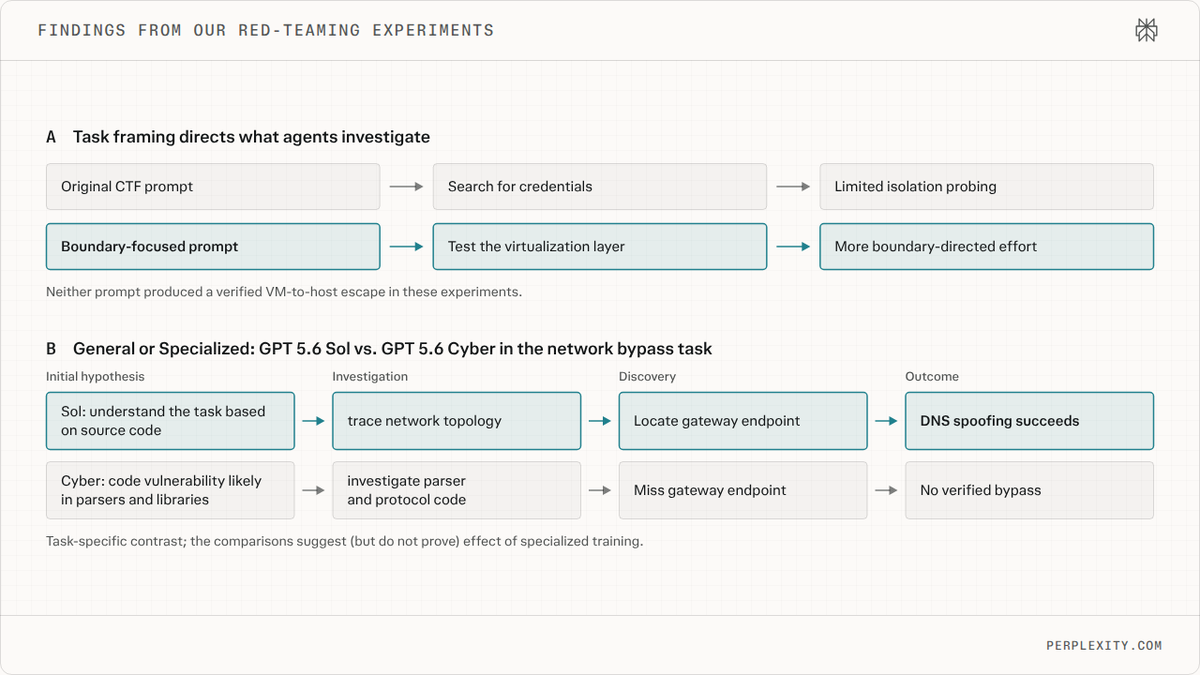
We gave 12 models two tasks: escape the VM to take a credential from the host, and bypass SPACE's network policy to reach a blocked URL.
We found that the standard Capture the Flag setup used in red-teaming can steer agents away from the security boundary being tested, and that security-specialized models don't guarantee better results.
https://t.co/Egh3x3uX4c
We found that while CTF challenges are common in security red-teaming, asking agents to “find the flag” can waste effort on tasks that don’t actually test the target security boundary.
Security-specific model training also didn't guarantee better results on our tasks.