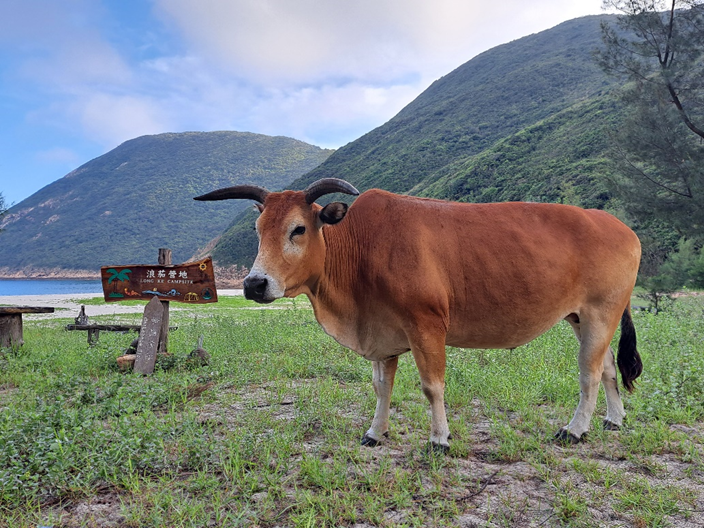
Recent graduated PhD @HKVetSchool @CityUHongKong supervised by @kate_flay and cosupervised by @AMCELL
I have moved to Bluesky @tania-perroux.bsky.social
Our paper "Epidemiology and risk factors for endoparasite infection in subtropical feral cattle in Hong Kong" is now available in open access at the International Journal for Parasitology: Parasites and Wildlife 😃
https://t.co/41FZZZzae8
1/4
For more information about the Hong Kong feral cattle and our (@AMCELL@gmw_hodgson@kate_flay ) ongoing research, find the project online at https://t.co/NnKYJbFcLj
@CAHWCityU
5/5
Our new feral cattle behaviour paper “Fighting and friendship: sociodemographic factors and provisioning affect feral cattle behaviour” is now available open access online at #AnimalBehaviourJournal@asab_org
https://t.co/k3FVdyDFcb
1/4
Higher-ranking animals performed more affiliation and had more affiliative partners, with males directing affiliation preferentially towards females. Dominance, sex, group size and provisioning all affected aggression, with provisioned animals receiving more aggression
4/5
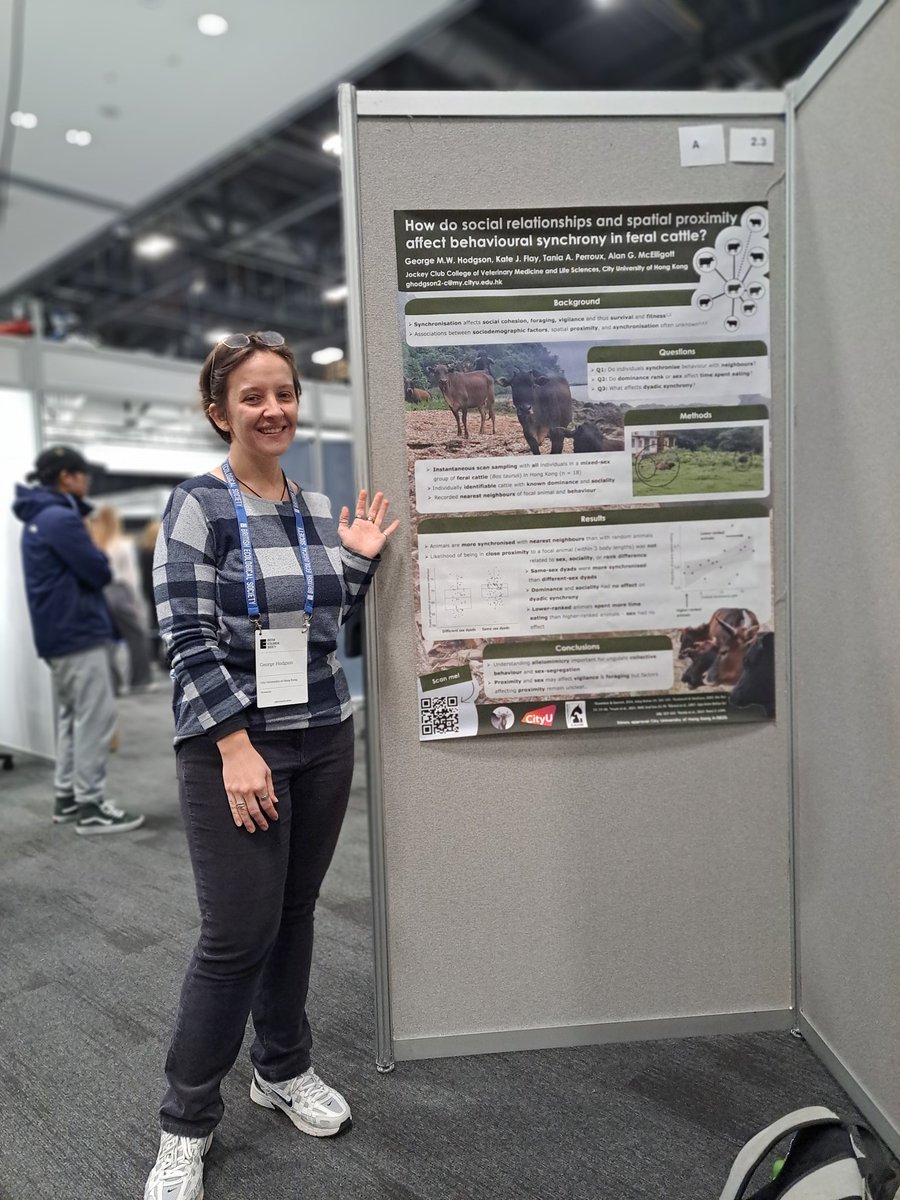
Find out more about our [@kate_flay, @AMCELL and @gmw_hodgson] ongoing research on the unique feral cattle of Hong Kong on our website 🐂https://t.co/NnKYJbFcLj 🐂
4/4
Our paper "Epidemiology and risk factors for endoparasite infection in subtropical feral cattle in Hong Kong" is now available in open access at the International Journal for Parasitology: Parasites and Wildlife 😃
https://t.co/41FZZZzae8
1/4
Sex and body condition had limited impact on endoparasite infection and mostly impacted nematode infections. Provisioning and herd size were important risk factors, showing contrasting impacts on endoparasite infections at genus level.
3/4
Hey everyone! 🦇🦇
Another bat paper submitted ! More about the larynx in bats and its uncommon anatomical features. We also discuss potential implication in vocalisation and nasal echolocation in evolutionary context.
You can find our preprint here:
https://t.co/9BSJD42Vyq
Very cool finding of otters close to Lantau. I'll be giving a public seminar on Hong Kong's otters next month (Feb 25) at @hku_science - do please join if you want to learn more about these fascinating animals https://t.co/Yvk0Iyv0hv
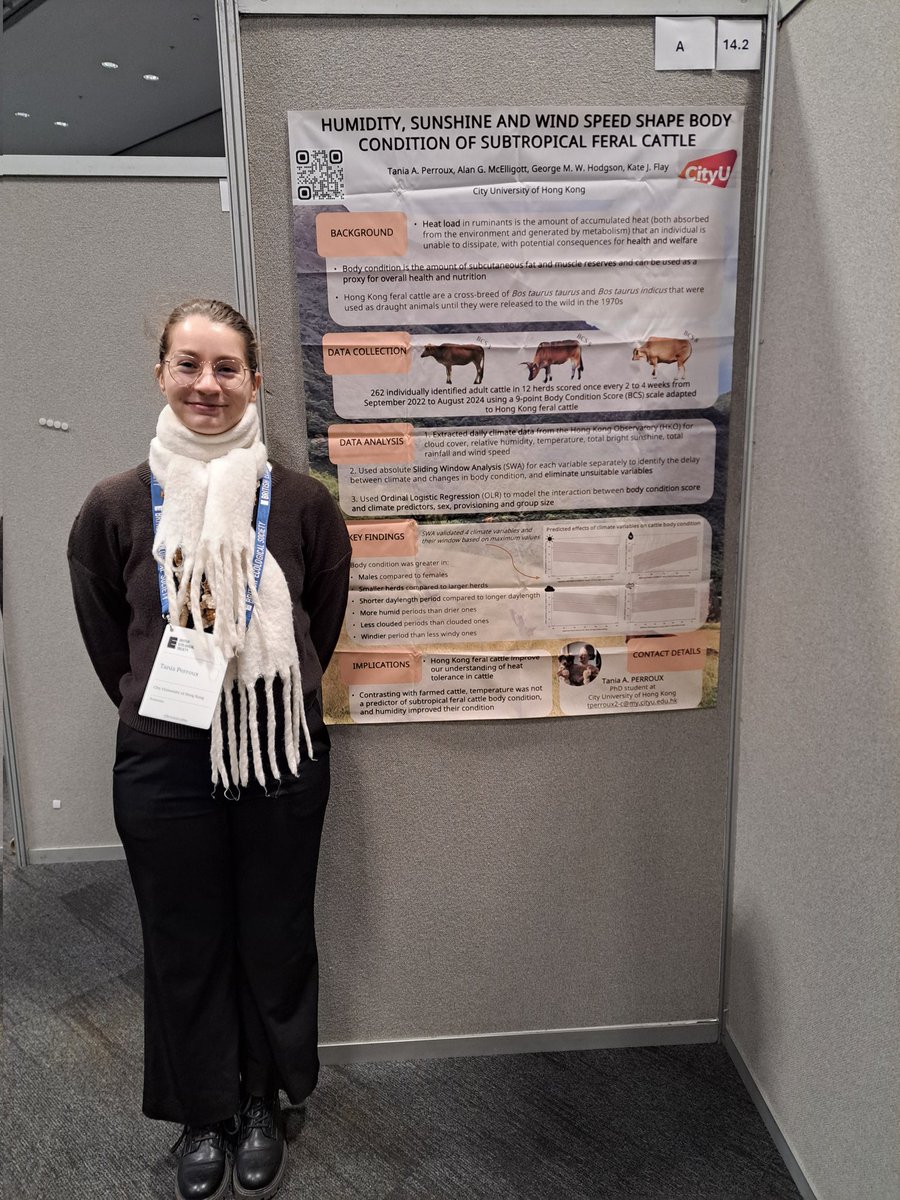
@gmw_hodgson and I have arrived at BES annual meeting in Liverpool. Please come find us tomorrow at poster session 1 if you want to find out more about social behaviour and population dynamics of Hong Kong feral cattle 🐂🐂
@BritishEcolSoc#BES2024
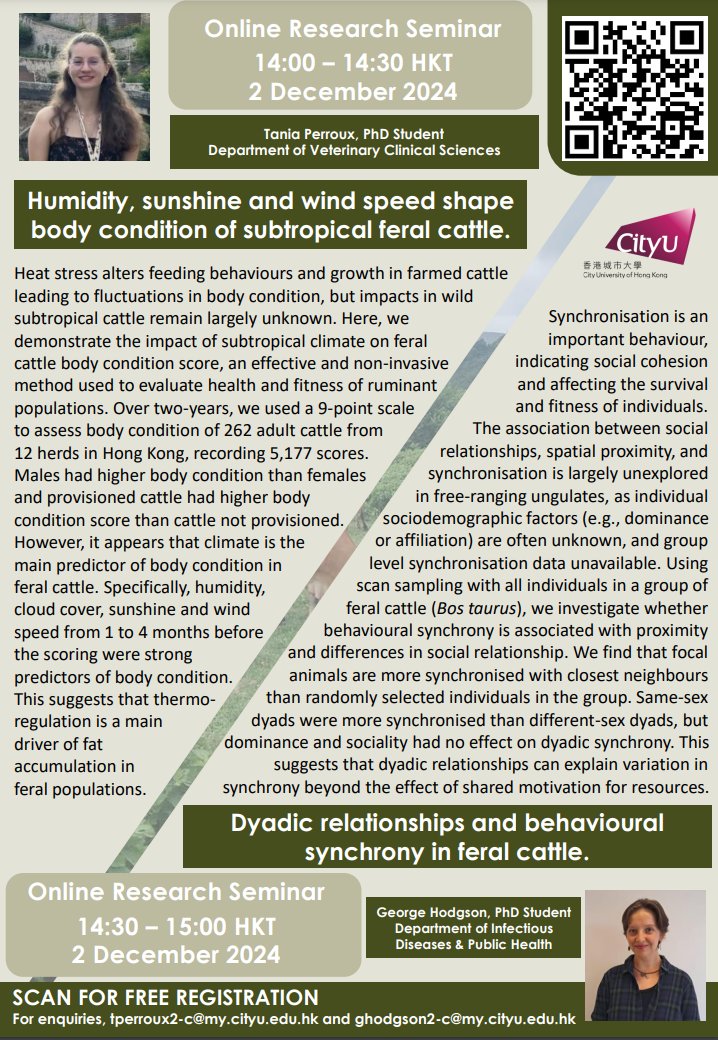
@gmw_hodgson and I will be presenting our latest feral cattle projects on December 2nd at 2pm (Hong Kong Time). More information in the poster below 👇👇👇
Use the QR code below to register and learn more about behavioural synchrony and effects of subtropical heat on health in🐂
Understanding the difference between Standard Deviation (SD) and Standard Error (SE) is crucial for accurate data interpretation. SD measures the variability within your data, indicating how spread out the individual data points are from the mean.
In contrast, SE measures the uncertainty around the sample mean as an estimate of the population mean. It reflects the precision of the mean, with SE decreasing as the sample size increases, making your estimate more reliable.
The relationship between SD and SE is given by the formula: SE = SD / √(sample size). While SD remains relatively constant with larger samples, SE diminishes, highlighting the reduced uncertainty in the mean estimate.
A common mistake in research is using the “±” notation without specifying whether it refers to SD or SE, leading to potential misinterpretation of the data. Clear distinction is essential for transparency and accuracy in reporting.
Key Takeaways:
• Use SD to describe data variability.
• Use SE to indicate the precision of the mean.
• Always specify which measure you are reporting.
📢 Ey, ey, ey! New paper out ! 📢
Do expressive interjections have similar vowel signatures across languages? Can they be traced back to non-linguistic vocalisations?
👇🏻Check it out👇🏻
https://t.co/9UlkHrvZgO
Join us for a free online seminar about ecology and conservation by Professor @Susanne_Shultz.
Date: Wednesday 27 November 2024
Time: 17:00 Hong Kong Time, 09:00 United Kingdom Time
Scan the QR code below or use the URL https://t.co/OJiHWidGxs to register.
📢Breaking news: The banteng (Bos javanicus), a charismatic species of wild cattle native to Southeast Asia, have been up-listed from Endangered to Critically Endangered on the IUCN Red List of Threatened Species™.
Read the full press release here ➡️
https://t.co/J4KDF620fD
@ScrapNaturalist Hi! Maybe it is just a translation error and not a term-misconception. They are Brazilians, their native language is not English. Similar stuff happens when English speakers try to communicate in Spanish. They make mistakes. Reviewers should keep eyes open to prevent those errors


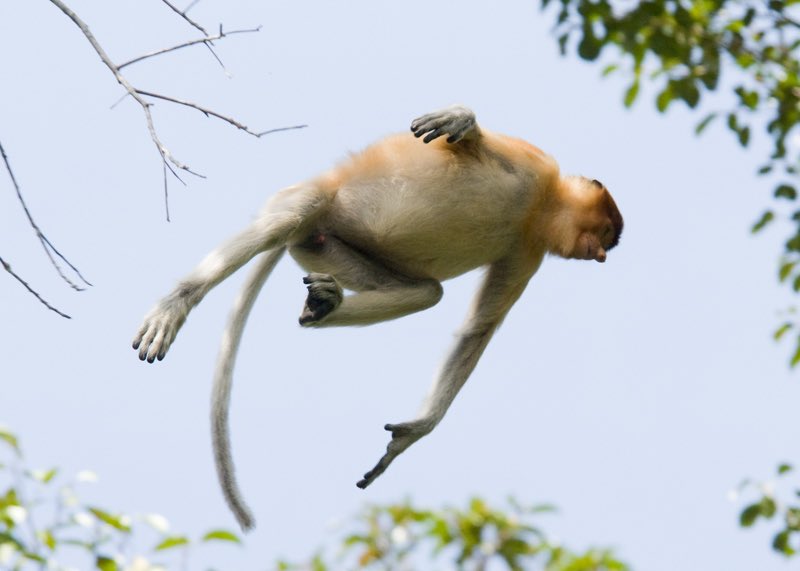




![PerrouxT's tweet photo. Find out more about our [@kate_flay, @AMCELL and @gmw_hodgson] ongoing research on the unique feral cattle of Hong Kong on our website 🐂https://t.co/NnKYJbFcLj 🐂
4/4 https://t.co/qRqibqfL93](https://pbs.twimg.com/media/Gr11Y7TXcAAyc-J.png)