Are you succeeding in a role that doesn't fit your natural style? 📷 You may be compensating instead of thriving. Explore your career strengths and find a better fit: https://t.co/tilQl0z2SU
The better question is not: “How do I get promoted?”
It is: “What am I becoming unusually good at?”
A strong career is not just a ladder.
It is a portfolio of strengths, experience, relationships, and choices that make you more valuable and harder to replace.
A promotion can improve your title without improving your career.
Your career is built on the skills you compound, the problems you learn to solve, the reputation you earn, and the environments where your strengths create real value.
Some people move up quickly and end up trapped in roles that do not fit them.
Others stay at the same level while building rare expertise, stronger judgment, and better options.
https://t.co/e7denntaJZ
Your strengths are real.
But at work, every strength has a cost if you overuse it.
Persistence can become stubbornness.
Curiosity can become drift.
Composure can become emotional distance.
Improvement focus can become endless refinement.
Ambition can become impatience.
That is why knowing your “top strengths” is not always enough.
The better question is:
How do your strengths actually behave at work?
Do they help you execute?
Think clearly?
Influence others?
Handle pressure?
Create value?
Or are some of them quietly creating friction?
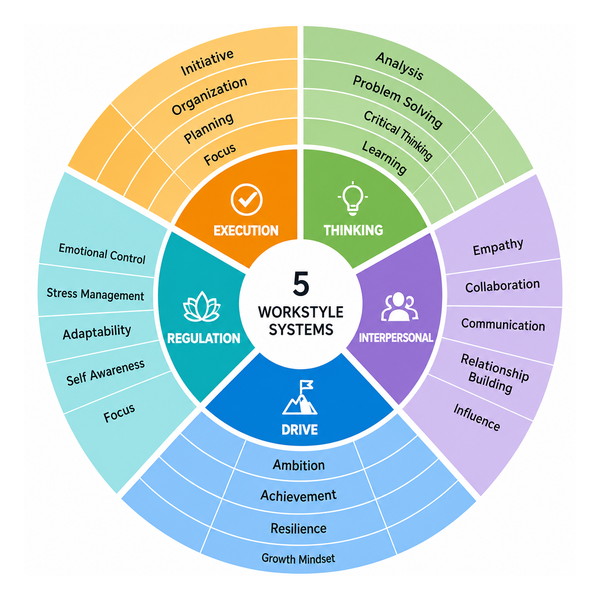
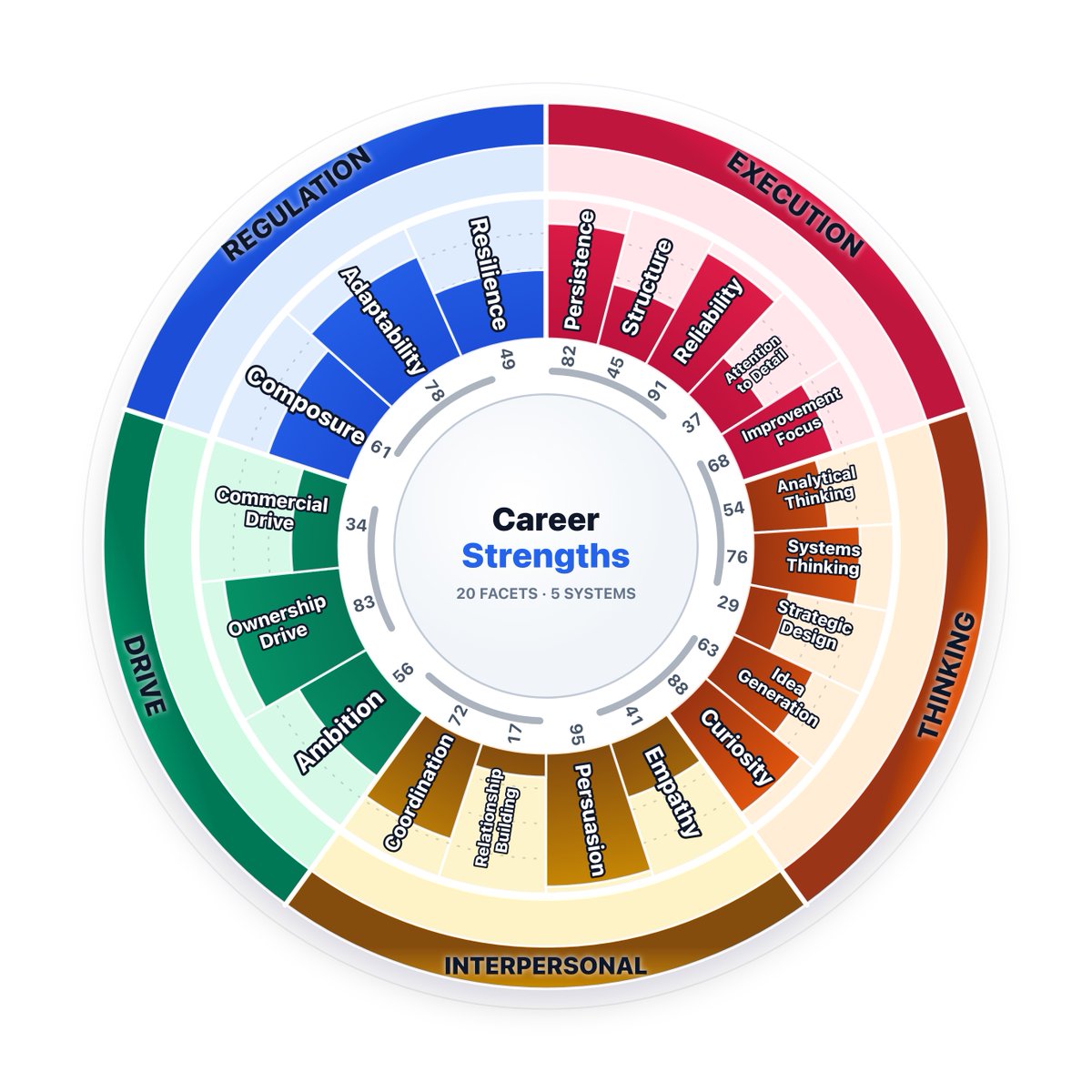
That is what the Career Strengths Profile is built to show.
20 career-specific facets.
5 work-performance systems.
A clearer map of how you work.
https://t.co/ks1h20kB4y
Your career moat is not your task list.
A task can be automated.
A workflow can be copied.
A template can be reused.
A prompt can be shared.
Your real advantage is the pattern underneath how you work.
How you think.
How you decide.
How you judge quality.
How you work with people.
How you handle pressure.
How you recover when things get difficult.
AI can produce more output.
But it does not automatically know what matters.
It does not know which trade-off is worth making.
It does not know when the work is good enough.
It does not know when refinement is useful, or when more polish is just delay.
It does not know what your team will trust.
It does not know which decision will still make sense under pressure.
That is where your strengths matter.
Your career moat is not speed alone.
It is judgment.
Standards.
Adaptability.
Follow-through.
Communication.
Recovery.
The deeper work pattern that turns tools into value.
In the age of AI, self-knowledge is not optional.
It is leverage.
AI makes average work easier.
Drafts are easier.
Summaries are easier.
Plans are easier.
Research is easier.
Ideas are easier.
But that does not make your strengths less important.
It makes them more visible.
Because when everyone can produce more output, the question changes.
It is no longer:
“Can you create something?”
It becomes:
“Is this worth trusting?”
AI can help you move faster.
But your strengths decide what matters.
Your judgment decides what deserves attention.
Your standards decide what is good enough.
Your follow-through decides what becomes real.
Your adaptability decides what survives pressure.
Your communication decides whether people trust the work.
AI made work faster.
It did not make work wiser.
That is why career strengths matter more in the age of AI, not less.
Know how you think.
Know how you execute.
Know how you collaborate.
Know how you handle pressure.
That is your real advantage.
High Openness is one of the most misunderstood career strengths.
It is not just creativity.
It is the ability to see possibilities before they are obvious.
That makes it powerful in roles involving design, strategy, research, innovation, writing, product, data, and education.
https://t.co/iOZBg9DV3e
Pressure is the only honest auditor of a strength.
Under a real deadline, a difficult colleague, a failing project: preferences fall away.
What remains is what's actually wired in.
That gap between who you think you are and who shows up under stress:
that's the most important career data you don't have.
You probably have a polished answer for “what are your strengths?”
But when did you last verify it?
Self-awareness is not just knowing your flaws.
It is knowing where your strengths live, where they show up at work, and where they start turning into liabilities.
That’s the point of the Career Strengths Profile.
A common career mistake for high-openness people:
Choosing a job because it looks “successful,” then realizing the daily work is too repetitive, narrow, or rule-bound.
Prestige does not compensate for cognitive boredom.
Fit matters.
https://t.co/wf62bZekTj
High Openness is not just “being creative.”
It is curiosity, idea-generation, pattern-spotting, and comfort with ambiguity.
That is why high-openness personalities often thrive in roles like:
UX Designer
Product Manager
Marketing Manager
Data Scientist
Instructional Designer
Content Creator
But the key is not choosing a “creative job.”
It is choosing a role where exploration is structurally useful, not quietly punished.
Best careers for high-openness personalities:
https://t.co/iOZBg9DV3e