Soudas takes each grievance at face value, then works through what separation actually does to it.
The transition plan is targeting July or August, with no public scrutiny window announced. The vote on Option 2 (the path toward a future separation referendum) is October 19.
Every grievanc is real. Almost none is an argument for leaving Canada; they’re arguments for fixing it.
We don’t fix this by walking out of the room. We fix it by refusing to leave.
So. Walk with me. Point by point:
1. Market access. You don’t have guaranteed access now, but you have it; leave and you’re a foreign country bargaining from weakness. Alberta exported ~$70B and imported ~$75B in 2024 : a net importer of the integration separation would shred. The internal barriers are absurd, but Canada is already gutting them. The One Canadian Economy Act scrapped all 53 federal CFTA exceptions in 2025, and killing the rest could add ~$200B to GDP. You don’t secede to win a fight you’re already winning inside.
2.The weak dollar. It’s ~72 US cents, but it’s a real currency backed by a central bank and a lender of last resort. Independent Alberta would have to invent a currency or adopt the US dollar and hand monetary policy to Washington with zero say. A weak loonie beats no currency at all.
3. No pipeline access across provinces. Wrong. Six crude export pipelines already leave Alberta, and the four biggest carry ~96% of everything out of the Western basin, plus the gas Mainline that’s fed Ontario and Quebec for decades. Those crossings exist today. Go foreign and a landlocked Alberta is more dependent on BC and Saskatchewan, who’d owe you nothing.
4.We pay more in than we get back. Yes, because Albertans earn more, so they pay more tax. That’s progressive taxation, including in the country you’d build. And “we get nothing back” ignores the $6.6B Health Transfer and $2.1B Social Transfer in 2025/26, plus the $75 to $100B of national debt you’d inherit day one. The math changes once you fund your own pensions, army, and currency.
5.The military is “decrepit and woke.” Stop. CAF members put their lives on the line. 158 came home from Afghanistan in coffins; others hold NATO’s eastern flank in Latvia right now, deterring Russia on your behalf. Smearing them as “woke” isn’t an argument, it’s just sad, and an insult to people who signed up to die for you. Underfunding is the politicians’ failure; the fix is investment, which NATO’s 2% push is already forcing, not building an army from zero beside a superpower you’d depend on.
6.We’re born Canadian. That’s the argument for staying and fighting for the country, not walking out. You can’t call it your country by birth and renounce it in the same breath.
7.The cost of staying beats leaving; we won’t trade liberty for safety. The evidence says otherwise. Quebec’s 1995 referendum threatened an estimated 5 to 10% of GDP; Brexit cut UK investment 11% over three years and produced six PMs in a decade. Separation isn’t a tidy political event, it’s a financial shock: capital flight, investors pricing in instability, companies leaving. A self made recession isn’t liberty.
8. Trade deals are falling apart. They’re under strain for Canada, a G7 economy of 40 million with a seat at the table. Canada is in the G7. Alberta would not be. You forfeit the seat, the voice, the leverage, then renegotiate every deal from scratch from weakness. A small, landlocked, single resource economy is the textbook price taker.
9.Liberal appointed judges, no say. A reform argument, not a secession one, and you do have a say through MPs, the Senate, and the amending formula. An independent Alberta would appoint its own judges through whoever runs Edmonton, with no Charter and no Supreme Court of Canada backstop. You’d trade judges you can vote against for judges you can’t.
10.We’re culturally different. Distinct identity never required a passport. Quebec protects its culture inside the federation, with more leverage than outside it. If family bonds survive separation, separation wasn’t protecting them; if a hard border and a foreign currency strain them, you’ve argued for staying.
Alberta would be the 125th largest country, economically, in the world if it was to become a sovereign nation, experts say, adding it could affect business investment and jobs: "No diversification of risk, no ability to share costs."
#yeg#ableg
https://t.co/WA4Rp6UGbd
The more freely Canadians can live, work, and do business across the country, the more the value of the federation shows up in ordinary life.
My latest on how doubling down on Canada's economic union might help with separatism: https://t.co/HQYgz9BLwa #cdnecon#cdnpoli
Gunter calls Alberta separatists' response to cost issue flippant, lacking facts. If it's "obviously a lot less," show us your numbers and how you arrived at them.
Quebec separatists had flawed numbers, but they had numbers. The APP's response to a $400B cost estimate was "who cares, let's go."
The APP's next finance analysis lands in August, vote is October 19 — that's roughly six weeks.
Albertans will have about six weeks to scrutinize the next half-assed estimate before they vote.
"One thing about the attitude that APP has demonstrated since they began their campaign for a referendum on separation is their naive insistence that the process after a winning vote would be easy."
https://t.co/7hVBesyQbo
Fair to treat CEO letters skeptically.
But Wilkinson was saying the same things publicly on the record. January 28, 2020 — three weeks before Lindsay's letter — he told reporters the cabinet decision would weigh Alberta's climate plan and that "what we're looking for is concrete action on climate change."
At COP25 in December he called it "entirely appropriate" to weigh Frontier's emissions in the approval decision.
And Trudeau himself, on the record: "We can't shut down the oil sands tomorrow. We need to phase them out. We need to manage the transition off of our dependence on fossil fuels."
That's the policy environment Lindsay was reading. Albertans who lived through it know it wasn't spin.
Andrew you're right that Teck wasn't getting to a final investment decision on Frontier in February 2020.
But the economics weren't what killed it. Lindsay's letter didn't mention economics once, nor did the Annual Report.
The month it went out, rail lines across the country were blockaded. Larry Fink had just told every CEO in the world that oil sands were a climate liability. 63% of Canadians said environment beats economy.
The Joint Review Panel had approved the project. Federal cabinet was weeks from ruling. Teck walked away anyway — writing down $1.13 billion and closing one of its business units because Lindsay looked at that room and concluded there was no constructive path forward.
He was reading the room accurately. The project died.
Then something changed. Trump showed up. Tariffs arrived. Suddenly 79% of Canadians want pipelines coast to coast. BC opposition to Northern Gateway dropped from 57% to 32%. The man who launched the ESG era was calling the term "loathed" three years later.
Alberta's grievance was real. The rest of Canada spent years signalling that our industry was a problem to be managed, not an asset to be developed. That signal had a body count — in write-downs, in closed offices, in people who lost their jobs.
What changed that wasn't a referendum. It was pressure inside Confederation, applied until the political cost of ignoring Alberta exceeded the cost of dealing with us.
The emissions cap is gone. The pipeline framework is signed. Industry CEOs are pre-ordering equipment and talking about a return to mid-2000s conditions.
Fair on Fort Hills economics. Teck put in roughly $3B and got $1B back — management had a front-row seat to exactly what an overpriced, underperforming oil sands mega-project looks like. That context matters.
But Lindsay's letter doesn't mention Fort Hills or oil prices. It names the policy environment explicitly — the unresolved debate about whether Canada would permit this category of development at all.
A $20.6B commitment over a 41-year mine life isn't priced at the spot price in February 2020. It's priced on where you think the regulatory framework will be in 2035 and 2045, and whether you believe the federal government will still permit the project to operate.
Mining companies are built for commodity cycles. A mine that's marginal at $65 oil can cover its entire capital cost in a single supercycle — anyone watching the Strait of Hormuz right now understands that. What you can't price through is a government that might decide mid-cycle that your asset is a climate liability.
The Fort Hills comparison actually illustrates the problem. Fort Hills was approved into a different policy era.
By 2020 Teck was being asked to bet $20.6B on a government that had just spent four years signalling it viewed the oil sands as the problem, not the solution. Lindsay said as much in the letter. The economics were marginal — and Ottawa made the non-economic risks unquantifiable on top of that.
It’s all talk. Just withhold foreign aid to Israel for a month and they’ll stop bombing their neighbors - instant peace, the Strait of Hormuz can be opened, and gas drops $2 a gallon. Israel has been, and continues to be, the biggest welfare recipient from American tax payers.
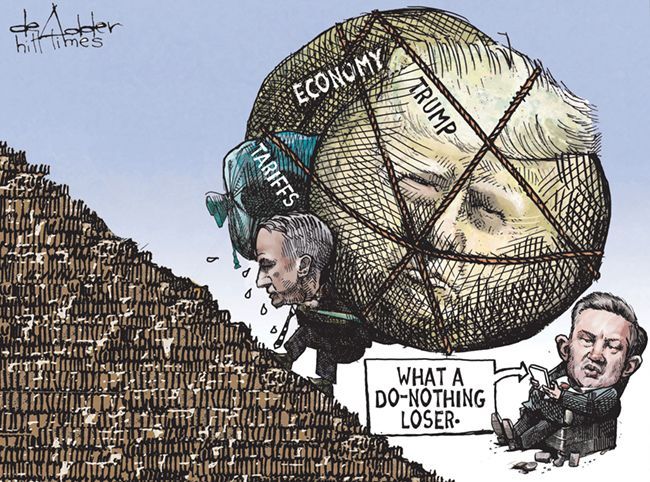
Why blame Trump?
Exports fell 0.5%, led by passenger cars and light trucks -> US tariffs. Dominion Lending.
Business capital investment fell for a 5th consecutive quarter, largely chalked up to uncertainty surrounding US tariffs. BNN
Residential investment contracted 7.9% and non-residential structures dropped 10.2%. Both consistent with businesses refusing to build for a US market that might be tariffed tomorrow. Desjardins
Exports / auto sector tariff damage: https://t.co/rUCE8ZWW5v
Business capital investment (5th consecutive quarter): https://t.co/wRTe4tYigh
Residential and non-residential investment contractions: https://t.co/tijjpmuqN5