Attorney, Programmer, and Independent Scholar
Founder, Founders' Quadrangle — an unincorporated association exploring possible Universities of the Future.
Marty Sklar proposed something radically different for the windows on Main Street in WDW than the tribute tradition in Disneyland. He was denied by Roy (for a very meaningful reason), but I love that some of his ideas were still integrated with fictional proprietors.
BELL LABS
Bell Labs in Holmdel, New Jersey opened in 1962 and quickly became one of the world's leading research centers.
Thousands of scientists and engineers worked here, helping develop technologies that shaped the modern world.
You are using dozens right this second.
I had the privilege as a kid to spend some of the 1970s in this place. I can’t put into words the electricity I felt each time I was there. It bristled with intellectual and engineering brilliance. It helped shape my research and experiment first, go to market later or never lifestyle for worse or for better (ask me in a few decades).
I met 100s of folks that just got paid to think. To just think about anything and build it or research it.
It was THIS and only this where generational shift changes take place.
None of the folks that tolerated my machine gun of questions had anything but love for thier life and what they did.
I have never been in a place like this since.
The best startups in the world hav pressure to go to market. Or prove to some committee. It was a moment when a forced monopoly caused a rip in the fabric of reality and made this model work. The funding and the thinking was to pay back humanity for the opportunity they were granted.
In my late teens I dated the daughter of the Chief Patent Attorney for Bell Labs and got super chanted on understanding the patents and how to find them in research libraries. This opened doors up to many opportunities in my life.
I got to see the future we live in today before Nixon was president.
We suffer from very short term thinking today and we suffer from the consequences of believing innovation only comes from a Stanford University dropout.
Before the government broke them into shattered pieces innovation was bubbling up by all ages and sexes one of the biggest was a goofy guy in his late 60s that owned no shoes and had a gray ZZ Top beard. He would take me from office to office and brainstorm. It apparently was his job. But I don’t think anyone had a proper title. He had no degree. But everyone stopped when he entered and in 29 minutes he would help solve the problem of the week.
I miss the promise and possibility.
I miss the many brilliant minds.
I miss this place.
@dylanmalone@Savethedmagic@JennyENicholson We just need to jam WiFi and Cellular in the show building and give guests something interesting to watch. It beats doom scrolling in a queue from hell for a no-time-flat in-and-out.
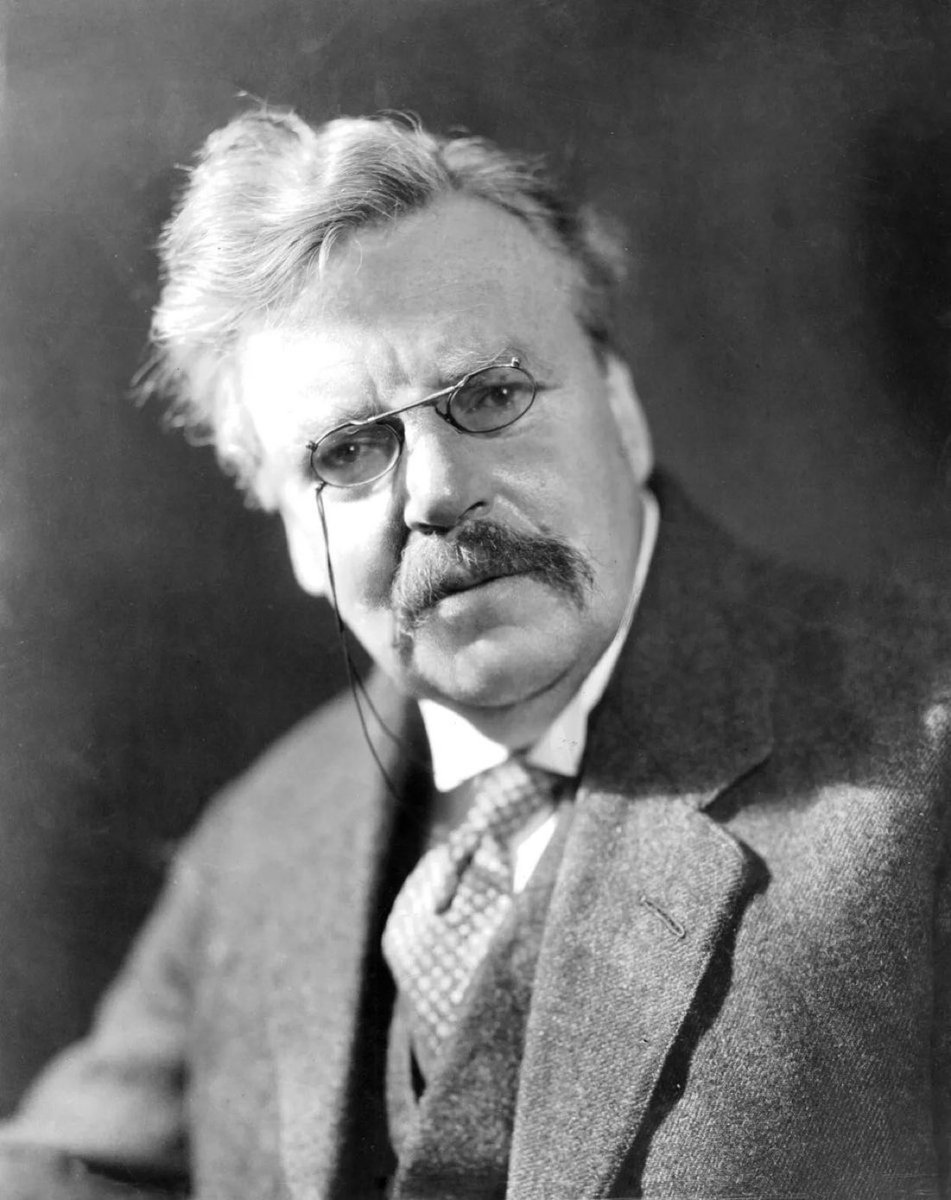
“A man who has read a thousand books is armed for life; a man who has read none is easy prey. The man who has read a thousand books has lived a thousand lives. He has seen cities he has never visited, spoken to men who died centuries ago, and walked in worlds that no longer exist. Reading does not merely inform him; it enlarges him. It stretches the boundaries of his own experience until he becomes something more than himself.”
-G. K. Chesterton
Walt Disney had a hard time resting. He suffered from insomnia, and his wife Lillian often found him late at night pouring over scripts instead of sleeping. He didn’t like weekends or days off from the office, and holidays weren’t his favorite because he couldn’t work.
I’m so serious that I think they should use this as an opportunity to send components of the original back to Anaheim and have two shows.
Disneyland gets Walt’s Worlds Fair version (1900s-20s-40s-60s) and Disney World gets its Horizons-esque sequel (1960s-80s-2000s-future).
@dylanmalone@Savethedmagic Walt would have gone with @JennyENicholson and added a second story to extend the ride with a hidden lift system to jack the audience up a level to rotate through the additional decades.
@JennyENicholson 💡The entire point of the ride was to start with electrification as the technological baseline; starting in the 60's unroots the experience. They should have made convertable dual scene sets or hot-swappable scenes to extend and lengthen the show.
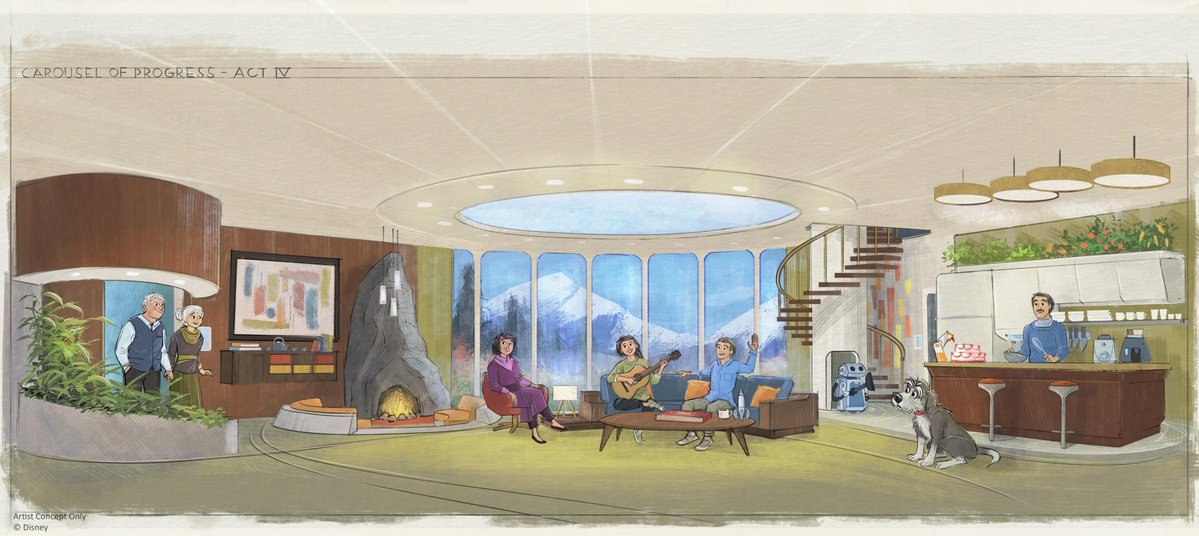
The idea of a totally new animatronic show is pretty hype but the idea of totally scrapping the existing Carousel of Progress is pretty sad, especially on such extremely short notice. Hope they don't do the Disney thing where they scrap the current and then cancel the replacement
Amazing how much Eisner era resort atmosphere still defines what makes WDW special. Disney hasn't built anything like this in a very long time, outside the parks. You can visit for free and just enjoy it even if you're not a guest. They don't do this anymore, and it's a loss.
Walt Disney’s Carousel of Progress is headed towards a Great Big Beautiful Tomorrow ✨ You'll get to see John, Sarah and the whole family experience new decades, when the attraction is updated at Disney World in 2027 🗓️https://t.co/pRz5KCMqy8
I’m making a show about buildings.
The concept is simple: do for the man-made world what Planet Earth did for the natural world.
But, when I pitched the idea, the answer was that nobody would watch it.
So I released a pilot episode on YouTube. It’s got 5.4 million views, 379k likes, and 23k comments.
People are interested, and now it’s time to make the full show.
Six episodes, filming in the UK, France, Belgium, Germany, Italy, and the USA, and releasing on a streaming service like HBO, Netflix, or Prime.
Why does this show matter?
First: we’re surrounded by buildings all the time. Look around yourself, right now… what do you see? Buildings are the logical conclusion of everything a society believes in. That’s the real focus of this show: not the buildings themselves, but what they say about us.
Second: there’s global dissatisfaction with modern architecture. This feeling gets written about online, but nobody’s given a voice to it on film or TV. That’s what this show will be. But this isn’t just about criticising modernity. That’s easy. This is about learning from the past in order to understand and improve the present, for everybody.
Third: there’s a drought of high-quality culture shows. When I spoke to film executives they said that only documentaries about sports, music, or true crime get funded. That’s a colossal missed opportunity. Galleries are always full, content about architecture goes viral online all the time, and people spend their precious holidays visiting beautiful cities.
Why no shows about architecture, then?
Tourists flock in their millions to see (for example) the buildings of Antoni Gaudí in Barcelona. But, if you asked those same people if they’re interested in “architecture”, they’d probably say no.
To put that another way: not many people want to watch “a show about architecture”, but lots of people want to watch a show that illuminates the real world they’re living in, each and every day.
What will the show be like?
Six episodes, going chronologically through history and arriving at the present, each focussing on the architecture and design of a specific period:
1. Middle Ages
2. Renaissance
3. Enlightenment
4. The Nineteenth Century
5. Art Nouveau & Art Deco
6. Present Day
But, in each case, the point isn’t just to learn about that era; the point is to learn about our modern world through those eras and what they’ve left behind. If you watch the pilot episode (included below) you’ll see what I mean.
So the show’s not really “about” the past; it’s about the twenty-first century.
That’s why it’s called The Modern World.
When you think of a typical history show there are loads of interviews, stock footage, archive photos, historical recreations, and graphics. We’re doing none of that. Everything will be filmed on location, because we’re telling our story only through the real world that exists right now. And, rather than going to the most obvious places, we’ll focus on buildings that aren’t well-known but should be more famous.
But that’s all big picture; what will it be like on screen?
Buildings used to look different in every country, and now they look the same. Why? Because the weather is different everywhere, and buildings were always a way of dealing with that weather, using local materials. Now we have air conditioning and we ship concrete around the world, so we don’t need to design our buildings with regard to local weather or rely on local materials.
Look at really old clocks and you’ll notice something: they don’t have a second hand… because it was only invented 300 years ago! Then you look at the present and you realise we’re surrounded by timers, by seconds ticking down and ticking up relentlessly. If we’re looking for a cause of our anxiety-inducing culture, that might be it.
When you spend time with the sun-softened bricks and time-warped timbers of old cities you notice that synthetic materials like plastic have taken over. When we’re surrounded by things that feel temporary, how do you think it makes us feel?
It’s only by seeing 19th century train stations, designed like cathedrals, that you realise tradition and technology aren’t enemies. New things don’t have to look boring: if the Victorians had designed AI data centres, they’d look like Medieval castles.
In the 1920s, at the zenith of Art Deco, people believed technology would uplift humanity. That’s why they decorated their buildings with statues inspired by electricity. Only by seeing their enthusiasm can we realise our own cynicism, and perhaps begin to fix it.
All of that… and much, much more.
But, above all else, this show is about a way of seeing. If you want to understand any society then you need to look at what it creates, not what it says about itself.
There’s a worldview in every single object; our skyscrapers are designed the same way as our phones. Learn to look at this world, to notice its details, and everything else starts to make sense.
What now?
I’ve been quiet online recently because I’ve been researching and working on scripts for six full-length episodes. Production begins when we’ve raised the funding.
The Modern World is coming.
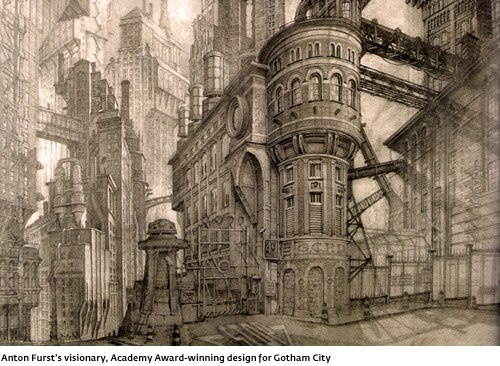
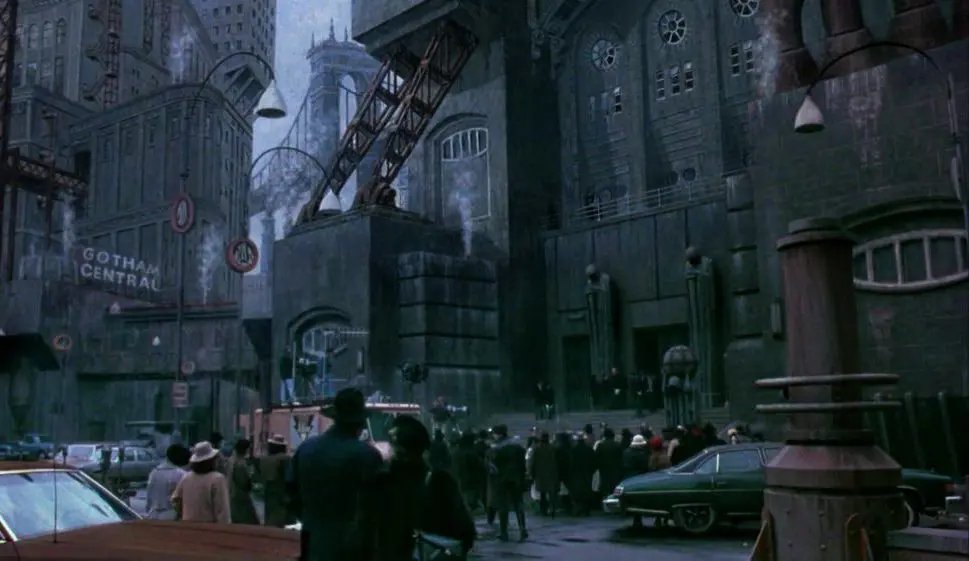
the rat-maze suffocating Art Deco Metropolis nightmare of Anton Furst really gave Schumacher a rich palette to draw from. for Gotham City you can describe its existence as a character as pre-Furst and post-Furst
Inside the Art Nouveau apartment house of architect Alexander Khrenov in St. Petersburg, built in 1909, this ornate iron elevator still turns a simple stairwell into a theatrical architectural moment.
This is the best preserved medieval street in Europe.
Recorded in the Domesday Book of 1086, The Shambles in York, England has had shops trading on it for nearly a thousand years. It's older than the Crusades.