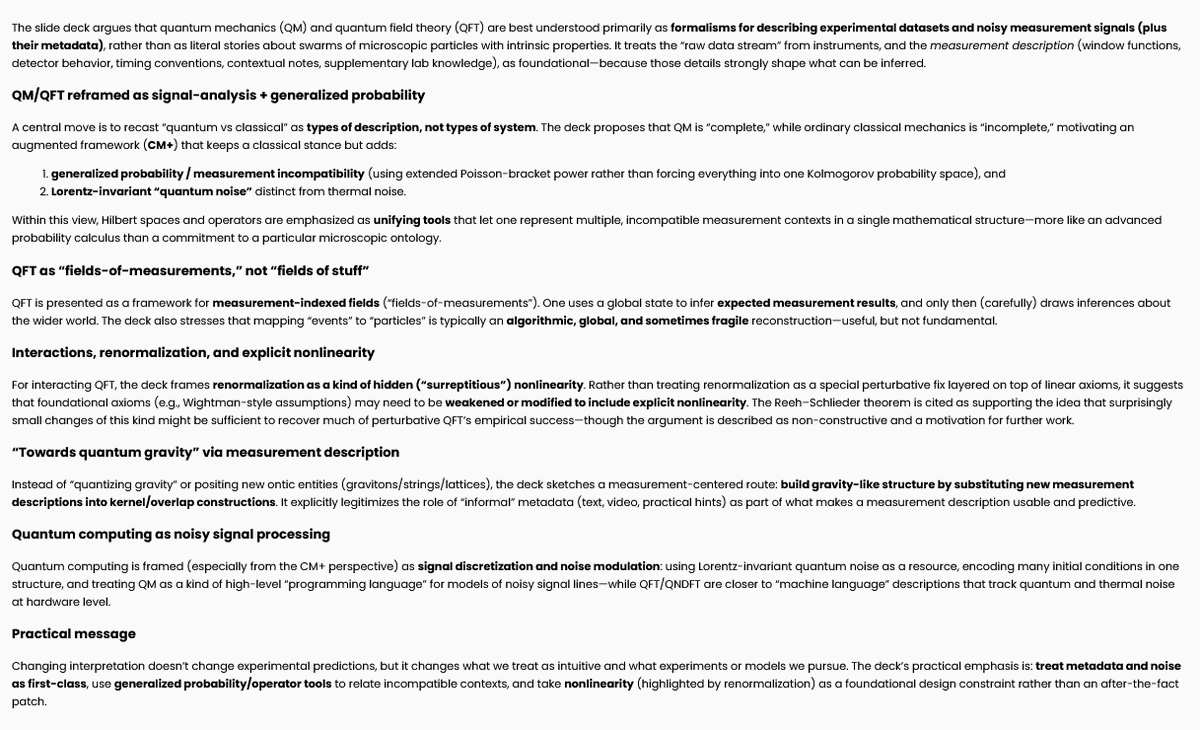
For those with less than 3h26m20s available (or ½ that at 2×), this is ChatGPT-5.2's summary of the discussion in the slide deck for my long-form video posted on April 28th, https://t.co/WrjxOJC0KN
Not what I would say, but does that matter? It hits some points ~OK~.
@0FreeRadical0@OdedRechavi Slapped-together PhD theses should be discouraged because they give less for later generations of PhD students (&LLMs) to learn from.
I think of resilience as a hard-to-define emergent trait in a wide field, so, yeah, I suppose LLMs will come to it only later or never.
@OdedRechavi@0FreeRadical0 A PhD thesis often gives more indication of what went wrong before it went right than the manicured lawn that is a published article. Surely LLMs have read many of them.
@InuitKodiak Perhaps a light at the end of a wooded tunnel might work as a cliché'd part of a prompt? I use the attached image on FB, which I partly intend to suggest a walk&talk together (though with only a dog, unseen here, when I took this photograph in East Rock Park, New Haven, in 2011.)
@InuitKodiak@ae_stallings The clouds are identical shapes in those two images. My hopes are not high, but I haven't yet seen a real 'after' photograph.
@melinda_esen Alt: Am I climbing a mountain for the world to see my photographs?
Will I tell too many stories about it?
Or will it be an unspoken part of me?
Balance is more difficult after a peak.
@qm_charge Exactly how we should construct a Generalized Probability Theory seems not completely settled in the literature, (I take 'Causal Modeling' to be a practical kind of GPT, for example) but I think there are not big enough differences that it's a problem for our discussion here.
@qm_charge + For sharpness for a single measurement, I suppose variance=0 is enough. For sharpness for multiple measurements, we can consider HUP and other more complicated properties of the joint generalized probabilities, so, yes, I think it's not quantum.
@qm_charge I'm not sure what "get the same result"(𝕏's translation) means here? If, for example, we record experimental data to memory in two computers and we later find that there's a difference, we will have the pragmatic issue of how to recover from that data corruption. +
@qm_charge We can surely use the concepts of PVMs, POVMs, and quantum channels as linear algebraic structures, but it's not perfectly clear how they relate to real-world measurement *insofar as* there is still a 'measurement problem' (not everyone thinks that is a problem, but some do.)
@qm_charge To speak of "a PVM measurement" is already quite deep into the language and mathematics of QM, without an immediately obvious relationship to how we use an experimental apparatus.
[ I would be happy to see an alternative to "sample space of a dataset=spectrum of an operator". ]
@qm_charge By 'sharp measurement', do you mean what in probability theory is called an 'outcome', like one throw of two dice getting🎲+🎲? That has probability 1/36, though for 100 throws the actual relative frequency might be 4/100...
For QM, outcomes are recorded in exactly the same way.
@qm_charge Physical Quantities are usually associated with Particles in QM, but I prefer to think of Measurements as associated with Datasets, so we can exactly equate two SETS,
a sample space of values in a dataset = the spectrum of an operator.
Particles&their properties are complicated.
@evalladen The connotations of con-trick etc make condividual wordplay badly, IMO. 'Divide' also works hard against what I take to be the intended meaning of con- as together-as-a-group.
I couldn't think of a better word myself, but to me 'ensemble' leaps out of this suggested list:
@evalladen Consensus reality ⟷ institutional reality. As a consensus builds, it creates institutions (such as new publishers and financial instruments) that make it more worthwhile for new adherents to develop the ideas more fully. A consensus gradually gets more real in multiple ways.
@martinmbauer "The deep insight in QM [is] that everything can be described by a wavefunction" might be better said as "A deeper insight in QM ...".
We might also say that "everything" is only all the data we have —so far— and that "described" is only a worthwhile step towards "explained". +
@heeney_luke "Measurement theory", not "quantum physics". HUP is just mathematics: any measurement theory can usefully include linear algebraic models for sample spaces & actual&expected relative frequencies associated with noisy measurements & their incompatible experimental/found contexts.+
@martinmbauer + But, yeah, HUP is just mathematics, and any measurement theory can usefully include linear algebraic models for the sample spaces and actual and expected relative frequencies associated with noisy measurements and their incompatible experimental or found contexts.
@martinmbauer "The deep insight in QM [is] that everything can be described by a wavefunction" might be better said as "A deeper insight in QM ...".
We might also say that "everything" is only all the data we have —so far— and that "described" is only a worthwhile step towards "explained". +
@melinda_esen Grok gave what seemed to me a worthwhile reply to a query (which came after asking Grok to explain your post), https://t.co/lGWJXxMM7p
Initiating discourse with Grok instead of with Plato is the lesser form, but it is more informed than discourse with only me.