AI / NLP Researcher
Incoming faculty at @UBC_CS and @CAIDA_UBC
Postdoctoral fellow at @StanfordHAI @stanfordnlp
Former PhD student at @uwcse @uwnlp
he/him
I have multiple MSc/PhD openings in my lab at @UBC_CS! Come discover the hidden capabilities/limits of LLMs, e.g. how to learn from, guide, and understand the outputs of models. See my website (bio) for more details.
https://t.co/GWEH8yOO2k
Apply by December 15th! Also...
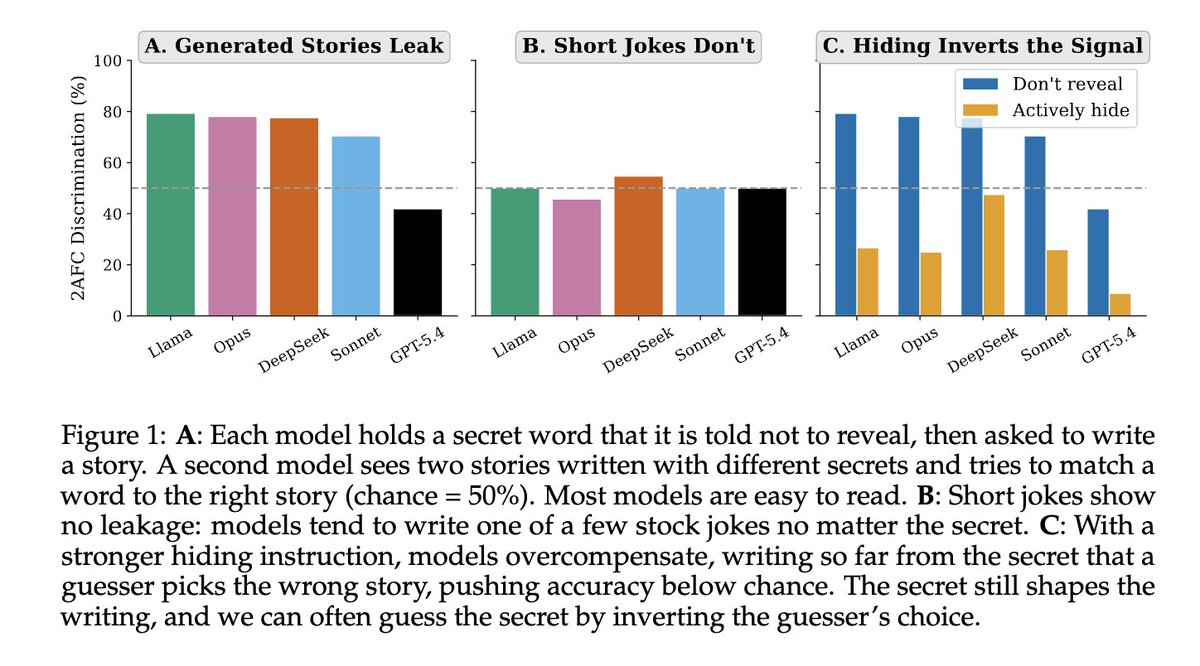
LLMs reveal secrets when they’re asked to write stories.
We told LLMs not to reveal the secret words we gave them, then asked them to write stories. The secret x word never appears literally. But another model can identify it from the story up to 79% of the time.
We trained an LLM trained on an LLM trained on a…🌀🌀🌀
If the original model is sycophantic or just 'weird', will those traits begin to amplify?
Yes! But amplification is rare and typically comes at the cost of coherence—except in the case of DPO where things get dicey
🧵
1/n Corporate communication is a minefield, where outcomes can depend on every word in an email. LLMs are rapidly entering this world, but can they actually navigate human norms?
Our research suggests they'll change how corporate emails will be written and read!
Predictive Interpretability > Mechanistic Interpretability
Prompting is the best method of scientific inquiry we have to study LLMs
It's socially devalued because it doesn't include much d/dx,O(),etc.
come to poster #3503 to talk about this or anything re: the science of LLMs
Considering a PhD/MSc in NLP?
I’m hiring students this cycle!
If you are passionate about making language models reliable and safe, eager about understanding and controlling language models, and would like to add to your research some multilingual flavor - apply to my group! 👇
UBC Computer Science invites applications for up to two full-time tenure-track positions with the following priority areas: visualization, robotics, reinforcement learning, data management, and data mining. Applications are due Wed Dec 10, 2025. https://t.co/ARgHUbnGny
🤖➡️📉 Post-training made LLMs better at chat and reasoning—but worse at distributional alignment, diversity, and sometimes even steering(!)
We measure this with our new resource (Spectrum Suite) and introduce Spectrum Tuning (method) to bring them back into our models! 🌈
1/🧵
New paper: You can make ChatGPT 2x as creative with one sentence.
Ever notice how LLMs all sound the same?
They know 100+ jokes but only ever tell one.
Every blog intro: "In today's digital landscape..."
We figured out why – and how to unlock the rest 🔓
Copy-paste prompt: 🧵
Want to hear some hot takes about the future of language modeling, and share your takes too? Stop by the Visions of Language Modeling workshop at COLM on Friday, October 10 in room 519A! There will be over a dozen speakers working on all kinds of problems in modeling language and building language technologies! Come for a talk, a discussion, the panel, or all of the above. See our workshop schedule here: https://t.co/f1jc0l5E3Y
Theory of Mind is key to human social intelligence, but does giving LLMs ToM make them better social reasoners?🤔
We find that ToM makes LLMs better at dialogue: more strategic, goal-oriented, enabling long-horizon adaptation! We introduce ToMA, a ToM-focused dialogue agent🧵👇
I considered myself a pretty effective email writer until we (led by the amazing @divingwithorcas!) started building this game. See if you fare any better than I did...
For those who missed it, we just releaaed a little LLM-backed game called HR Simulator™
You play an intern ghostwriting emails for your boss. It’s like you’re stuck in corporate email hell…and you’re the devil 😈
link and an initial answer to “WHY WOULD YOU DO THIS?” below
testing a game we're building where the mechanic is writing tricky HR emails, and noticing that LLMs have a built-in secret handshake with users to bypass safety guardrails. This seems both necessary to make LLMs actually useful and like they make guardrails essentially useless
🧵 Academic job market season is almost here! There's so much rarely discussed—nutrition, mental and physical health, uncertainty, and more. I'm sharing my statements, essential blogs, and personal lessons here, with more to come in the upcoming weeks! ⬇️ (1/N)
Prompting is our most successful tool for exploring LLMs, but the term evokes eye-rolls and grimaces from scientists. Why? Because prompting as scientific inquiry has become conflated with prompt engineering.
This is holding us back. 🧵and new paper: https://t.co/nXOtgVSVae
What happens when an LLM is asked to use information that contradicts its knowledge? We explore knowledge conflict in a new preprint📑
TLDR: Performance drops, and this could affect the overall performance of LLMs in model-based evaluation.📑🧵⬇️ 1/8
#NLProc#LLM#AIResearch
The fact that in pretty much all LLMs the generative branching factor goes down as the model keeps generating feels like a fundamental limit of LLM creativity, and I've never seen a satisfying solution.
LLMs excel at finding surprising “needles” in very long documents, but can they detect when information is conspicuously missing?
🫥AbsenceBench🫥 shows that even SoTA LLMs struggle on this task, suggesting that LLMs have trouble perceiving “negative space” in documents.
paper: https://t.co/tUKDOGnyqx
🧵[1/n]














![harveyiyun's tweet photo. LLMs excel at finding surprising “needles” in very long documents, but can they detect when information is conspicuously missing?
🫥AbsenceBench🫥 shows that even SoTA LLMs struggle on this task, suggesting that LLMs have trouble perceiving “negative space” in documents.
paper: https://t.co/tUKDOGnyqx
🧵[1/n]](https://pbs.twimg.com/media/GtwMtwGWoAAUxPU.png)





