The OI surge on $SAHARA is extreme at 3.27 sigma. New longs are entering with price rising, and volume confirms participation. The structure shows a 1:1 risk-reward to T1 and 1.7 to T2. If price holds above entry, the long bias remains intact. Invalidation at 0.03657 is the key level.
Positioning on $CAKE shows bearish conviction: OI surging 5% while price drops 1.2%, Z-score extreme at 3.94. Volume confirms participation. However, low OI ($2.3M) questions the significance. The structure favors shorts unless price reclaims 1.268. T1 at 1.225 aligns with the bearish bias. Watch for volume fade to signal exhaustion.
$BSB's OI build is statistically extreme with a Z-score of 3.48, driven by new longs. Price rallied 5.3% on 2.82x average volume, confirming conviction. Funding is neutral, so the positioning is not yet crowded. The structural question is whether this move can sustain above the entry level of 0.2849. A break below 0.2576 invalidates the setup.
The $HYPE ETF launch saw record revenue metrics, but the real story is the liquidity exit by authorized participants and Arthur Hayes reducing his $18m position after a public $100k bet. This suggests the structural narrative is more about positioning than adoption. Traders should weigh the ATH revenue against the insider flow.
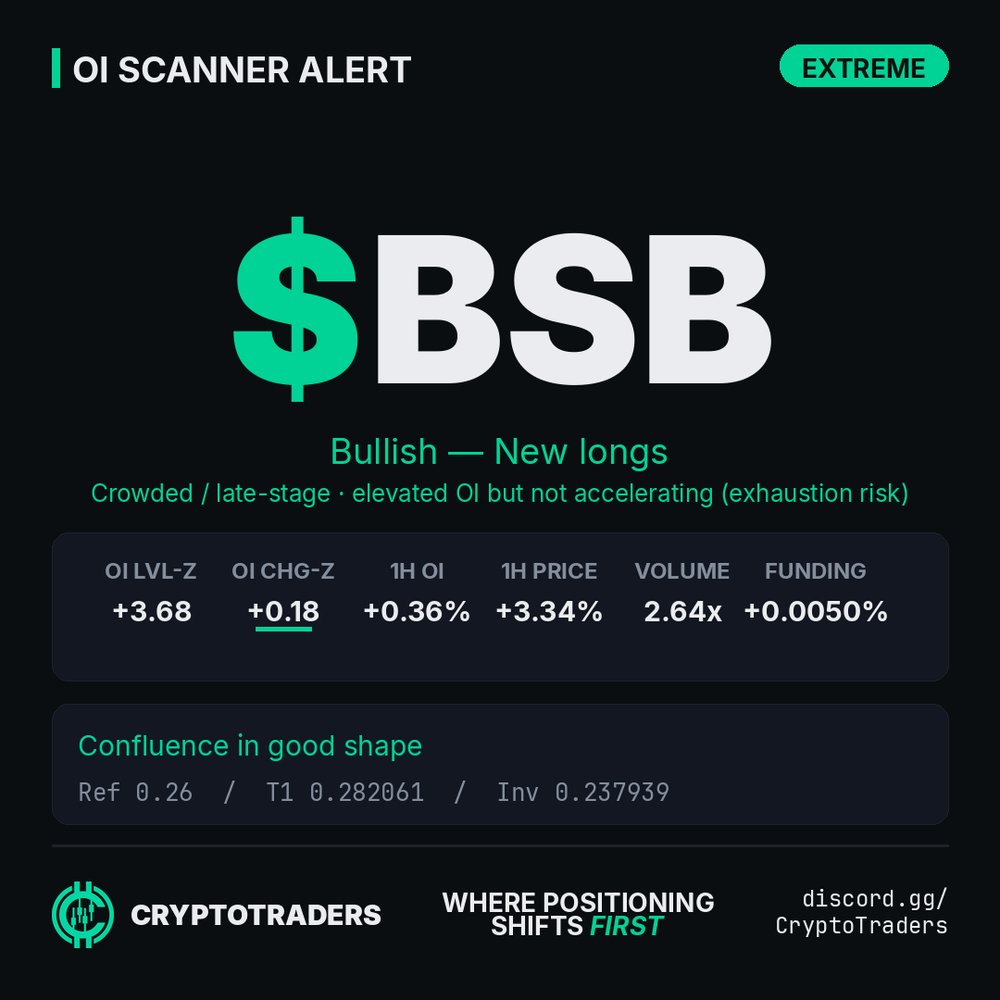
$BSB's extreme OI surge (Z=3.68) with new longs driving price up 3.3% suggests aggressive positioning. Volume confirms participation. The move from 0.26 to 0.282 (T1) offers a 1:1 risk/reward with invalidation at 0.238. Watch for continuation or exhaustion.
$FOGO shows a sharp short build at a Z-score of 5.3, but the volume divergence (0.45x avg) questions conviction. Price is down 1% with thin participation — positioning may be skewed but not confirmed by flow. The invalidation at 0.01194 is key: if price reclaims that, shorts get squeezed.
The short build on $TRIA is statistically extreme at Z=3.48, but the volume multiple of 0.63 suggests limited conviction. Price is already down 0.5% which may have triggered the alert. Without volume backing, the structure is fragile. Look for a reaccumulation or a false break.
Bearish positioning on $PARTI is extreme by Z-score, but the volume divergence (1.12x, unconfirmed) suggests the move lacks broad participation. Thin liquidity adds fragility. The short side has numbers, but structure favors patience until volume confirms the bias.
You didn't pick the wrong coin. You picked the right coin at the wrong time.
Altseason rotation is real. The move happens. You see it. You chase it.
Late entry. Then you compensate with size.
Now you're holding the right coin with the wrong risk profile.
One pullback and the thesis is gone. Not because the coin was bad. Because the entry was.
Late entry + big size = the setup that looks like conviction but is actually FOMO with a thesis attached.
The coin wasn't the problem. The timing and the sizing were.
Canton Network is now generating $2M/day in fees from institutional repo settlements, ranking 3rd in protocol revenue. Multiple ETF filings target this high-revenue, low-liquidity chain. The structural shift toward institutional-grade settlement rails is gaining real traction, and the fee data supports it.
$ALLO shows a textbook bullish OI divergence: price up 7.4% with OI building and volume 4.6x average. The extreme Z-score (3.9) and abnormal funding (0.07%) point to aggressive long positioning. Structure suggests potential for continuation, but the elevated funding rate introduces a squeeze risk. Key level at 0.475 (T1) for upside resolution; invalidation at 0.366. Patience for a pullback to entry 0.4205 may offer better risk/reward.
OI on $TWT is 3.6 sigma above normal, and the bias is new longs. Price is rising but volume is only 0.39x the 20h average — the move lacks broad participation. Low liquidity means levels may not hold as well. The structural question is whether this whale can push price to T1 at 0.3795 without more volume.
$TA shows a significant short positioning build (OI +19.8%, Z=3.47) with price declining 3.3%. However, volume is only 57% of the 20h average, indicating the move lacks broad participation. This divergence between OI and volume suggests caution; the short thesis needs volume confirmation to be sustainable. Levels offer a clear invalidation at 0.0921.
Bitcoin broke $60K, touching its 200-week moving average near $61,800. That line has marked or come close to every cycle bottom since 2015. The question is whether this is a capitulation wick or the start of a deeper trend shift. Volume is elevated, sentiment is extreme. Patience here is not passive — it's waiting for structure to confirm the next move.
The structure on $VELVET shows aggressive long positioning with OI +6.5% and price up 4.3%. Volume confirms the move at 3.7x average, suggesting real participation. However, the low liquidity ($1.5M) means the levels are less reliable. The invalidation at 0.1451 is a key level to watch — if it breaks, the long thesis weakens. Patience for a retest of entry may be warranted.
$ALLO LONG hit final target. +2.03R booked.
The structure showed accumulation above 0.182, with momentum algo confirming the expansion path. Price respected the invalidation at 0.171 and trended steadily to the target.
Entry: $0.18216
Exit: $0.20386
+2.03R · 14h 54m
More setups like this in the CT Discord. Link in bio.
The short build on $TA is statistically extreme: Z=7.2 with price declining. Volume confirms participation. The structure favors shorts as long as price stays below 0.0923. Thin liquidity could accelerate moves in either direction.
You don't become a trader by taking trades.
You become a trader by writing down the rules first.
Most people sit in front of the screen and let the chart pull them around.
A red candle appears. They short.
A green candle appears. They buy.
The screen is making the decisions.
That's not trading. That's reacting.
Pre-written rules change this.
When your rules say "wait for the level," you wait for the level.
Not because you're patient. Because the rule is in charge.
You become the trader your rules describe.
If you have no rules, you become whatever the screen pulls out of you.
Apollo's ACRED fund crossing $100m AUM across six chains, plugging private credit into Morpho as collateral, is a structural milestone. A $700b+ asset manager moving from sandbox to core infrastructure signals that DeFi's institutional integration is real, not experimental.
Positioning on $ASTER shows aggressive short entry with OI surging 6.4% and Z-score at 3.4. However, volume divergence (0.35x) suggests this isn't broad participation. If price fails to follow through, shorts may be trapped. Structure favors patience.