Graphic Design | AI Automation Builder | 3D Digital Oil Paintings | I create visuals, branding & smart creative systems | Web3 Explorer | DM for collaborations
The more automation I build, the more I notice repetitive work everywhere.
Copying data. Updating statuses. Moving files. Sending the same follow-up.
If a process follows clear rules, I start asking: why is a human still doing this?
#Automation#WorkflowAutomation
Debugging automation has taught me to stop blaming the node that looks guilty first.
Sometimes the real problem happened 3 steps earlier and only becomes visible later.
Trace the data. Check assumptions. Then fix the actual failure.
#n8n#Debugging#Automation
Self-hosting n8n taught me that automation isn’t only about nodes.
You start thinking about Docker, storage, persistence, file paths, restarts and what happens when the server comes back up.
The workflow is only one part of the system.
#n8n#Docker#SelfHosting
One habit that has saved me a lot of debugging: validate data before the next step depends on it.
Especially with AI output.
If a required field is missing or malformed, stop it early instead of letting the error travel through the whole workflow.
#n8n#AIAutomation
APIs are where “just connect the apps” stops being simple.
Different platforms want different auth, payloads, upload flows and error handling.
The workflow can look unified on the canvas while the integration logic underneath is completely different.
#API#n8n
Not every automation problem needs AI.
If the rules are already clear, deterministic logic is usually faster, cheaper and easier to debug.
I use AI where judgment helps. I use code where consistency matters.
#AIAutomation#n8n#WorkflowAutomation
One thing I stopped doing in automation: treating “workflow finished” as the same thing as “task succeeded.”
If the final action fails, the system should know.
A good workflow doesn’t just automate the action. It confirms the result too.
#n8n#Automation#WorkflowDesign
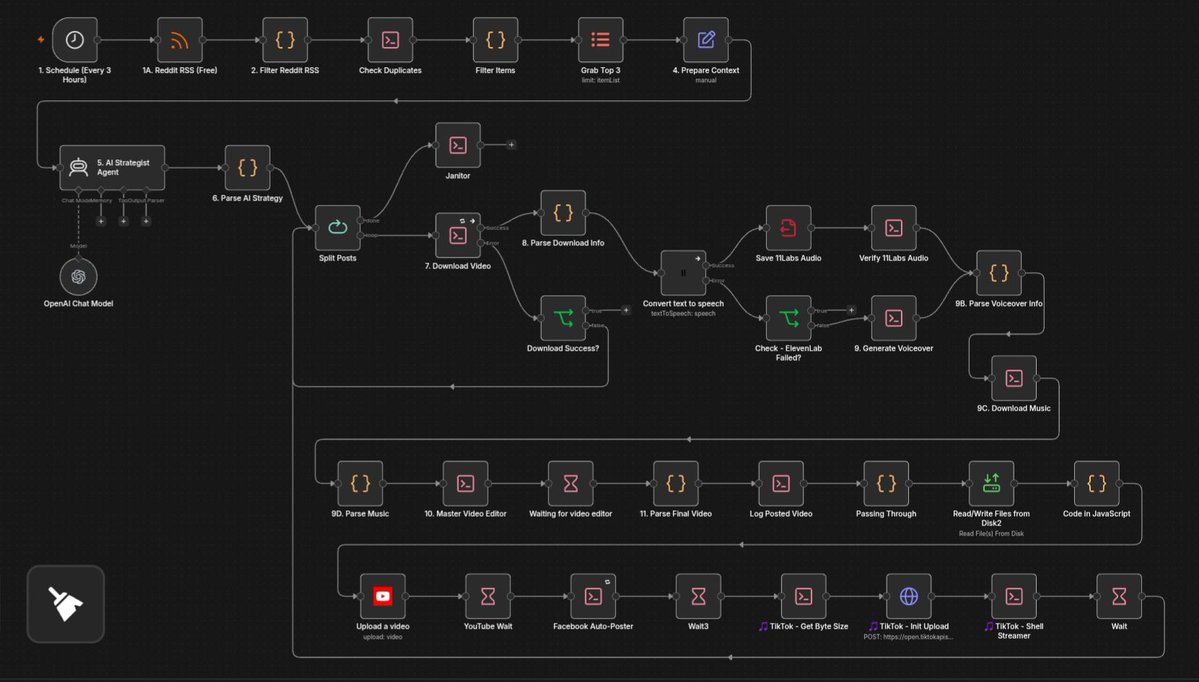
One workflow, three very different publishing paths.
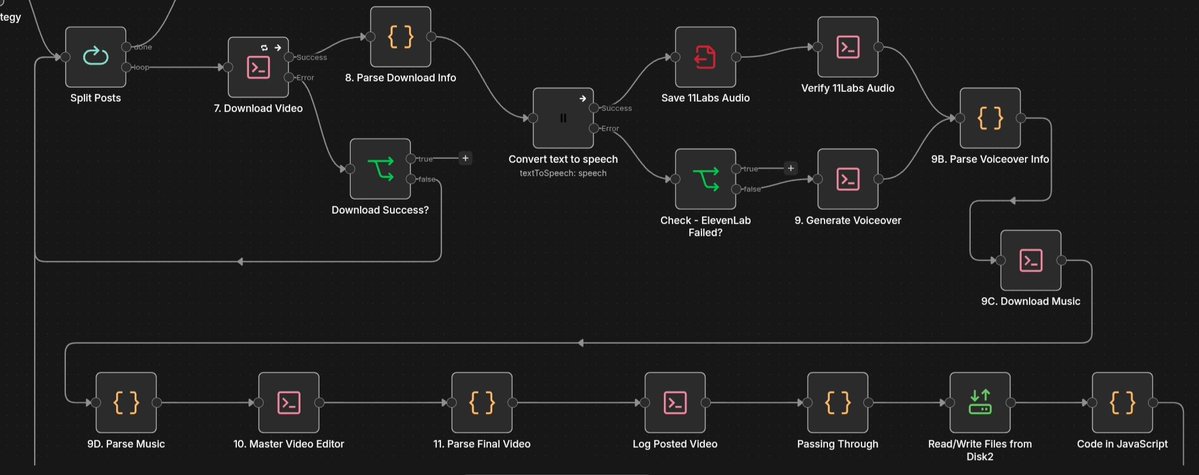
YouTube uses its upload node, TikTok needs an upload-init + file streaming flow, and Facebook has its own publishing step. Multi-platform automation gets interesting when each API expects something different.
The media stage is where this project became more than a normal n8n workflow.
I used voice generation, Bash and FFmpeg to turn workflow data into actual media files, then verified the output before sending it toward publishing.
I don’t let the rest of my workflow blindly trust AI output.
The strategist returns structured data, then a parser checks the required fields. If the response is malformed or incomplete, that item gets rejected before it can break the media pipeline.
Before this workflow touches a video, it filters what comes in and checks the video ID against a posted log.
If I’ve already processed it, it stops there. No point wasting AI calls and media processing on the same content twice.
I built an AI football media engine that goes from Reddit discovery to filtering, AI strategy, voiceover, FFmpeg processing and multi-platform publishing.
The interesting part wasn’t one tool. It was getting data, files, AI output and APIs to behave like one system.
A tiny thing made my publishing workflow much easier to manage.
I use custom markers inside Google Sheets for line and paragraph breaks, then JavaScript converts them before publishing.
Simple solution, but it keeps the content queue clean and predictable.
A publishing workflow is useless if it marks a failed post as complete.
Mine only changes Status to “Posted” after the publishing path succeeds.
Post_ID tracking, retries and success checkpoints keep the workflow from guessing what happened.
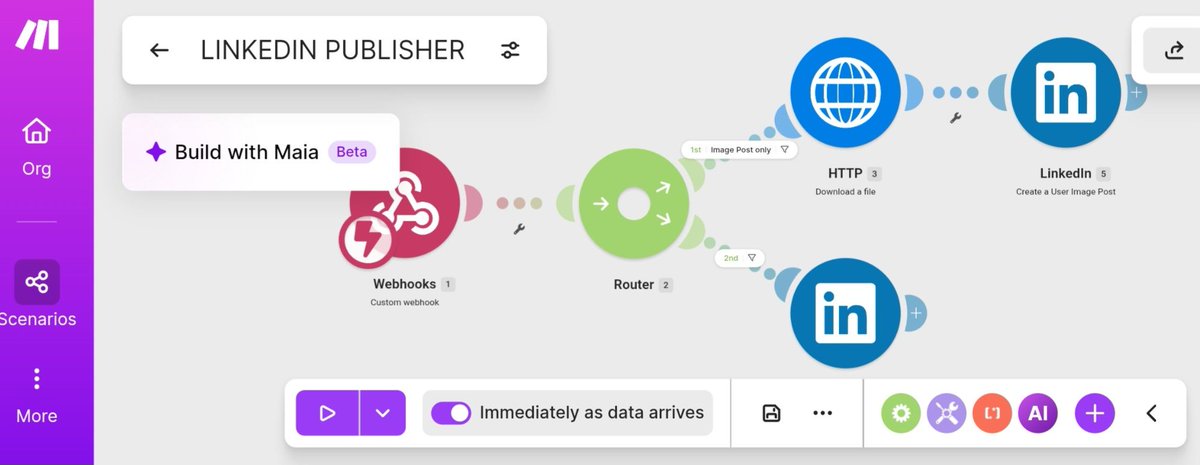
LinkedIn and X needed different publishing routes, so I didn’t force one tool to do everything.
n8n stays the orchestrator, https://t.co/hWUSA79yZB handles LinkedIn, and Buffer handles X.
Good automation architecture is often about using the right tool at the right point.
Not every automation needs AI.
In this publishing workflow, the hard problems were scheduling, routing, retries and state tracking.
An LLM would have added uncertainty where simple logic was better. Use AI where it creates value, not just because you can.
I built a multi-platform publishing engine with n8n, Google Sheets, https://t.co/hWUSA79yZB and Buffer.
It schedules, routes and tracks posts across LinkedIn and X.
The part I like most: no LLM. This was a deterministic problem, so I kept the logic deterministic.