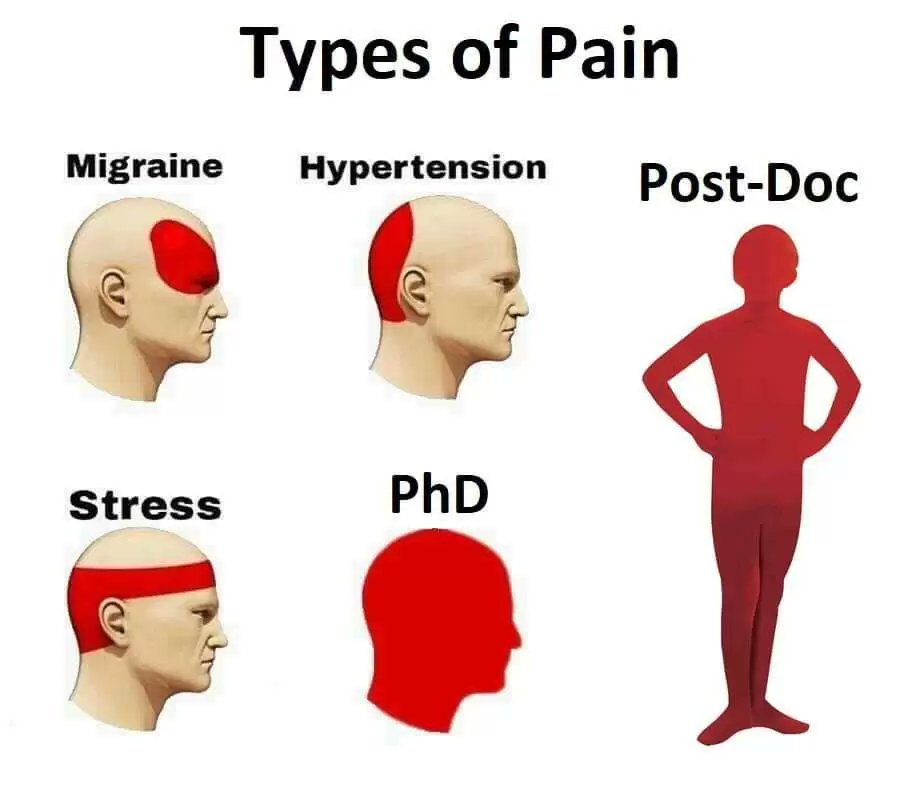
They say a PhD is a marathon, not a sprint. But guess what nobody tells you? The finish line is just the beginning of a whole new race of exploring the right career path for yourself. #phdlife#phdjourney#CareerGoals#CareerOpportunity
When we depart from this world, God doesn't care if we were once Nobel laureates, professors, PhD students, researchers, or lab technicians. However, kindness towards our co-workers leaves a lasting legacy. #kindness#bekind#academia#research
Don't let your research job consume your life. If you can work more than 8 hours a day, you can surely spare 1 hour for yourself. Meet friends, cook a healthy meal, enjoy a nice dinner with loved ones, pursue hobbies, or learn a new skill. Balance is key! #WorkLifeBalance
Some may not realize this yet, but your family/loved ones are more important than your research, whether you are single, married, or with kids. #family#postdoc#phdlife#AcademicTwitter
The tortured postdoc department:
1. Uncertain career trajectory
2. Severe underpayment
3. Intense pressure to publish
4. Expectations of expertise in all areas
5. Lack of mentorship/guidance
6. Feelings of isolation
#postdoc#lablife#phdlife#academia#AcademicTwitter#STEM
Ever met a potential supervisor who confidently says, 'Talk to the lab members to learn about our lab culture'? Don't be fooled because nobody will openly voice concerns the first time meeting you. #lablife#phdlife#postdoc#AcademicTwitter
Faculties cannot find strong postdocs. Plus, new data shows a drop of postdoc applicants in the US.
For example, in biomedical sciences:
- Drop by 3% in total
- Drop by 10% in U.S. citizens and permanent residents
Unsurprisingly, this coincides with a boom in biotech.
▫️
Now, here are some examples published 1-2 years ago:
1. Postdoc position in computing at the University College London:
- Three rounds of recruiting and the PI is still struggling to find a postdoc.
2. Postdoc position targeting “mini brains” to understand neural development at the University of Cambridge:
- Only 36 applications! WAY less than typically expected.
3. Postdoc position at Max Planck Institute of Molecular Physiology
PI received only five applications, and none of them was “serious”.
▫️
What postdocs said:
1. Postdocs feel unappreciated. “It’s the way we’re treated by PIs, by senior management and by academia in general. People don’t feel valued by anyone in the system.”
2. Salary. In a molecular biology lab, it is £34,400 in the UK and €42,200 in Germany, $54,840 in the US. It’s far less than in industry. Sometimes TWICE as small.
3. Postdocs have a widespread anxiety and uncertainly about their job paths. Less than half would recommend a scientific career to their younger self.
▫️
📍 My opinion as an ex-postdoc:
PhD students often ask: “OK, let’s suppose we’ll do this postdoc. But what’s next? What will it give me?”
- Only few postdoc get faculty positions.
- Postdoc does NOT give advantage when applying to industry (unless it’s very specific direction in biotech).
- Postdoc pushes you into an academic track. People don’t see you as an industry person anymore.
- Salaries are very low. Supporting a family during postdoc requires real survival skills.
Unless you have an outstanding PhD profile and will surely land a faculty position where you want (or if you have immigration status to solve), postdoc position is hard to justify.
Especially when high-tech industry is booming.
▫️
✅ To change it, we in academia should make better ties with industry:
1. Postdoc positions should become an excellent stepping stone to industry.
Currently, industry is not so open to academic community and has little funding opportunities. This can be changed via governmental incentives.
▫️
2. Industry should be able to help increase postdoc salary.
Basic salary can come from regular funding. BUT extra 30-40% can come from a specific company while a postdoc could work in synergy between the academic lab and industry, this would be a blast.
Currently, this is considered ‘double funding’ and is rarely supported. We should move away from such a view.
▫️
There is a great disappointment with academia and a big outflow of strong researchers.
But it can be stopped with the right policies, salaries and career opportunities.
#AcademicTwitter #AcademicChatter #PhD
I used to struggle with the complexity of Drosophila genetics, but now as a postdoc working on infectious diseases, trying to understand a doctor's report on a case study is an upgrade from 'complex' to 'complicated AF' #postdoc#Drosophila#Doctor#scientist