An effort led by former international and first-generation STEM PhDs to help international and first-generation graduate students navigate their PhD journey.
If you're a senior grad student applying for a #postdoc position & want to spend as little time and $$ as possible, we're offering our best seller action-driven guide rated 5 stars for ONLY $5. Use code: NEWYEAR24. Link: https://t.co/zHW7AQXyA4. Valid until Dec 31st. #phdchat
@FromPhDtoLife 💯.PIs are tied to topics that are appealing to funding agencies! More working hours, less pay. And academics do it all, w/ little training&self-learned via trials&errors on the expense of students' future. While all jobs have goods&bads, being honest abt academia is important.
@awfulPhD@PhDVoice If you submit your response, please let us know. We would love to help you in return with CV/Cover letter, job applications, networking guidance, and applying for jobs FREE of charge. Thanks in advance for your contribution if you wish to participate.
First-generation and international grad students, what is the one thing you wished you knew before joining graduate school? Please comment below. We'd love to hear from you :). Thank you @PhDVoice
@awfulPhD@PhDVoice Agree 100%. First-generation aren't exposed to the hidden curriculum & not all PIs are equipped (sometimes care) to help their students. If you wish to help us develop useful resources for you and future first-gens, please consider completing this form.https://t.co/1kVUKidHKV 1/2
@LA4573957683192@PhDVoice For example, bioinformatic work produce more results because the experimental part is less than someone who works with model organisms that take 2 months to experiment with.
@LA4573957683192@PhDVoice Depends on many variables. Topic, experimental setup, resources, help you could use, etc. And being productive doesn't equal results. It could be reading papers, helping others with experiments, brainstorming ideas for your projects, troubleshooting techniques, etc. 1/2
It is great to see many career coaching services available to academics. However, NONE of these services will help you achieve your potential IF you don't know what you want and don't want in your career. It all starts with you.
That is a very good advice. But it is equally important to making friends outside of your niche because it will allow you to expand your perspective about your topic and make helpful connections if you wish to explore other career options.
Welcome to all of our new followers! Please take advantage of the free guides and resources we are offering on our Gumroad page. Link: https://t.co/GmwloZQRBK
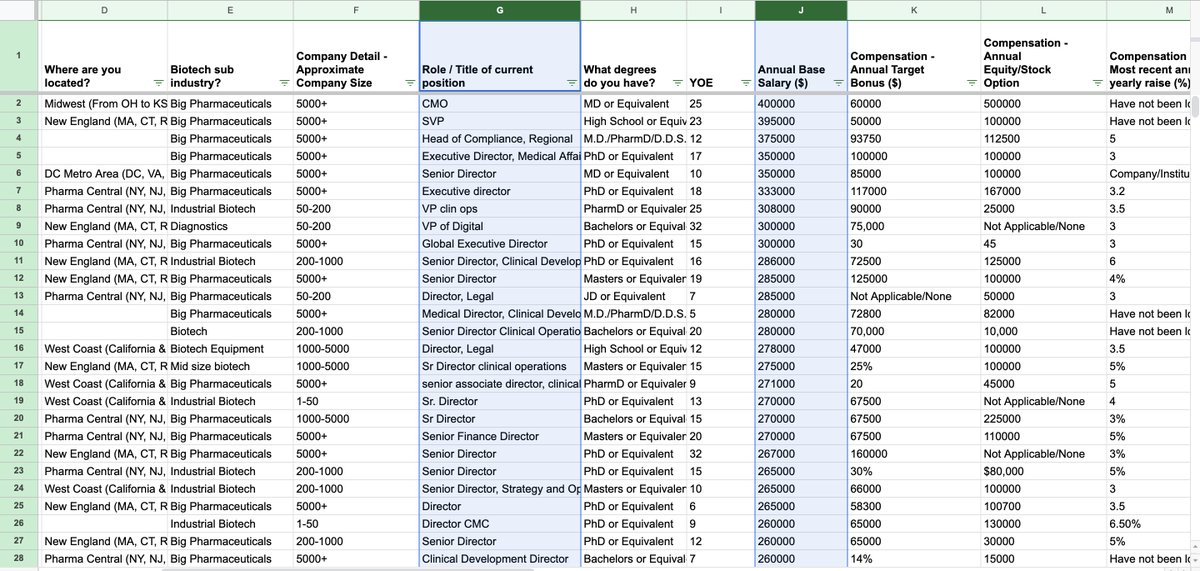
Curious about salaries in biotech?
r/biotech's annual survey data for 2024 is out. With 700+ entries showing a range from $400k - $30k in annual base. Leadership roles earn significantly more and the inflection point is at director level and up. Link below👇
@jdpereira I am amazed by that the majority of UK schools don't require coursework, only lab work and no teaching responsibility and no requirement to publish their work. No wonder it only takes UK PhD graduates 4 to 5 years max to finish their degree! This is a great thing of course!
Although doing a postdoc is not ideal for those aiming for a great career that supports them financially and professionally, being a postdoc could be a great stepping stone to a fulfilling career outside academia. You need to be strategic with your career plan post graduation.
Faculties cannot find strong postdocs. Plus, new data shows a drop of postdoc applicants in the US.
For example, in biomedical sciences:
- Drop by 3% in total
- Drop by 10% in U.S. citizens and permanent residents
Unsurprisingly, this coincides with a boom in biotech.
▫️
Now, here are some examples published 1-2 years ago:
1. Postdoc position in computing at the University College London:
- Three rounds of recruiting and the PI is still struggling to find a postdoc.
2. Postdoc position targeting “mini brains” to understand neural development at the University of Cambridge:
- Only 36 applications! WAY less than typically expected.
3. Postdoc position at Max Planck Institute of Molecular Physiology
PI received only five applications, and none of them was “serious”.
▫️
What postdocs said:
1. Postdocs feel unappreciated. “It’s the way we’re treated by PIs, by senior management and by academia in general. People don’t feel valued by anyone in the system.”
2. Salary. In a molecular biology lab, it is £34,400 in the UK and €42,200 in Germany, $54,840 in the US. It’s far less than in industry. Sometimes TWICE as small.
3. Postdocs have a widespread anxiety and uncertainly about their job paths. Less than half would recommend a scientific career to their younger self.
▫️
📍 My opinion as an ex-postdoc:
PhD students often ask: “OK, let’s suppose we’ll do this postdoc. But what’s next? What will it give me?”
- Only few postdoc get faculty positions.
- Postdoc does NOT give advantage when applying to industry (unless it’s very specific direction in biotech).
- Postdoc pushes you into an academic track. People don’t see you as an industry person anymore.
- Salaries are very low. Supporting a family during postdoc requires real survival skills.
Unless you have an outstanding PhD profile and will surely land a faculty position where you want (or if you have immigration status to solve), postdoc position is hard to justify.
Especially when high-tech industry is booming.
▫️
✅ To change it, we in academia should make better ties with industry:
1. Postdoc positions should become an excellent stepping stone to industry.
Currently, industry is not so open to academic community and has little funding opportunities. This can be changed via governmental incentives.
▫️
2. Industry should be able to help increase postdoc salary.
Basic salary can come from regular funding. BUT extra 30-40% can come from a specific company while a postdoc could work in synergy between the academic lab and industry, this would be a blast.
Currently, this is considered ‘double funding’ and is rarely supported. We should move away from such a view.
▫️
There is a great disappointment with academia and a big outflow of strong researchers.
But it can be stopped with the right policies, salaries and career opportunities.
#AcademicTwitter #AcademicChatter #PhD
@Andrew_Akbashev Many PhD graduates, especially the top of their cohort, want to be in a place that appreciates them by providing them with great career development opportunities and good salary to sustain this cost of living crises. The sad part is that not all recruiting faculty understands it.
You can apply cold and, with a strong resume and cover letter, get an interview. But since there are many unknowns in all this, you have a better chance if someone the hiring manager trusts recommends you. Remind people you're searching, and get to know others in your industry.
Please take a moment to read through the replies to this tweet by @PhDVoice. Knowing what to look out for is important. In addition to the replies, check out our article where we summaries red and green flags for each category. Link: https://t.co/GbaI6byEM7
To help prospective PhD students, what are some red flags to watch out for when looking for a supervisor?
And, what are some green flags?
#PhDVoice@PostdocVoice
@PhDVoice@PostdocVoice There are many red flags that can go unnoticed. However, it is as important to look for the green flags as well. We summarised these flags into categories in this article. https://t.co/GbaI6byEM7. Let's know if you agree!