🇺🇸 BREAKING: On April 8, 2025, Trump's investment accounts made 327 stock purchases, most of it in Apple, Nvidia, Microsoft, Amazon, and Alphabet.
The next morning he posted "GREAT TIME TO BUY!!!" Hours later he announced a 90-day tariff pause. The S&P 500 jumped nearly 10% that day, one of the best single sessions in its history.
Federal law requires officials to disclose trades like this within 45 days, specifically so the public can catch conflicts like this while they're still relevant. Trump filed it 14 months late.
The fine for filing that late: $200.
🚨 Ansem didn't launch the $ANSEM memecoin. But he's the one who turned it into a $200M frenzy.
And people are starting to notice the pattern repeating itself.
Here's the timeline nobody's connecting yet 🧵
Three days ago, I called the $OUSD consortium the most credible attack yet on Circle's business model. That part still holds. But the "140 companies" number is already cracking.
Samsung, Dunamu, KakaoBank, K Bank, Shinhan and several others listed as $OUSD partners are now telling Korean media they never formally agreed to join. Samsung Electronics says it had no formal talks and doesn't know what role it's supposed to play. Others say Open Standard only asked if they'd be interested, and their name ended up on the roster anyway.
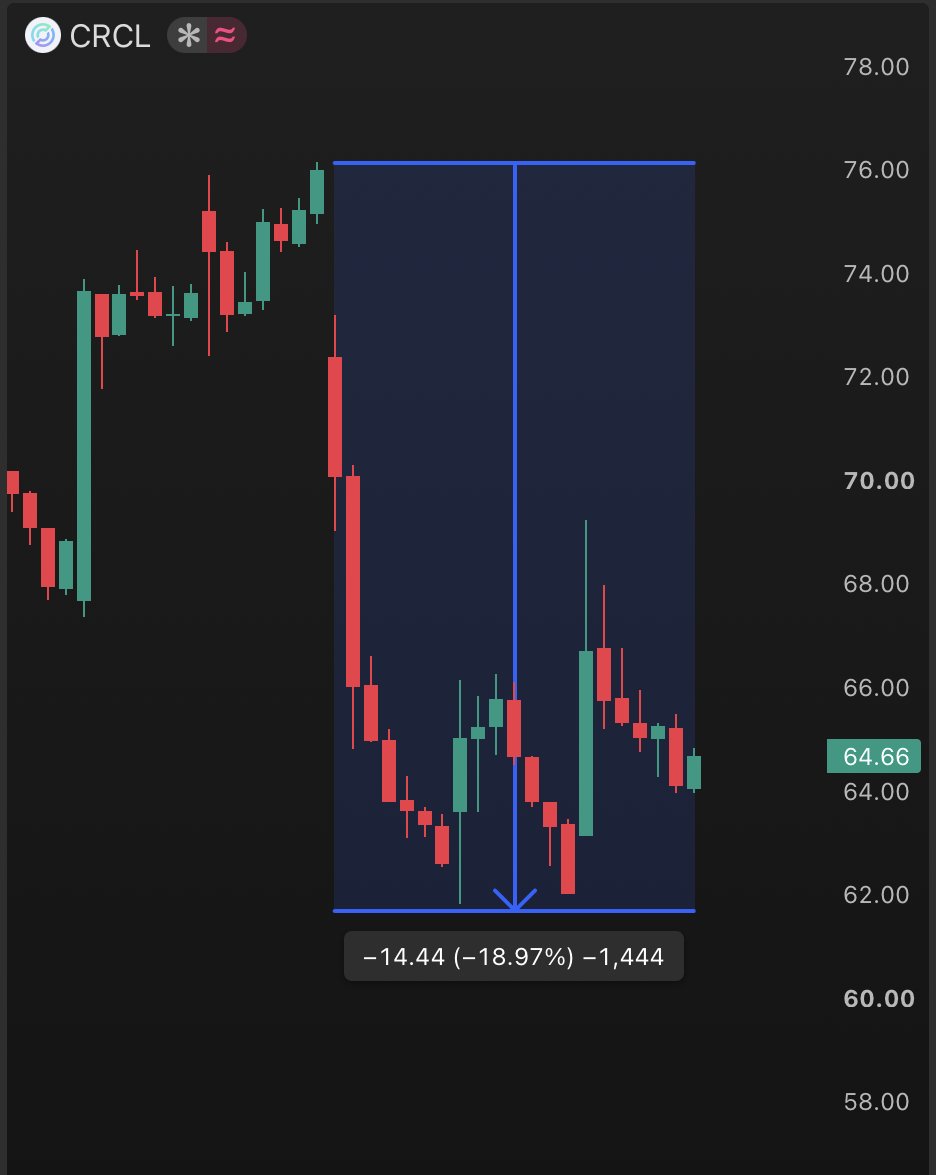
Circle already dropped over 16% on the initial announcement. The real test isn't the logo count, it's whether $OUSD's flagship commitments hold. Stripe's default-stablecoin pledge and Coinbase's Base integration are real and on record. The Korean 13 looks more like tentative leads padding the headline number.
This doesn't mean the $OUSD threat is over. It just means the "140 companies" pitch needed to be "a handful of committed giants plus a long tail of maybes," and got caught inflating the tail.
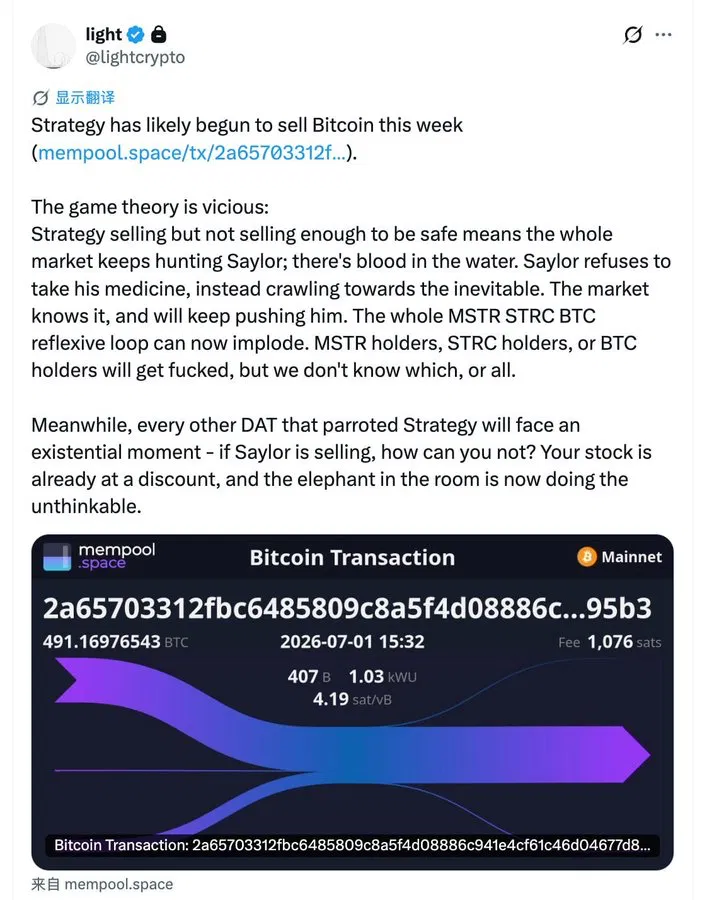
🚨 BREAKING: Saylor may have just sold Bitcoin again. This time it's not 32 coins.
An unconfirmed on-chain transaction shows 491 $BTC moving from Strategy on July 1st. That's 15x the size of the sale everyone dismissed as "immaterial" in May.
Here's the trap Strategy built for itself. STRC needs Bitcoin to compound 2.3% a year just to cover its dividend without selling a single coin. If price stays weak, that math breaks, and "de minimis" sales stop being one-offs.
The scariest part isn't the transaction. It's that Bitcoin barely moved after it. The market isn't shocked anymore. It's already pricing in more.
Watch for the 8-K. If this confirms, "never sell" just became "sell quietly and hope nobody notices."
MOST PEOPLE HAVE NO IDEA HOW TIM DRAPER'S 2014 BET LOOKS RIGHT NOW.
THE US MARSHALS AUCTIONED OFF BITCOIN SEIZED FROM SILK ROAD.
DRAPER SHOWED UP AND BOUGHT 29,656 $BTC.
PURCHASE PRICE: $632 PER COIN.
TOTAL SPENT: $18.7M.
THOSE SAME COINS HIT $3.74B AT THE PEAK.
TODAY THEY SIT AT $1.82B. 🤯
🇮🇳 India just got its first fuel price cut in over two years.
Nayara Energy, the country's largest private fuel retailer, just slashed petrol prices by ₹5 and diesel by ₹3 across all 7,000 of its stations today, effective immediately.
The reason is the full circle of the Iran story. When the conflict escalated in March and the Strait of Hormuz looked like it could close, Nayara was the first company to raise prices. ₹5 on petrol, ₹3 on diesel, almost exactly what they just reversed. Now the ceasefire has held, the shipping lane has reopened, and crude is retreating.
What to watch now: IOC, BPCL, and HPCL, the three state owned companies that control more than 90% of India's fuel pumps, have not moved yet. They raised prices by a cumulative ₹7.50 per litre in May, more than Nayara did. If they follow Nayara's lead, that is meaningful relief at scale for 1.4 billion people.
Nayara moved first when prices went up. The question is whether the government lets state companies move first when they come down, or holds them back to protect fuel tax revenues.
🚨INSANE: Foreign investors net-sold ₩6.25T won on the $KOSPI. Retail instantly absorbed it with ₩11.55T won in buying.
the largest single-day retail purchase in Korean market history.
Two-to-one. Retail didn't defend the index; they overran the sellers.
But nobody is asking the actual question here, which is: who is the retail buyer structurally? This isn't a grandma buying Samsung. Korea has the highest concentration of leveraged single-stock products tied to two names, Samsung and SK Hynix, anywhere in Asia. Retail buying the dip in this market is retail buying leveraged exposure to the dip.
That's the same mechanism that turned a routine pullback into back-to-back circuit breakers this month. Leverage amplifies the move on the way down. It also amplifies the "buy the dip" reflex on the way back up, because the products are designed to force rebalancing in both directions.
So when you see "retail absorbed the selling," the correct read isn't conviction. It's leveraged retail flow doing what leveraged retail flow does, which is overcorrect in both directions until the underlying stops moving.
Foreigners have net-sold $62B this year. Retail has net-bought roughly $70B. That's not a contest of conviction; that's two different risk appetites trading against each other with one side using margin.
Nobody loses money on this trade until the day they do. And in a market where two stocks are 45% of the index, that day shows up fast and all at once.
🚨 Japanese Yen just broke 162.40, its weakest level since 1986. Beyond the July 2024 intervention low is entirely.
Japan already spent ¥11.73 trillion, $72.4 billion, defending it at 160 between April and May. The defense bought maybe three weeks before USD/JPY round-tripped right back through it.
Nobody is asking why the intervention failed so fast. It's not that Japan didn't spend enough. It's that intervention treats the symptom. The actual driver is the rate differential between the Fed and the BoJ, and that gap hasn't meaningfully closed.
You can sell reserves to buy yen all day. If the yield gap stays wide, carry trade flow refills the short within weeks. That's exactly what happened here.
Katayama said "we stand ready to take appropriate action whenever necessary." That's the same language used before the April intervention. The market has now seen this movie once. It knows the defense has a shelf life.
Next intervention buys time, not a trend reversal. Until the rate gap closes, 162 isn't a floor, it's a waypoint.
🚨🇺🇸JPMorgan urges strong safeguards as Congress weighs crypto market structure rules
Most people are going to read this as JPMorgan finally embracing crypto, and I think that misses what is actually happening in the post.
What JPMorgan is really doing is fighting over one specific thing, and it is not whether tokenization is useful. They already concede that. What they are fighting over is whether stablecoins are allowed to pay yield, because yield is the only real reason anyone would move money out of a checking account paying nothing into a stablecoin instead.
Take the yield away, and a stablecoin stops competing with a bank account and starts being just a faster way to move money, which is exactly the outcome JPMorgan wants and exactly why Dimon said the banks will fight this down to the wire.
So the headline people are running with, that Wall Street is welcoming crypto into the system, has it backwards. What is actually happening is that the banks are negotiating the terms under which they let crypto in just far enough that it cannot take their deposits with it.
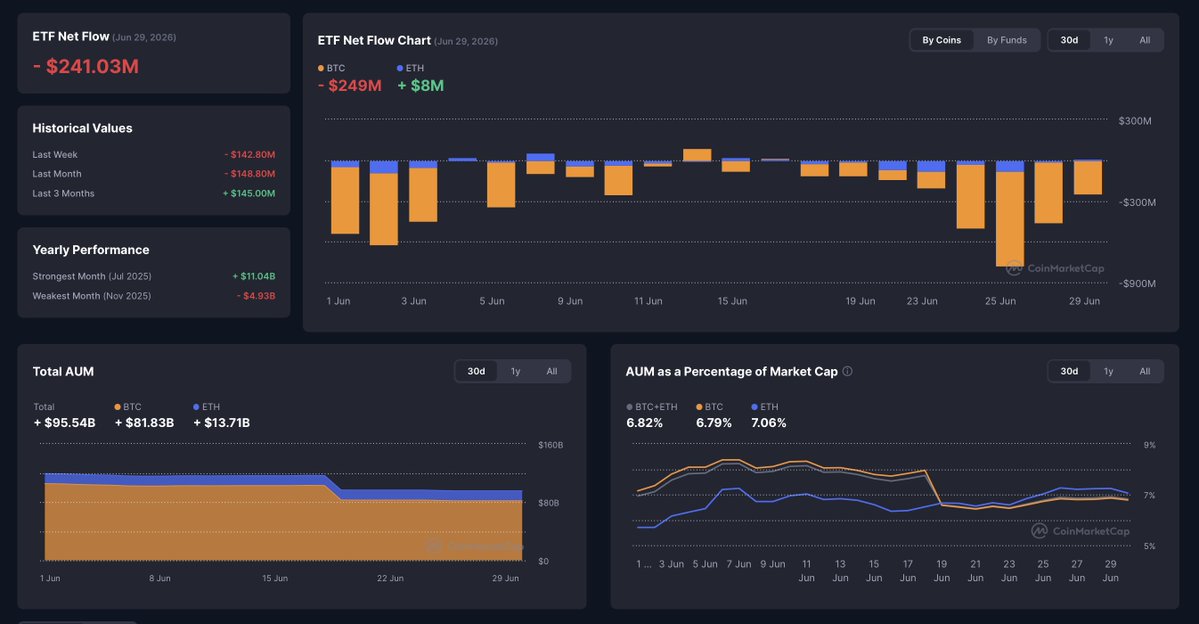
🚨ETF outflows are not slowing down. They are compounding.
June 29: -$241 million net. Bitcoin alone bled $249 million. Ethereum barely offset it with $8 million inflows.
Last week: -$142.8 million. Last month: -$148.8 million. Look at the chart, and the pattern is obvious: every red bar this month is bigger than the ones in early June.
Three months ago, this same chart was green. +$145 million net over three months. That entire cushion is gone, and the bleeding has only gotten heavier since.
Total crypto ETF AUM still sits at $95.5 billion, so this is not a collapse. It is a slow, steady walk toward the exit, every single day, for weeks straight.
The institutions are not panicking. They are just quietly leaving.
🇯🇵🇮🇳BREAKING: Japan and India are moving to settle trade directly in yen and rupee, bypassing the dollar entirely, per Nikkei.
Right now, almost all Japan-India trade routes go through the dollar. A Japanese company selling to India converts yen to dollars, then dollars to rupees, paying two separate conversion spreads and absorbing dollar volatility on a transaction that has nothing to do with the US at all.
This new scheme would let both currencies settle directly against each other, cutting out the middleman currency completely.
The timing is not random. Japan is dealing with a yen near multi-decade lows and a unwinding carry trade that has already pulled tens of billions out of global assets. India is fighting its own rupee weakness and a current account deficit wide enough that Modi is publicly asking citizens to stop buying gold. Both countries are independently trying to reduce their dollar dependency, just from different angles.
This is not BRICS-style dollar rebellion. Japan is a US treaty ally and the largest foreign holder of US debt. When even your closest allies start building dollar-free payment rails for purely practical reasons like cost and speed, that is the more important story than any sanctions-evasion headline.
The dollar's dominance erodes one efficiency decision at a time, not one geopolitical statement at a time.
🚨 A whale just opened an $81 million 20x short across Bitcoin and Ethereum.
$71.5 million of it is on $BTC alone, with liquidation sitting at $67,578. The remaining $9.5 million is on $ETH, liquidating at $3,222.
The trade is already up $1.75 million in PnL this week, and $BTC is currently sitting around $59,357, comfortably below the liquidation line.
$ETH is the one bleeding the position right now though down $310,000 unrealized while $BTC sits up $38,000.