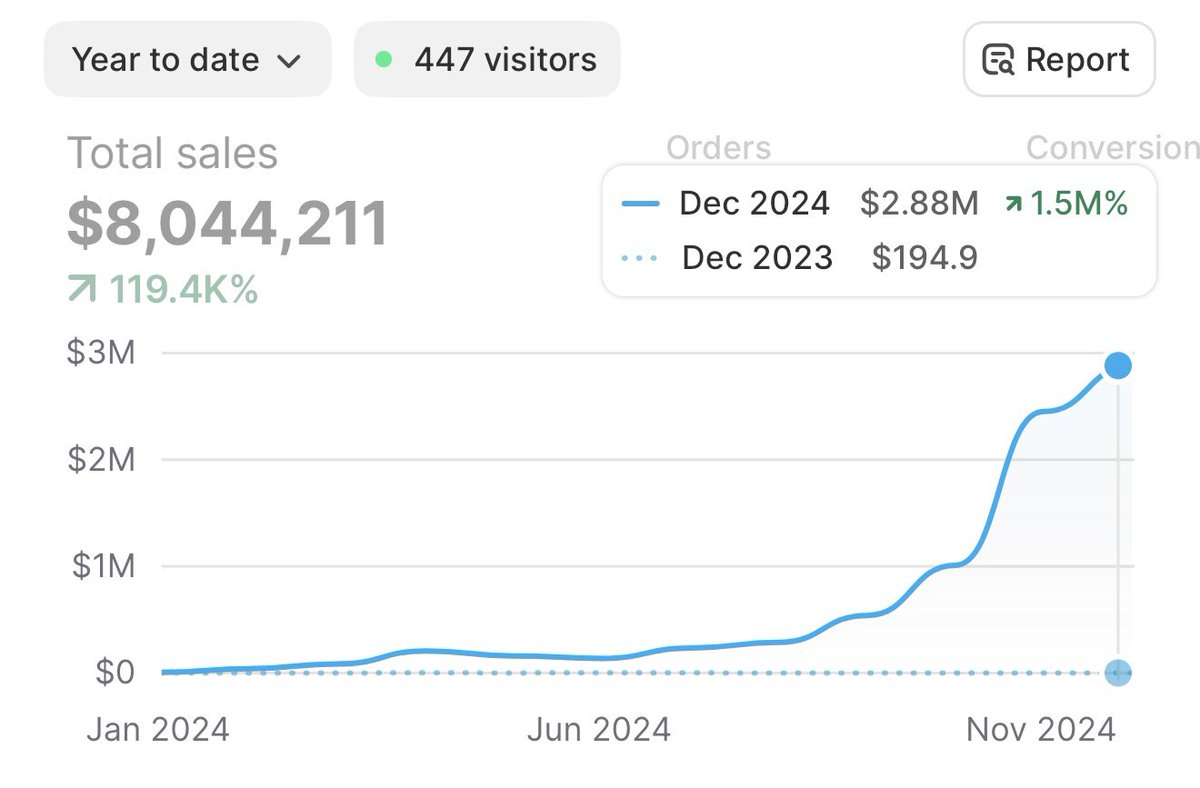
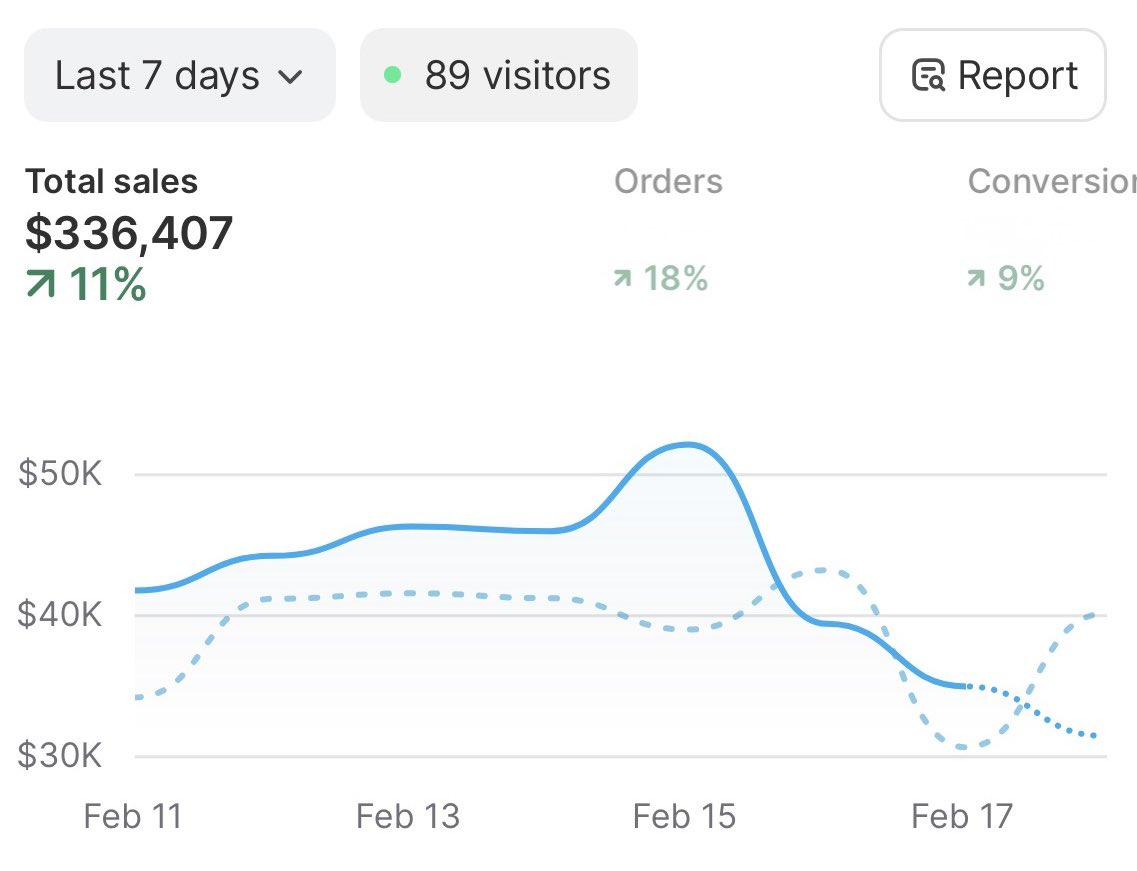
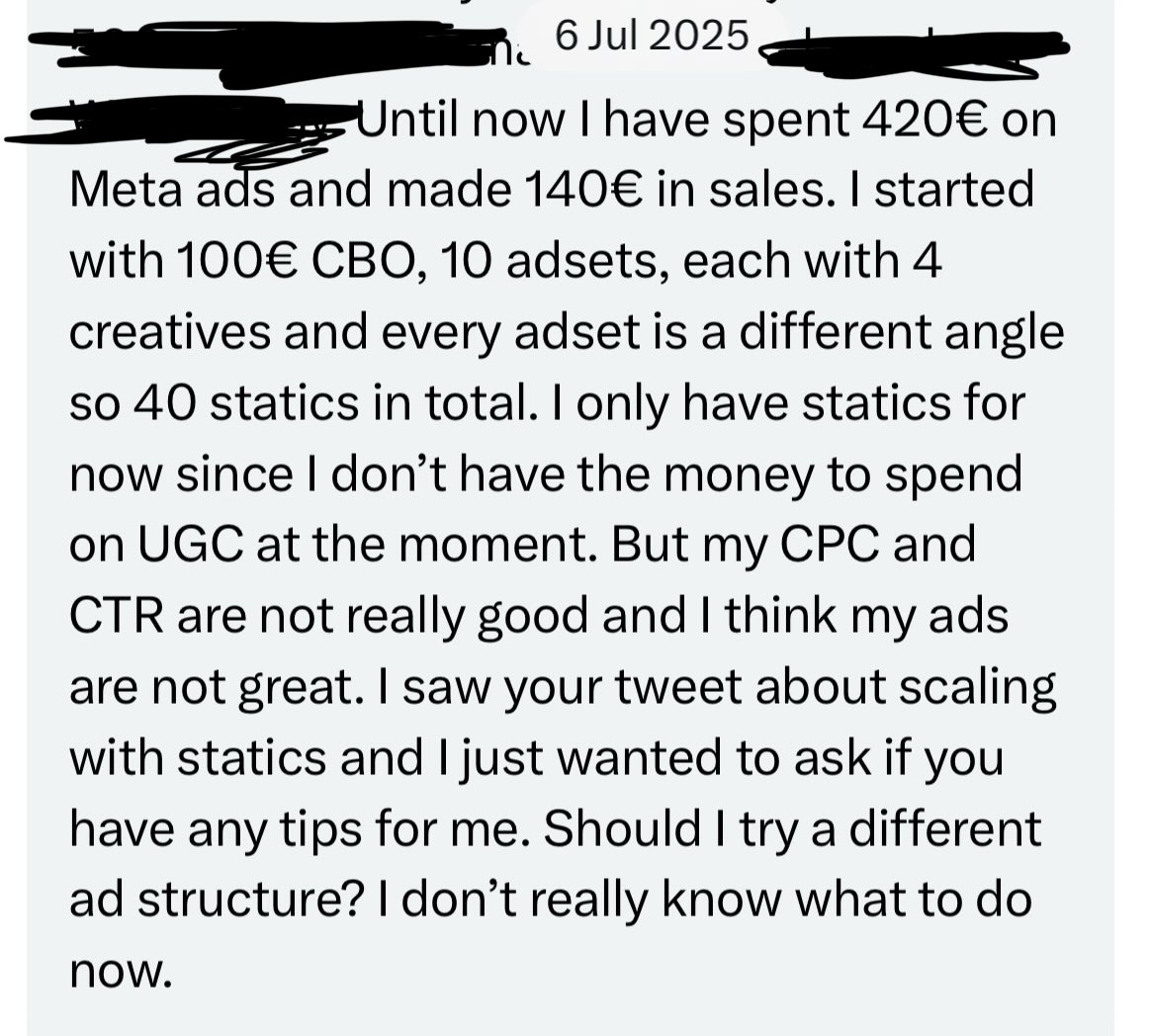
first client: "I just need proof of concept"
first $10K month: "I just need consistency"
first $50K month: "I just need the right systems"
first $100K month: "I just need better clients"
this is the game.
the goal never stops moving.
and that's how you know you're growing.
We’re hiring a senior Video Ads Creative Strategist for a 7-figure supplement brand.
Compensation:
$8,000–$10,000/month
+ 3% of ad spend, uncapped
We need someone who already knows how to create direct-response video ads that scale in the health and supplement markets.
You’ll be responsible for writing and developing:
• VSLs
• UGC ads
• AI/Pixar-style ads
• Long-form and short-form video ads
• New angles and iterations based on performance data
You should understand:
→ Customer pain points, frustrations and desires
→ Objections, mechanisms, proof and market sophistication
→ How to turn reviews, Reddit threads, comments and complaints into winning angles
→ Why successful health ads work—not just what they look like
→ How to study 50 winning ads and identify the patterns underneath
→ How to use performance data to develop stronger iterations
We are not looking for someone who is still learning video ads. we are looking for somone who UNDERSTAND why they work
You must have personally have made an ad that has over $100,000+ in spend.
If none of your individual ads have spent at least $100,000, please do not apply. Your application will not be reviewed.
Serious, experienced and hungry applicants only.
Interested? Comment APPLY and will send you the application
@creativestrategist @directrespondmarketers @strategist
biggest thing killing people's funnels is incongruency - if the ad hook doesn't match the pre-lander headline, and the pre-lander doesn't match the sales page angle, you're basically running 3 different offers/angles
what i actually track per step:
ad → pre-lander: CTR + hook rate (thumbstop) - tells you if the ad is earning the click.
pre-lander → sales page: LP CTR - this is the copywriting checkpoint, if headline/intro don't carry the promise from the ad through, this number tanks, we run a lot of tests on the copywriting.
sales page → checkout: RPV (revenue per visitor) - the real tell, tells you if the page converts the traffic quality you sent it, the people that reach this stage are already very warmed up so your RPV should be strong.
most people obsess over ROAS alone and forget RPV. RPV is what tells you if it's a traffic problem or a page problem before you waste spend
Every brand is mass producing videos
Primal Viking is scaling to 8 fig months with statics
Here are 5 winning static formats they're running
[Bookmark this and share it with your team]
Most important roles when building a team:
1. Start with a good customer service team, this all comes down to having a good CS manager who can do weekly check-ins with the team and will be your direct POC. When you have 2 CS agents this can easily be managed without a manager, but once you start scaling and go to 10-20-30-40 CS agents, you don't want to be in touch with all of them separately, that's where the CS manager comes into play as he will be your only POC.
2. Hire a creative strategist, designer & video editor -> This might be the most undervalued hire you can do, I know a lot of you guys are doing everything yourself but having a creative strategist full-time analyzing all of your assets, doing creative research etc. will make a huge difference & will result in higher quality creative output.
3. Spending 50-100K+ /day -> Hire a CMO this is a big play & will be really helpful! Having another set of eyes on your ad account will give fresh insights, you can brainstorm, come up with new strategies and re-evaluate everything you're doing and might change your approach.
4. A junior media buyer -> One of the most time intensive tasks when you're scaling is building out new campaigns & creative tests, hiring a junior media buyer who will launch all creatives & put them in the ad account for your review will save you huge amounts of time!
@MattElms We launch 15 new adsets per week. Each one with a new format/angle and 3-6 variations of hook, actor or on screen headline.
I did DCTs before hitting scale but they took that from us. I don’t use flex ads cause they don’t actually show me the winning variables.
@Chess_Trainer_ I start with $100/day , I don’t touch anything for the first 3 days at least , I usually don’t expect to be profitable until a few K in spend
May 2024 I made £2.2k in 4 days with zero experience. No clue what I was doing, just started.
Fast forward to now.. consistently hitting $330k/week… $17.1m a fucking year if I keep this up. Absolutely madness in reality.
It wasn't smooth. Setbacks, doubters, months where nothing worked or made sense.
But I just kept going.
The one thing that actually changed everything was joining EB Builders.
Private suppliers, weekly product drops, live calls, and a community that's genuinely ahead of the game.
Less than $100/month. Still the best investment I've made.
👉 https://t.co/4l6TjrmaS0
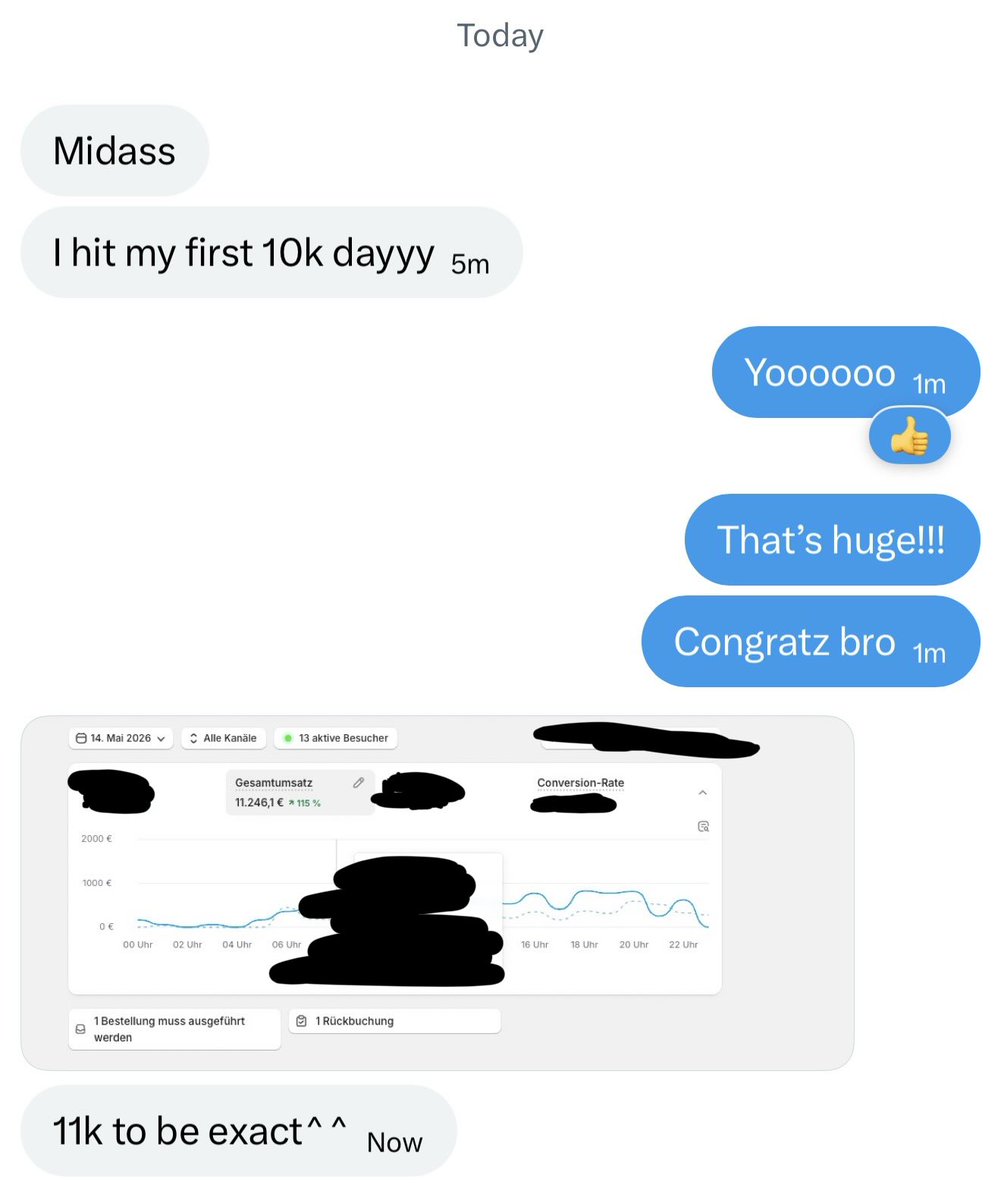
One of the best feelings in the world:
Help someone out > they implement your advice > it works.
This guy dmed me almost a year ago asking for advice.
I helped him out a bit, did one consulting call, and we stayed in touch.
Now 10 months later he hit his first 10K+ day.
I need to be clear:
This result is NOT because of me.
It's because of his hard work, effort, curiosity, consistency and beeing able to use common sense (a lot of you out here don’t use it enough)
But it's cool to see that the people who are curious enough to ask, humble enough to learn, and consistent enough to put in the work almost always make it.
2022 vs 2025
What got us here?
- being obsessed with the product.
- being obsessed with every touchpoint of the customer journey (support, shipping, packaging).
- staying focused on one acquisition channel instead of trying to win on Meta, TikTok, Pinterest, Snapchat and 10 other things at the same time.
- hiring people who are better than me.
- building systems that work without me.
- and reinvesting aggressively every year.
biggest lever = ignored every single Meta recommendation 😂
Advantage+ sending traffic to broken pages, consolidated single CBO structure they swore by, all out of the window.
they get paid when you spend regardless of performance. different game.
Here’s my exact strategy on how i keep surf scaling stores to 2x-5x revenue in a couple days.
1) look for the opportunity. If you launch a new batch of creatives and day 1 is good ROAS, double from whatever starting budget but only after 24h. DO NOT TOUCH BEFORE.
If its a random batch of creatives launched previously that starts picking up performance, double budget, again do not touch for 24 hours.
IMPORTANT: Doubling budget latest at 9pm local customer time zone.
2) Day 2. This is where the fun begins.
If it’s from a new batch launched, as soon as the ad set ( i do abos ) tracks at least 2 sales with good roas start doubling. If it’s from a previous launched batch that started picking up just start doubling as soon as roas is good. This is how to double:
Start 9 am local customer time or whenever good roas is achieved. Double budgets every 1h until 1k budget. After that, do it every 2 hours.
If roas goes up, gg go on doubling.
If roas remains same, gg go on doubling.
If roas goes down, unlucky, scale down to previous step. If roas still keeps dropping, go down to half the amount the ad set spent until roas is good again to double. If it stays decent but not good, leave it be.
3) midnight reset. You will get to a point at the end of your meta cycle (usually midnight if ur ad acc is set to your local time) where you might have an ad set with 30k budget that only spent 10k.
Here’s what to do:
If roas good, set budget at double what it spent.
If roas decent, set budget at what it spent.
If roas bad, set budget at half what if spent.
Ask me anything if unclear. Happy surfing🏄🏄
One of my students did $57,421 in a single day.
4 months ago he was doing $8,000.
He came to Bali for one month to lock in. Never left.
775 orders.
3.87% conversion rate.
Supplier visit booked for next week.
His words: pace, speed, and execution changed everything.
That's what it looks like when it actually clicks.
I've been watching this happen in real time and now I want to do it again with a few people.
I'm opening 5 spots to work with me directly.
3 are already gone as we speak.
2 are left.
I'm not looking for someone who needs convincing.
I'm looking for someone ready to execute,
whether you've never launched a store or you're already making sales and can't break through.
If you want in, comment "MENTOR" and tell me where you're at.
I'll ask you a few questions. If we're a fit, we get to work.
"What Ecom brand should I launch in 2026"
Some dudes say Fashion stores are the easiest to start
Some say you have to run supplements for LTV
There's no magic niche. Most of them can work
But most of you just pick without thinking and wonder why you're having such a hard time scaling.
Here's the 4 criterias I use to decide if a product/brand is worth pursuing:
1) Google Trends
⠀
Some of you are marketing products people don't want anymore
If you were selling newspapers today, no ad is saving you. The market is against you.
Same if you're still pushing Kojic acid products you found on TikTok Shop. That trend has been declining all year
Take EMS ab trainers as an example. Fitness as a category keeps growing, so even though everyone's calling the product saturated, there are still people printing with it.
Market "saturation", or competitive niches are not a problem. But declining markets are.
Do a simple Google Trends search on your niche, market, and product in your target country for the last 5 years.
If the trend is flat or going up, you can make a lot of money.
If there's a big decline, you're fighting gravity.
Also check for seasonality. You'll be surprised the product you're selling may be seasonal. Plan accordingly.
2) Affinity
Do you actually believe in what you're selling?
If you don't have conviction in your product, it's hard to convince others.
You don't need to be passionate about it. Just something that resonates with you.
E.g. Pilates products for women, even if you're a guy. If you've seen how it works and believe it can help, that's enough.
If you don't care about the niche or the value you're providing, avoid selling that product long-term.
I'd way rather sell something I'm interested in than push some random supplement for the LTV.
Even if that caps you at $5M/mth instead of $30M/mth (hypothetical numbers), you're still making a fck ton of money to do whatever dumb sht you want WHILE enjoying it.
If you don't enjoy what you're building, you won't last long enough to see the compounding effects stack for your brand.
If you truly believe in your product, you'll work way harder, your vision is far greater, and you'll attract top tier talent much easier.
Hudson at Comfrt talks about his brand like it's a mission. That belief pulled in the best creators on TTS to run "The Hudson Method." Now they're on pace for $1B/year, fully bootstrapped.
3) Non-Gimmicky Products
⠀
If your product doesn't actually work, you'll hit a wall.
Selling height-boosting gummies? Good luck.
You'll spend more time convincing yourself it works than convincing customers.
Do a simple search on GPT. If the product is obviously BS, avoid it.
You see tons of new supplements with new mechanisms show up. I don't see a point hopping on random Ayurvedic/TCM/folk medicine supplement trends. Some have real research behind them of course — ashwagandha, reishi, tongkat ali, etc. But most of the trendy ones are just gimmicks.
You may be able to sell well, but the product just doesn't work.
And when you're trying to hire A players, money is not the only thing they care about. If that's all you can offer they would rather work for another huge brand like Comfrt that can pay them well + has a real mission behind it.
The goal is to provide as much value as possible, and if you make a ton of money doing that, that's perfect.
Hudson at Comfrt nailed this. He saw a gap in the value equation, and made premium hoodie quality affordable.
4) AOV Above $60
If you're selling to the US, CPMs are high.
Low AOV = hard to scale.
$20 product with $30 AOV? Getting a CPA in the US below $20 is nearly impossible at scale.
I aim for $60+ AOV after bundles and upsells.
The Ecom brands that scale hardest usually have a high Shopify health score. Ideally 250+
You don't need a really good score when you start, but the higher the better.
Shopify health score = CVR × AOV
3% CVR × $80 AOV = 240 ✓
6% CVR × $25 AOV = 150 ✗
The brands we've scaled past $100k/day all score 200+
Because aiming for a 10% CVR at a big scale on a $25 AOV product is borderline impossible in US.
I've never seen anyone do it.
Low AOV means you need way more winning ads just to stay afloat.
Either that or really good LTV, so you don't have to be front-end profitable.
LTV products definitely make scaling way easier due to better unit economics.
It doesn't have to be supplements. It could be beauty, clothing, hobbies, etc.
And it doesn't mean subscriptions. Comfrt for example is a LTV brand without subscriptions.
But that doesn't mean the default pick is always a LTV based brand.
If you find an opportunity in a vertical that you are interested in, and you can find your unique positioning there, you'll still be able to win big.
No point forcing yourself to run an LTV brand you don't believe in.
"Oh but MRR brands have crazy exit value"
It's true but 99% of y'all will never see a BIG exit unless you're an experienced brand owner who has the skill, capital and moat.
So don't bet on it.
Whichever route you take, as long as you follow these criterias, the opportunity is there to build to $10M
You can take $10M, invest it and pretty much retire.
Then go for bigger bets after you secure your own financial freedom.
Live life on your own terms instead of just chasing the bigger $$$ value.
If your product passes all 4:
The trend isn't declining
You have conviction in it
It's not gimmicky
AOV isn't too low
You're qualified to play
With that, standing out comes down to one move.
Positioning.
Find an underserved avatar, or find a new mechanism. Find the white space.
That's how you beat "saturated" markets.
Fix that, and scale is inevitable.


![Salifsibane16's tweet photo. Every brand is mass producing videos
Primal Viking is scaling to 8 fig months with statics
Here are 5 winning static formats they're running
[Bookmark this and share it with your team] https://t.co/BR6V8C4dwi](https://pbs.twimg.com/media/HNw2x_JWsAAJ0fN.jpg)
![Salifsibane16's tweet photo. Every brand is mass producing videos
Primal Viking is scaling to 8 fig months with statics
Here are 5 winning static formats they're running
[Bookmark this and share it with your team] https://t.co/BR6V8C4dwi](https://pbs.twimg.com/media/HNw2xigWgAAVYeX.jpg)






![Salifsibane16's tweet photo. Every brand is mass producing videos
Primal Viking is scaling to 8 fig months with statics
Here are 5 winning static formats they're running
[Bookmark this and share it with your team] https://t.co/BR6V8C4dwi](https://pbs.twimg.com/media/HNw2ymzXUAAtNqO.jpg)