@Trezor@JanKomarekk@Rabby_io Oh I know they are I harass them and waste their time lol.
I checked the change log and see the issue is being fixed in the next update I just haven't got it yet.
Thanks though :)
@Rabby_io@Trezor
Using my trezor with rabby mobile and when I go to the trezor suite mobile to sign a transaction it shows gas fees around 2-9 eth.
Is there a fix for this? Is it on rabbys end or trezors?
@ChrisVigneronX No this is an issue with the trezor suite that's being fixed in a future update. Where's your trezor badge on your profile? Strange your posts are from 2021 & not about trezor or crypto. Then all of a sudden it's all trezor posts. Just like all the other accounts trying to "help"
@PaulWilfrevx01 If you really worked at trezor you'd know the current version pushed to android isn't the latest yet. The next versions change log specifically mentions there is a fix for this. I read this after posting and left it up to waste time of people like you 😉
As things currently stand, there are two options:
Either we move towards partially centralized "filter-assists" hosted services that still require syncing
or we take the other path that does not require external services and gives instant sync UX similar to bitcoin
as there is a way to keep wallets stateless and keep publicly shareable addresses, there are no good arguments for jamtis left.
as previously discussed: https://t.co/tNz2zyzxFO
structural similarity to pgp key exchange: https://t.co/vE4QwHXgtL
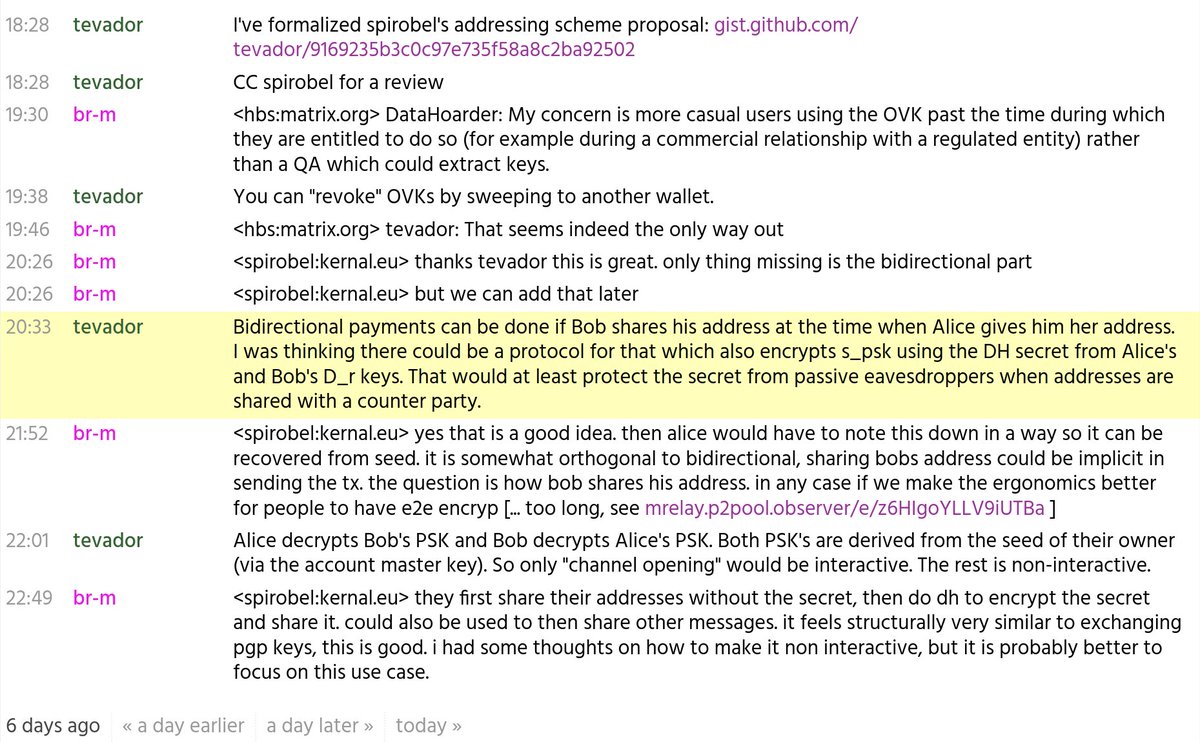
end users will mostly rely on sender shared keys, which move the responsibility to write the channel opening to the receiver.
as a consequence we get stateless wallets and publicly shareable addresses.
After a one round opening that does not require both participants to be online, there is a bidirectional channel.
merchants will mostly rely on pre shared keys. The out of band channel of the checkout page is end to end encrypted. Merchant wallets are swept after recovery. To deploy the same merchant wallet without rotation after the rare case it would have to be recovered makes no operational sense.
the PSK has similar properties to a txid. knowing a txid doesnt mean knowing which enotes belong to sender and receiver.
the current draft introduces the unnecessary restriction to be blockchain independent,
which leads to the addrgen tier being able to see more than the "txid" of the channel opening
if this is done properly, the worst thing that could happen is that somebody knowing the address knows the txid of the first transaction sent to this address in the PSK case,
in the SSK case this does not apply. There is no downside to sharing the address publicly.
https://t.co/PK9FpX7ZtZ <- I politely tried to avoid this confrontation around jamtis.
I would prefer jamtis to quietly go the way of seraphis. i didn't participate in this discussion, because I fundamentally disagree with the notion that this is either or vs jamtis.
the current jamtis draft is a moderately verbose document that fails to clearly articulate the value proposition for end users, while introducing 400 character addresses that now got another 40 bytes added.
right now there is no indication that the 400 bytes ++ jamtis addresses are useful for users and there is nothing that can stop wallet app & library authors from implementing an alternative that solves the UX challenges of privacy preserving wallet synchronization.
instant synchronization will help with merchant and end user adoption while 400 character addresses are greatly impractical and nobody in the real world will accept a change that worsens the user experience like this without providing a tangible benefit.
jamtis addresses scaling via the introduction of "filter-assist" tiers. This is something I am fundamentally opposed to. It is not as bad as the "oblivious syncing services" in Zcash land,
but it still introduces the unnecessary dependency on hosted "services" that have to be maintained, while not fundamentally solving the syncing issue.
@XMRVoid@Goblin_cards@offgridcash The basic offgrid virtual card is only $49 and 3% top up fee. I don't use crypto cards much so for me it's not a bad deal.
I think it really comes down to what your personal needs are as to which card you choose.
@Jacksnowdenxxxx@DouglasTuman Possibly but I have a suspicion this is governments funding certain companies to find bad actors.
There's lots of competition among swap services & other chains.
Most governments don't do their own exploits they outsource to companies & organizations that already have experience.
Justin Berman recently put forward a proposal to continue to work full-time on Monero development, with focus on the audits of the integration of Full-Chain Membership Proofs (FCMP++) into the Monero codebase and beta stressnet!