An Agentic RAG (Retrieval-Augmented Generation) combines the power of information retrieval with generative models to provide more accurate, context-aware responses.
Instead of relying solely on pre-trained knowledge, it dynamically retrieves relevant information from a database before generating answers.
In this thread, we will walk you through building one in minutes using @phinlp—step-by-step with code, all running locally 🧵.
@SolportTom@prokayy Please send us a DM, we want to participate in the hackathon however we would be much more confident after having a conversation first!
@SolportTom@bonkfun We have already DM’d with @solportskg, would love to have a conversation with you as well if possible before partaking in the hackathon as we are very confident in winning this.
After months of dedicated development, our team is excited to unveil our final product this evening.
We have been intentionally waiting for the right launchpad and optimal market conditions, and we are confident that time is now.
Revenue generated will be actively distributed among holders, and the launch will take place on @bonkfun.
More information will be available in the next few days.
Today, we built an autonomous RAG (Retrieval-Augmented Generation) chat application, demonstrating how quickly and easily this can be achieved with PhiNLP.
The process is straightforward and requires minimal steps.
Here’s a breakdown of the features and use cases:
- Supports external documents: You can integrate PDFs, CSV files, and website links into the chat for dynamic, context-aware conversations.
- Chat history memory: The app retains conversation history, ensuring continuity across interactions.
- Powered by Qdrant: Qdrant is used for efficient storage and retrieval of relevant data, ensuring fast and accurate responses.
- State management & multi-session workflows: The app manages different sessions seamlessly, allowing for smooth multi-session workflows.
This process can be accomplished with just a few steps using PhiNLP, and all the details on how to set up and customize this functionality can be found in our comprehensive documentation: https://t.co/ndxRgqCSuj
With PhiNLP, you can easily build AI agents that automatically generate and upload Reddit posts based on user input for a specific subreddit and topic.
This is just one of many examples of the platforms where you can create AI agents using our platform.
As a test of its capabilities, we developed a crypto analysis agent that reads top news, extracts key insights, and delivers summaries of analysts' recommendations.
This showcases how the platform can be used to create reasoning agents tailored to various needs—whether it’s analyzing market sentiment, tracking crypto price trends, monitoring blockchain activity, or designing investment strategies.
The possibilities for building advanced reasoning agents are virtually limitless.
Now that your Agentic RAG is set up, you have a powerful tool for retrieving and generating context-aware responses to any question.
@phinlp makes it easy to build and deploy these systems locally, helping you unlock deeper insights from your data.
Whether you're working on research, customer support, or knowledge extraction, the possibilities are endless!
Stay tuned for more tips and advanced use cases.
Step 4: load the knowledge base into the vector database.
This allows your Agentic RAG to quickly retrieve relevant information from the stored documents during inference.
Here’s an example question for your RAG agent: "What’s the key idea behind the 'Attention is All You Need' paper?"
You can ask the agent anything you like, and it will retrieve relevant information and generate insightful responses.
Step 3: initialize the PDF Knowledge Base by extracting key content, transforming it into embeddings, and preparing it for efficient querying by the RAG model.
An Agentic RAG (Retrieval-Augmented Generation) combines the power of information retrieval with generative models to provide more accurate, context-aware responses.
Instead of relying solely on pre-trained knowledge, it dynamically retrieves relevant information from a database before generating answers.
In this thread, we will walk you through building one in minutes using @phinlp—step-by-step with code, all running locally 🧵.
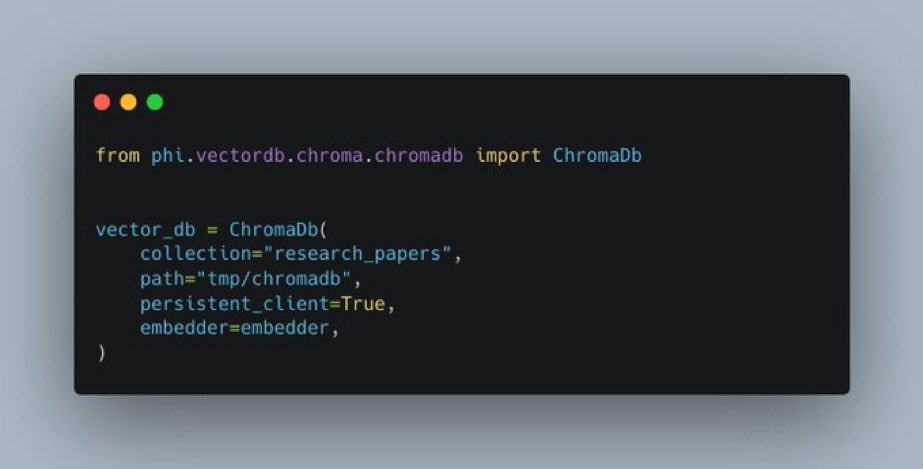
Step 2: set up the @trychroma vector database to store and query the embeddings. Chroma offers fast and scalable vector search capabilities, ideal for large-scale retrieval tasks.
Step 1: start by defining the @ollama embedder to convert text into dense vector representations, enabling efficient search and retrieval from the knowledge base.
To build an Agentic RAG, we will use:
1. @phinlp as the agentic framework for intelligent retrieval-augmented generation
2. @ollama Llama 3.3 as the model for inference
3. @trychroma as the vector database for efficient document storage and retrieval
That said, you might have noticed that many LLMs (like the models used by ChatGPT or Grok) struggle with seemingly simple tasks—like counting specific letters in words (e.g., the "r" in "strawberries") or misinterpreting spelling in generated images.
This happens because LLMs are trained on large datasets and break input down into "tokens"—chunks of letters, symbols, and spaces that help them predict the next part of their output.
For example, when you input a word like "addition," it’s converted into tokens that the model processes.
While we see an equation like "2 + 2" as a simple, whole input, LLMs view it as a series of tokens.
This token-based processing is why models like ChatGPT can’t add numbers or count letters the way we do—they rely on probabilities and training data to predict outputs, rather than performing calculations.
But that doesn’t mean you can’t get accurate answers from AI!
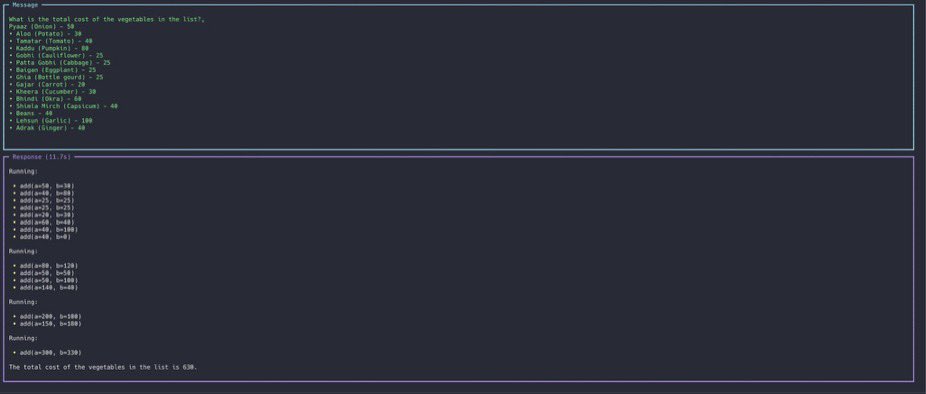
By using tools like PhiNLP’s calculator, you can enhance your LLM to handle specific tasks like precise calculations, overcoming the limitations of general-purpose models.
Did you know PhiNLP has practical use cases for everyone, not just those in AI?
Whether you're tracking expenses, calculating tips, organizing a to-do list, or even summarizing a meeting, PhiNLP's calculator tool can help.
You can easily deploy your own LLM in just minutes to assist with tasks like these, making everyday tasks simpler and more efficient.
Did you know PhiNLP has practical use cases for everyone, not just those in AI?
Whether you're tracking expenses, calculating tips, organizing a to-do list, or even summarizing a meeting, PhiNLP's calculator tool can help.
You can easily deploy your own LLM in just minutes to assist with tasks like these, making everyday tasks simpler and more efficient.