L'admirable
Mariane Saprati est
"morte de tristesse", a annoncé sa famille hier. Immense chagrin traverse le monde libre. En hommage, un réseau télé mettra-t-il son grandiose Persepolis, à sa grille des prochains jours? https://t.co/pYJGzKR5oD
@icirctele@TVAreseau@telequebec
@QuebecOUIaussi C’est aussi ce que Lavau appelait la fonction tribunicienne. Les extrêmes sont avant tout des gueuloirs, ce qui les conduit à se retrouver le plus souvent. Ils semblent opposés mais c’est une opposition de façade. On verra l’allure de QuebecOuiaussi après l’effet d’annonce.
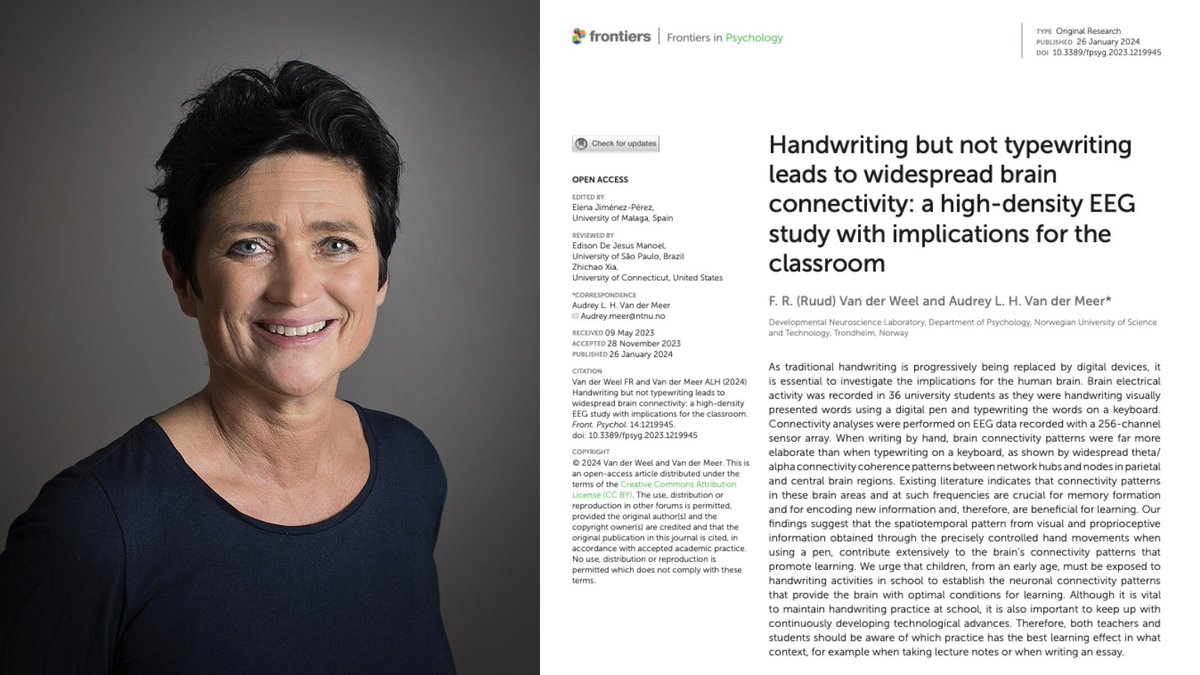
L’IA nous détourne du désir de penser par soi-même et le clavier du travail cérébral. Écrire à la main finira par devenir un acte de salut public …. si nous ne cessons pas d’apprendre à le faire
A Norwegian neuroscientist spent 20 years proving that the act of writing by hand changes the human brain in ways typing physically cannot, and almost nobody outside her field has read the paper.
Her name is Audrey van der Meer.
She runs a brain research lab in Trondheim, and the paper that closed the argument was published in 2024 in a journal called Frontiers in Psychology. The finding is brutal enough that it should have changed every classroom on Earth.
The experiment was simple. She recruited 36 university students and put each one in a cap with 256 sensors pressed against their scalp to record brain activity. Words flashed on a screen one at a time.
Sometimes the students wrote the word by hand on a touchscreen using a digital pen, and sometimes they typed the same word on a keyboard. Every neural response was recorded for the full five seconds the word stayed on screen.
Then her team looked at the part of the data most researchers had ignored for years, which is how different parts of the brain were communicating with each other during the task.
When the students wrote by hand, the brain lit up everywhere at once.
The regions responsible for memory, sensory integration, and the encoding of new information were all firing together in a coordinated pattern that spread across the entire cortex. The whole network was awake and connected.
When the same students typed the same word, that pattern collapsed almost completely.
Most of the brain went quiet, and the connections between regions that had been alive seconds earlier were nowhere to be found on the EEG.
Same word, same brain, same person, and two completely different neurological events.
The reason turned out to be something nobody had really paid attention to before her work. Writing by hand is not one motion but a sequence of thousands of tiny micro-movements coordinated with your eyes in real time, where each letter is a different shape that requires the brain to solve a slightly different spatial problem.
Your fingers, wrist, vision, and the parts of your brain that track position in space are all working together to produce one letter, then the next, then the next.
Typing throws all of that away. Every key on a keyboard requires the exact same finger motion regardless of which letter you are pressing, which means the brain has almost nothing to integrate and almost no problem to solve.
Van der Meer said it plainly in her interviews.
Pressing the same key with the same finger over and over does not stimulate the brain in any meaningful way, and she pointed out something that should scare every parent who handed their kid an iPad.
Children who learn to read and write on tablets often cannot tell letters like b and d apart, because they have never physically felt with their bodies what it takes to actually produce those letters on a page.
A decade before her, two researchers at Princeton ran the same fight using a completely different method and ended up at the same answer. Pam Mueller and Daniel Oppenheimer tested 327 students across three experiments, where half took notes on laptops with the internet disabled and half took notes by hand, before testing everyone on what they actually understood from the lectures they had watched.
The handwriting group won by a wide margin on every question that required real understanding rather than surface recall.
The reason was hiding in the transcripts of what the two groups had actually written down.
The laptop students typed almost word for word, capturing more total content but processing almost none of it as they went, while the handwriting students physically could not write fast enough to transcribe a lecture in real time, which forced them to listen carefully, decide what actually mattered, and put it in their own words on the page.
That single act of choosing what to keep was the learning itself, and the keyboard had quietly skipped the choosing and skipped the learning along with it.
Two studies. Two countries. Same answer.
Handwriting makes the brain work. Typing lets it coast.
Every note you have ever typed instead of written went into your brain through a thinner pipe. Every meeting, every book highlight, every idea you captured on your phone instead of on paper was processed at half depth.
You did not forget those things because your memory is bad. You forgot them because typing never woke the part of the brain that would have made them stick.
The fix is the thing your grandmother already knew.
Pick up a pen. Write the thing down. The slower road is the faster one.
@Honoukai@JeanMarcLeger1 Mais voyons ce ne sont pas des statistiques . On compare ici des quantités incomparables. Demandez au statisticien qui partage. C’est de l’humour !
Superbe chronique de @pvfoisy dans le @JdeMontreal
Zohran Mamdani et les leçons pour QS et le NPD | JDM
Mamdani, le nouveau maire de New York a misé sur des promesses très concrètes, proches des électeurs: bus gratuit, gel des loyers et épiceries...
Zohran Mamdani et les leçons pour QS et le NPD | JDM https://t.co/XJa6Pt4yGi
@atrupar Facts say the opposite. Canada—with the universal healthcare that 32 of 33 developed countries have—has better health-related quality of life, vastly lower maternal and infant mortality rates, and a longer life expectancy than the US.
Cette vidéo est fabuleuse. Il s’agit d’une pieuvre dévissant le couvercle d’un vase de l’intérieur. Elle provient de l’Aquarium Enoshima à Fujisawa, au Japon.
Les pieuvres sont des animaux extrêmement intelligents, capables de résoudre des problèmes complexes, comme ouvrir des bocaux pour accéder à de la nourriture.
Dans cette vidéo, une caméra placée à l’intérieur de l’aquarium capture la dextérité de la pieuvre utilisant ses tentacules pour dévisser le couvercle et accéder à son repas.
Certains objets comme les bocaux à vis sont utilisés pour stimuler mentalement les pieuvres.
Mens sana in corpore sano.
Salukes
#science #pieuvre #animaux #intelligence #profbucella #lasciencepeuttout
PM @francoislegault sur la tentative de meurtre sur D Trump: «C’est inquiétant ( … ) on n’a pas ça, cette violence-là envers les politiciens, au QC. En tout cas, physiquement. »
Que faites-vs de la tentative d’assassinat sur #PaulineMarois ?!
#Attentatpolitique
et misogyne.
@Gaspard_Skoda Plutôt l’impression que #QS s’organise pour être un repoussoir et donner le goût à son électorat d’aller organiser l’avenir ailleurs …. Avec son pragmatisme #GND n’a pas raté sa cible , on n’a plus du tout envie de rêver.
@Vadeboncoeur_Al Trés beau tweet , on sent une parenté, proche ou lointaine , consciente ou inconsciente avec À.Damasio , et plus exactement « l’ordre étrange des choses ».
Ce qu’il y a de plus fascinant dans l’évolution, c’est qu’elle ne concerne pas seulement les espèces, mais bien plus fondamentalement, la sélection des processus biochimiques fondamentaux les plus efficaces, qui sont aussi encodés dans notre génétique et se transmettent ainsi depuis la nuit des temps. Non seulement cette évolution des processus biologiques a précédé celle des espèces complexes, mais elle en a permis l’émergence.
@lefebvreren @Leffjoalec Pleurer ça a jamais empêché personne d’être fort face à l’adversité. Ça montre par contre qu’on est attentif aux autres et c’est cette valeur là qui fonde la politique.