I’ve been struggling with the OpenClaw setup. Burned over $1,000 on tokens in just 3 days.
Then this guy saved me weeks of time and serious money.
Much respect.
If you’re setting up OpenClaw, this is the only post you need to read. 👇
Chamath: Two terms you need to pay attention to in AI are Prefill and Decode
“There's two terms that I think you're going to hear a ton about over these next few years.”
“The first term is prefill, and the next is decode.”
“What prefill and decode are, are two very distinct ways of how models think, and how a model goes through the process of answering a question that you ask it.”
“And so when you send a prompt to AI, what happens is that the model processes it. This is called the reading phase or prefill.”
“It reads your entire prompt all at once. And then it does a bunch of math, calculates all these relationships between all the words, and it stores them in temporary memory.”
“The problem is that this is really compute bound. So it requires massive brute force. And Nvidia GPUs crush here.”
“And their architecture is designed for massive parallel processing, which makes them really amazing at digesting these long prompts.”
“So the problem just gets bigger and bigger, Nvidia just completely dominates.”
“But the next phase though, this critical phase, the decode phase, is the writing phase, right?”
“So the model starts to generate a response, you ask it a question and its response, one token at a time.”
“And then to pick the next token to pick the next word, it has to look back at everything it has said already so that it doesn't hallucinate.”
“The problem is that this is incredibly memory bandwidth constrained.”
“And in our architecture, a long time ago, we made these design decisions from day one.”
“And so what we did was we took a very different architectural approach, we took a very conservative process technology. We weren't pushing the boundaries of physics.”
“And we used a lot of what's called SRAM. So memory on the chip so that we could do this decode thing as well or better than everybody else.”
“And so now when you put these two things together, I just think it's going to create a huge acceleration in the ability for this entire infrastructure layer to get much cheaper and much more valuable, which I suspect then it'll have a lot more developer pull, you'll get a lot more applications being built, billions and billions of more people using it.”
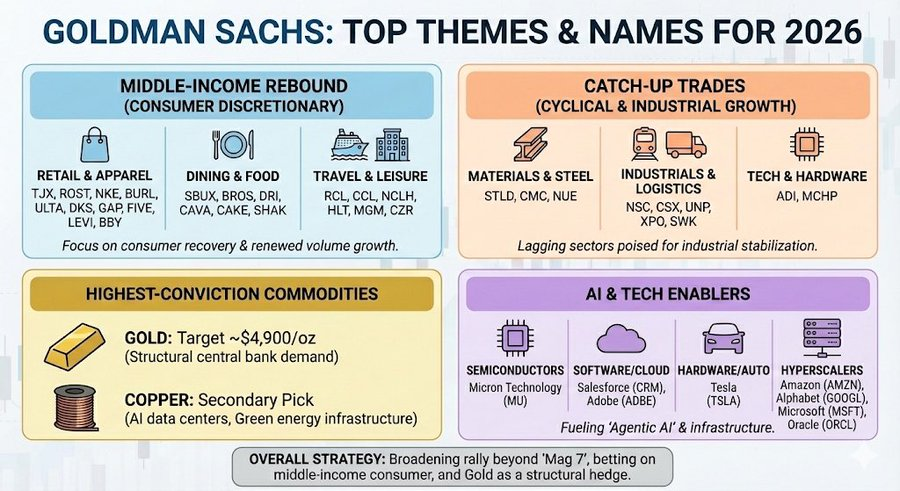
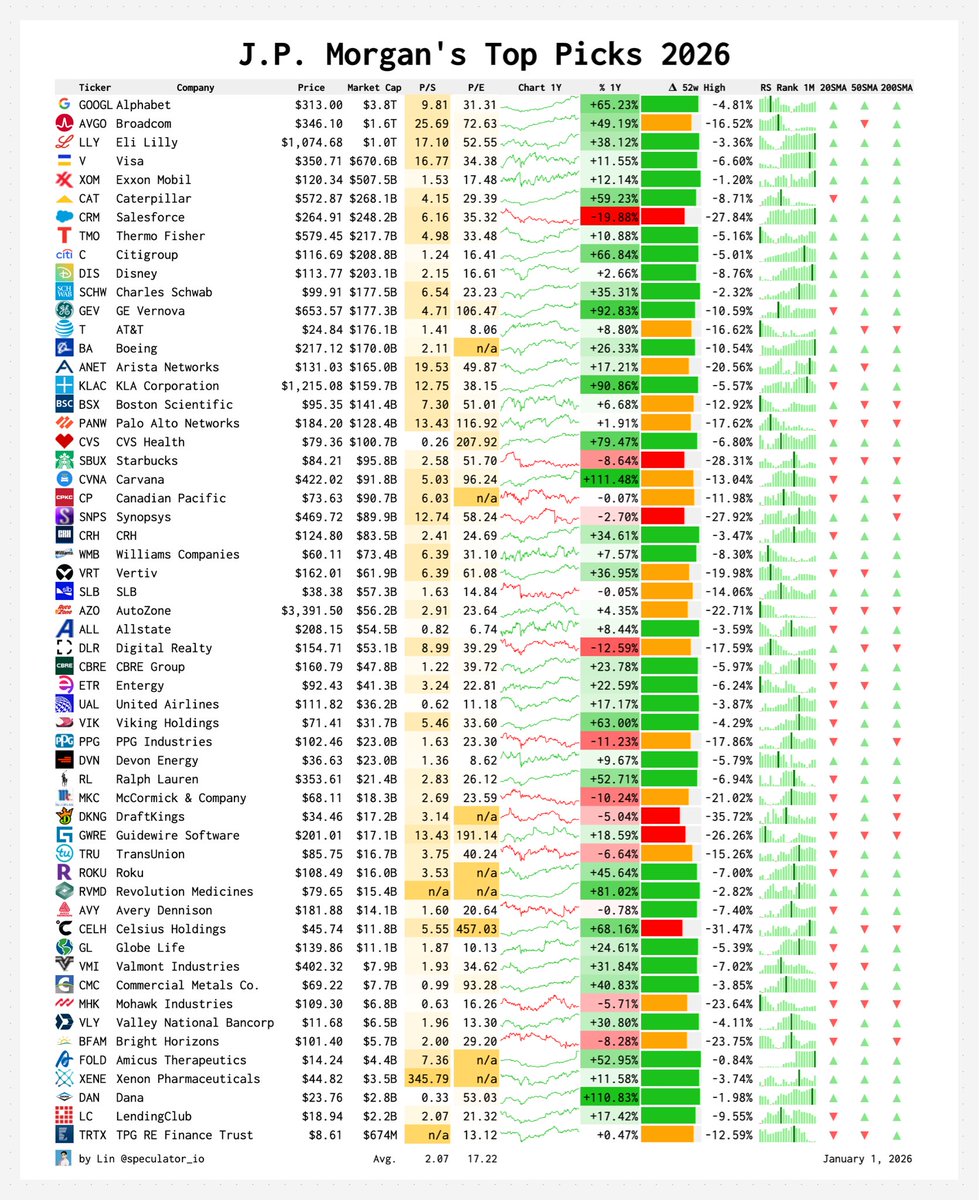
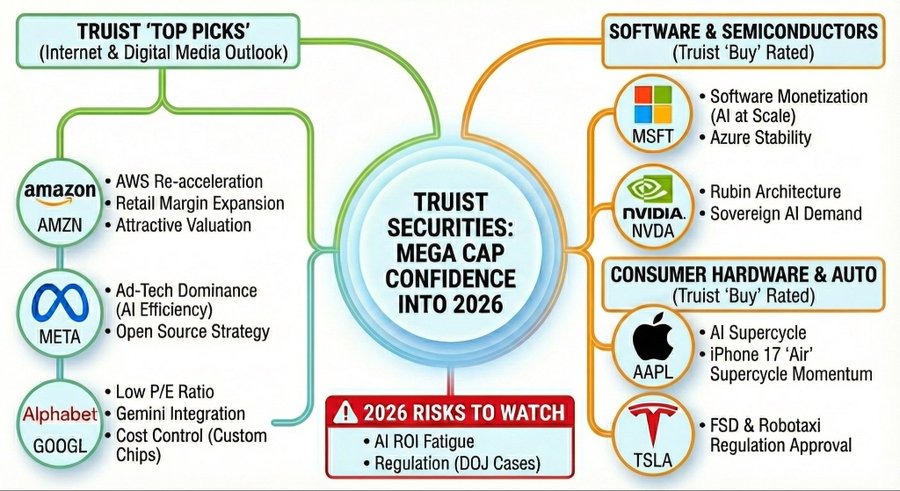
Here is what some of Wall Street thinks will happen in the stock market next year
JPMorgan
UBS
Goldman Sachs
Truist
(Credit to @WisemanCap for making these)
A room full of AI engineers just voted Perplexity most likely to fail at a major conference and nobody’s talking about what that actually means.
These are the people building LLM products. They looked at a $20B valuation and said “dead company walking.” That’s not skepticism about AI. That’s pattern recognition.
The numbers are worse than you think. Perplexity processes 780M queries monthly. Google does 13.7B daily. Perplexity is trading at 100x revenue on 0.2% of Google’s volume while burning LLM inference costs on every single query. Google serves most searches from cache for pennies.
But here’s what makes the conference vote interesting. Perplexity just launched Comet browser in July and made it free for everyone. Reviews say it’s better than Arc. That sounds like good news until you realize what it actually means. They’re building an excellent browser to solve a distribution problem that excellent browsers don’t solve.
Arc is beloved by users and has barely made a dent in Chrome’s 65% market share. Perplexity building a better Arc doesn’t matter. They’re optimizing product quality in a game where product quality is irrelevant. Browser wars were decided 15 years ago when Google bundled Chrome with every service and defaulted it on Android.
The Comet launch reveals what game Perplexity is actually playing. Search isn’t about better answers. It’s about owning the default box on 4 billion devices. Google pays Apple $18B annually just to stay default on Safari. They own Android’s 72% mobile share. They own Chrome. Every Gmail, YouTube view, Maps query feeds their algorithm. Perplexity has $1.5B in total funding trying to compete with a company generating $300B in annual revenue.
Track record annihilates any bull thesis. Neeva was founded by Google’s SVP of Ads who ran search infrastructure for 15 years. Sequoia and Greylock backed it. They believed 2.5% market share was enough to win. Peaked at a few million users, sold to Snowflake for $184M. That’s what happens when you have perfect search quality without distribution.
Microsoft integrated ChatGPT into Bing in February 2023. Nearly three years later their global market share has moved from 3.4% to 4%. That 60 basis point gain is the entire lift from exclusive access to GPT-4 and billions in marketing spend. The company with infinite capital, default placement on Windows, and the hottest AI integration in the world gained 0.6 percentage points in three years. DuckDuckGo has spent 17 years clawing to 2.3% market share despite being profitable since 2014.
Making Comet free and better than Arc makes the story worse, not better. It means Perplexity is investing resources into product excellence when the constraint is structural. Arc proves you can build a superior browser and still lose. Chrome didn’t win on quality. Chrome won because Google spent a decade training user behavior, bundling it everywhere, and making it impossible to avoid.
The unit economics collapse at scale. LLM inference on every query means costs rise with usage. Google’s cached results mean costs drop with scale. The more Perplexity grows, the worse their margins get. The more Google grows, the better theirs get. And the instant any Perplexity feature gains traction, Google copies it and ships to billions of users overnight.
What the conference vote reveals is the gap between what makes compelling fundraising versus what actually works. VCs see conversational AI and a polished browser and write $20B checks. Engineers see a company pouring resources into product differentiation when distribution is everything. They’ve watched better products with better teams and more capital fail on this exact playbook.
Perplexity needs either DOJ to blow up Google’s distribution deals or users to completely rewire 20 years of search behavior. The people voting at that conference have done the math on both scenarios.
The cap table hasn’t.
🇨🇳 INTERVIEW: “XI JINPING MAY HAVE LAUNCHED HIS OWN COUNTERCOUP”
David Zhang, Host of The China Insider (@DavidZhang360)
“People ask who the coup was targeting. My view is that it may have come from Xi himself.
Multiple sources inside China reported that a private army was forming outside Beijing, around 20 kilometers away. It was described as a division-sized force, ten to twenty thousand people including planning and logistics.
The timeline lines up. This happened between November 2024 and March 2025, the same period when Zhang Youxia refused to look at Xi during the political meeting. That kind of body language is not normal in CCP politics.
If the generals were plotting, they wouldn’t need a private army. But if Xi was losing control of the military, he would.
Look at the Fujian aircraft carrier launch. It is Xi’s legacy project, yet the ceremony was smaller and quieter than the previous two. No big reception, no inspection, no applause.
For the most important ship of Xi’s career, the celebration was tiny. That tells you something inside the military has shifted.”
This story is wild
Chinese state-backed hackers hijacked Claude Code to run one of the first AI-orchestrated cyber-espionage
Using autonomous agents to infiltrate ~30 global companies, banks, manufacturers and government networks🤯
How the attack was carried out in 5 phases