This account will be retired next week as we streamline where we share updates, making it easier to stay connected with the latest research and journal news from APS.
The science continues over at @apsjournals 👉
Haven't seen much here lately? That's because updates from Physical Review Fluids are now shared through @APSjournals.
Thanks for following us over the years, we hope you'll join us there!
This account will be retired next week as we streamline where we share updates, making it easier to stay connected with the latest research and journal news from APS.
The science continues over at @apsjournals 👉
In each place I gave a tutorial and a technical talk, mostly an hour each session, with audiences in the range 50-100 in each case. The trip was phenomenal. I am a bit at a loss to communicate just how warmly the outreach was received. Science is truly the common language.
3/3
As we celebrate #PRF10, Chief editor Beverley McKeon shares reflections from her recent visits as part of the Journal's anniversary:
> In the 10th birthday year of Phys. Rev. Fluids, I was very pleased to be able to visit India and Singapore to promote the journal.
1/3
I visited and spoke at the National University of Singapore (NUS), A-STAR (public agency), the International Center for Theoretical Sciences in Bangalore (ICTS), the Indian Institute of Science (IISc) in Bangalore and the Indian Institute of Technology Bombay (IIT-B).
2/3
New simulations in Physical Review Fluids show 4D quantum vortices reconnecting in ways 3D never allows: one mode follows the classic universal scaling law, another loses almost no energy at all, and a third type doesn’t reconnect, it just spins.
🔗 https://t.co/ySm9sO1WIV
When shock waves propagate through a flexible fiber curtain, increasing the fiber aspect ratio and reducing flexibility increase shock resistance. A scaling law predicts the curtain expansion, accounting for fiber elongation and bending deformation.
https://t.co/u8muCEhB1O
A simple droplet generation technique consists of rapidly stretching a liquid ligament from static or vibrating baths. Systematic experiments map the parameter space for ligament pinch-off into a single droplet, showing excellent reproducibility.
https://t.co/eviz1CigA4
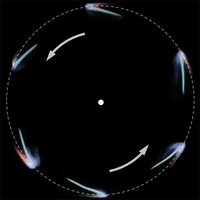
In a circular unheated Hele-Shaw cell, self-sustaining CH4-air flames emerge spontaneously, rotating along the edge. The stable traveling-wave pattern arises from a balance between local flame speed, flow, and wall heat loss.
Read the editors' suggestion: https://t.co/7ajzY3gE3I
Simulations of stratified flows past a vertical cylinder show that weak stratification gives a narrow turbulent wake, while in strong stratification, thermocline-spanning recirculation cells and stationary internal waves appear.
Editors' suggestion: https://t.co/W2UfBC7EBw
Strongly gyrotactic microswimmers in turbulence align with the vertical, weakly gyrotactic ones are nearly isotropic, and rods align with the strain direction, showing how orientation and transport are set by response time and shape.
Editors' suggestion https://t.co/PPtSmfhKWx
A 30-day experiment follows the flow of a high-viscosity liquid through a capillary tube, revealing persistent diffusive imbibition and testing how models that account for the dynamic contact angle perform in long-term imbibition processes.
https://t.co/GD3RDSJs8y
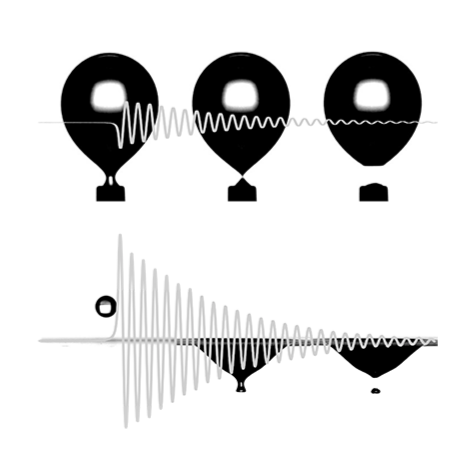
The sound emitted by a detaching bubble is set by the amplitude of its volumetric oscillations, mainly controlled by the bubble’s initial growth velocity, as shown by experiments and captured by a simple model.
Editors' suggestion: https://t.co/j8yZDWktPs
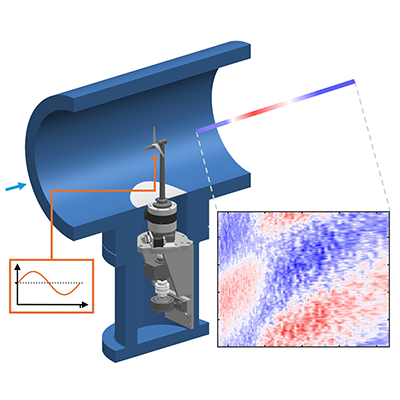
Forcing a wind-turbine wake via slow periodic rotation-rate oscillations generates traveling waves advected with the wake, controlled by thrust and tip-speed ratio, highlighting the importance of advection for modeling and control of wind-turbine wakes.
https://t.co/jRaYlARSy3
A passive vector model with spatially linear advection has a Hopf equation that can be solved exactly by an ensemble of Gaussian fields, displays an intermittent energy flux from large to small scales, arising from a probabilistic mixture of sub-ensembles
https://t.co/uds9rCQ551
A sessile soap bubble in an electric field stretches into a taller dome, but past a critical point the top sharpens into a pre-jet cone. When properly rescaled, bubbles of different sizes deform along the same curve, set by electrocapillary balance.
https://t.co/t9JetoEmry
🚨 Next PRFluids Journal Club! Mihailo Jovanović presents a perturbation-based frequency-response framework for subcritical transitions in shear flows.
🕒 July 23, 12:00 pm ET
Read ahead https://t.co/vXtqT2BNrt
Registration https://t.co/PPjPs9z2g1
A new framework provides quantitative guidelines to accurately simulate turbulent two-phase flows, with a priori criteria and cost estimates based on Reynolds, Weber, and Capillary numbers, capturing key interfacial scales.
Editors' suggestion: https://t.co/hiFSFdPAbd
The shear rate determining the viscous-to-inertial transition of non-Brownian suspensions near jamming has a critical behavior, tied to a diverging microstructural length scale governing the emergence of inertial effects.
Editors' suggestion: https://t.co/NcLfLgqTFT