We are #hiring across AI Research, Product, Engineering, and GTM 👀
Join the team that is defining what Physical AI is and building a physical world model that learns from sensors and works across every asset, use case, and workflow.
🔗 Apply today: https://t.co/9vi8wsSFpO
Tomorrow I join Hiroaki Kitano of Sony on a @wef panel about world models. We worked together at Sony CSL in Tokyo when I was Research Scientist in @rkmt group years ago and I’m excited about this reunion.
AI has read everything about the physical world and experienced none of it. World models change that.
Nov 12, 6am PT. Learn more: https://t.co/S3DoXtK9ru
At Archetype AI, we build Newton, a physical world model. Newton learns how machines and operations actually behave directly from sensor data, so the teams who run them can predict unknown failures, understand their root cause in plain language, and automate the response. Teams put it to work through Newton Agents.
A Newton Agent has no interface. It runs in the background, reading vibration, current, video, and other sensor streams and reasoning about what they mean. When someone needs to act on these insights, the agent needs an application around it: a control plane for a fleet of assets, a review screen for a flagged event, a conversational interface for building the next agent.
Designing those applications is messy. They are live, dense, and probabilistic, and they draw on industrial processes that never stop changing. More and more often, they’re also built with AI coding agents. That changes what a design system has to do: it can’t just work as standard UX practice for designers and engineers, it also has to hold up when a coding agent is the one building the interface.
That’s why we’re introducing Signal — the design system behind Archetype AI Console and every prototype we build, and it’s made to work with Newton Agents. The name is also the goal: to help people find the signal in complex, constantly changing data.
Happy to introduce Signal the first design-system for Archetype AI. I built it together with the design team @PhysicalAI. Check out the comments for more.
Cameras show what a construction crew is doing. Water-level and weather data help explain why it slowed down. On @KAJIMA_CORP's canal project in Niigata, Newton combined all three and found storms cut productivity for days after they passed.
Our CTO Nick Gillian explains ↓
For the first time, you can build a Physical AI agent on your own sensor data for free. Try Newton free for 14 days with Anomaly Discovery, Operational State Monitoring, and Rare Event Detection. Build in Python or with your AI coding agent. https://t.co/xiGXolu4Le
This is a little bonsai that grows differently depending on the room it’s in. In a hectic meeting room, it grows lots of branches of different sizes. In a quiet studio at home, it grows fewer branches, some bigger than others.
We’ve been running a few experiments to see how physical AI could help everyday objects adapt to their surroundings. This is the first one, built by @lukas_moro.
A closer look at the functionality of the 'little tree'. 🌳
An @adafruit Feather nRF52840 Sense board streams light, sound and vibration to Newton Omega, our time-series model, running on a @Raspberry_Pi. When the blinds go up, it sees a new state and grows a branch. In the end you can see the embedding map with Newton's outputs. After a state is not detected for a while the branch yellows and drops off after about ten minutes.
Moving on I will add many different states the tree can go through and build a game director where Newton facilitates the long term growth of the tree and short term reaction like wind, blossoming and more.
We showed Newton, our physical world model, a motor it had never seen. With no labels, it separated off, on, and an anomaly from acceleration and current data that we provided.
At the last week's Strange Summit hosted by @taratan, our co-founder and Chief Scientist @_jaimelien_ explained how it works: Newton is a physical world model pre-trained on sensor data. It can learn how new machines it has never encountered behave instead of being rebuilt for every asset. One model across the fleet, deployed on-prem, at the edge, or in your own cloud.
Learn more about Newton capabilities: https://t.co/WdlgkmCM4W
90 minutes. Real sensor, video and telemetry data. A coding agent and Newton's API.
Thank you to everyone at AWS who built with us at the Physical AI Agent Hackathon this week.
Agents that came out of the session:
→ Sonar monitoring for ships and sharks near undersea fiber cables
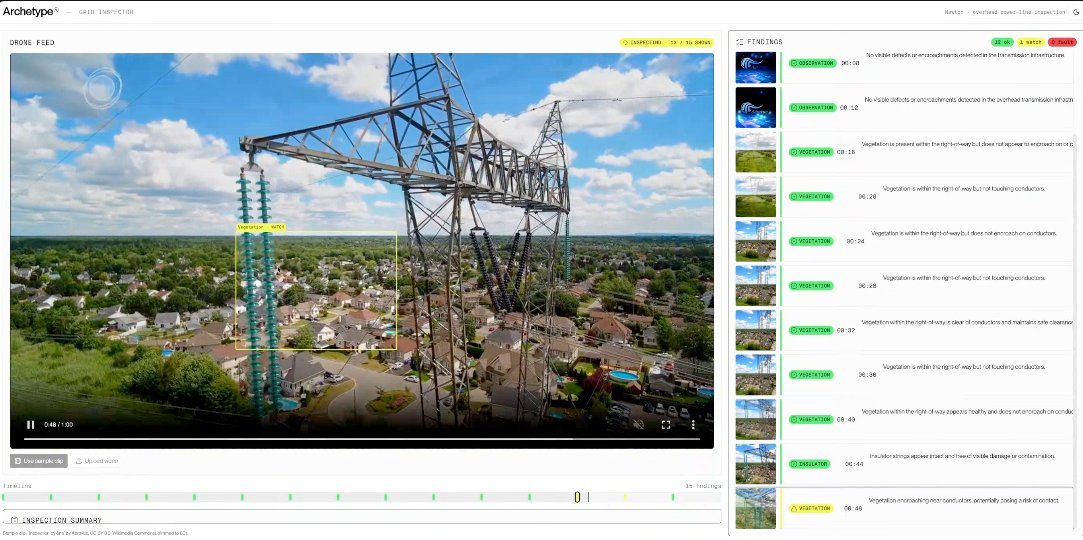
→ Drone inspection of power lines
→ Fault detection across 44 motors
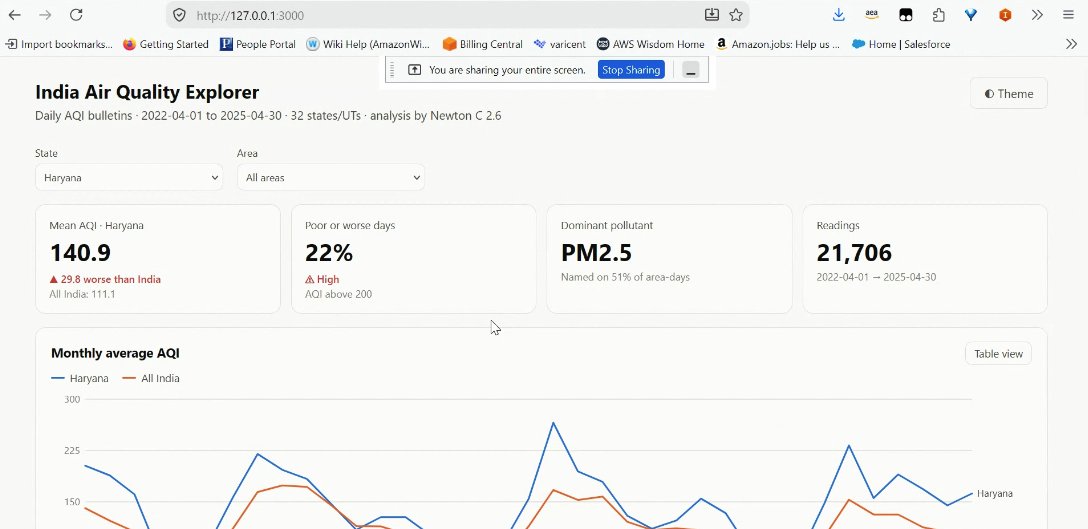
→ Air quality monitoring, queryable in plain language
Newton is on AWS Marketplace and deploys inside your own AWS environment. Build with it: https://t.co/9ADkjW2DpX
Most AI outputs text. On a factory floor, sometimes the right answer is a control signal.
Newton does both: a report on why a machine is drifting, and a real-time agent next to the sensor.
Our CTO Nick Gillian explains ↓
Newton’s embeddings turn a window of raw sensor readings into a single point, placed so that moments that look alike in the physical world land near each other.
This public dataset, PAMAP2, shows data recorded when a group of nine people wore three motion sensors, on the wrist, the chest and the ankle, while going through twelve everyday activities.
This visualization tool helps our team see the data in more detail and isolate different states: Rest, walk, run, cycle, stairs and housework each settle into their own region.
Seeing why a model groups two moments together is the first step toward understanding what it tells you about the physical world.
Built with Newton on the PAMAP2 physical activity dataset (Reiss and Stricker, 2012).
When people hear Physical AI, they picture a humanoid robot. Our CTO, Nick Gillian, makes the case that most of the real opportunity lies in existing equipment rather than in deploying a humanoid workforce.
Every factory is streaming radar, video, vibration, and current. Newton is one model that reads all of it, catches what’s off in real time, and adapts to machines it’s never seen, right at the edge.
Full conversation with @AI_in_the_AM ↓
An AI model correctly identified a slow, regular heartbeat in patient monitoring data. Then it incorrectly concluded the readings ruled out a serious cardiac conduction abnormality.
Even when an AI model is given the right conclusion about a physical system, it can still be wrong about why.
In new research with @encord_team, announced today at the Long Horizon Summit alongside the launch of Encord Data Labs, we tested three AI models on sensor data from patient monitoring (see the graph below), building HVAC systems, and atmospheric CO₂. Each model was given the correct finding, and domain experts reviewed its explanation against the underlying signals.
The research found that all three produced flawed explanations of the evidence behind it:
→ An HVAC airflow obstruction was recognized, but sensor readings were misread to rule out other faults
→ Seasonal CO₂ patterns were recognized, but the physical processes driving them were reversed
→ A slow heartbeat was recognized, but pulse data was misread to rule out heart block
A plausible explanation isn’t the same as an accurate one, and accuracy matters when real-world decisions depend on it.
With Encord Data Labs, we’re pairing Newton’s native understanding of sensor data with expert evaluation to ground AI reasoning in measurable evidence.
Read the full findings on our blog: https://t.co/QutZ24pOAf
Our Chief Scientist @_jaimelien_ joins the panel at Long Horizon in San Francisco on Oct. 20 to take on one question: “Will World Models Eat Physical AI?”
“World model” is a broad term; some are built to generate or simulate the physical world. Newton is a physical world model that learns from real-world sensor data, so it’s built to understand what is actually happening on a machine or a factory floor.
That’s the view Jaime brings to the debate.
➡️ In SF? Join us: https://t.co/wqtKKF7frn
Operational State Monitoring agent helps you understand the hidden operating conditions that drive machine performance.
It allows operators to:
📊 Continuously monitor machines and industrial processes
🔎 Identify changing operating states from multimodal sensor data
💡 Provide real-time visibility into machine behavior, surfacing equipment degradation, process instability, and the operating envelopes that drive reliability, quality, and throughput
Learn more about our physical world model, Newton's, capabilities here: https://t.co/s9t4Kdg2ta
Unplanned downtime cost the world’s 500 largest companies roughly $1.4 trillion in 2024, about 11% of their annual revenue, according to Siemens.
Factories, grids, and fleets have been monitoring sensor data to detect these failures early for years. What’s been missing is the intelligence layer that can read those signals and help operators take action before a line stops.
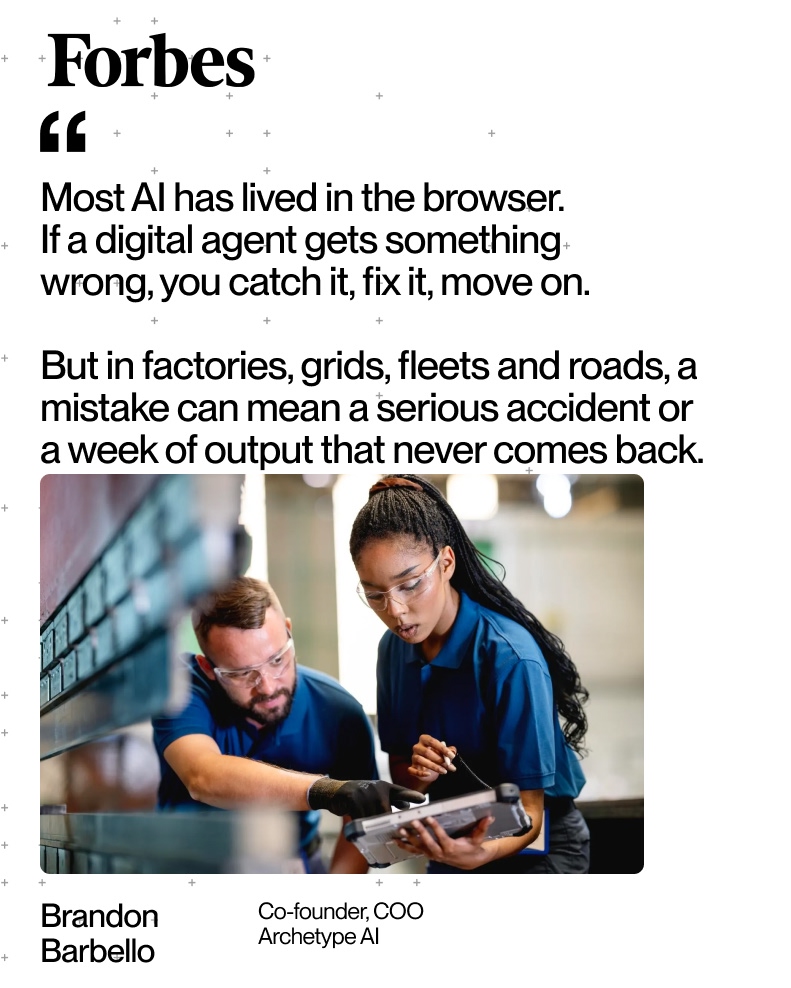
Our Co-founder and COO, Brandon Barbello, explains why the first wave of AI models struggled to understand the physical world and what the next wave needs to get right.
Read the full piece in Forbes.
https://t.co/IUURwahqpn
ICYMI: Newton, our physical world model, was named one of the Next Big Things in Tech in Foundational AI 🚀
Thanks to our talented team that made this possible!
Learn more about the award and this year’s winners:
https://t.co/hZVTFtcRTd
Most products are finished the day they ship. Physical AI makes a different kind of object possible, one whose behavior keeps unfolding through use, shaped by the people and places around it.
That idea sits at the center of Living Objects: Designing Products That Grow With Us, the talk our co-founder and Chief Design Officer Leonardo Giusti is giving at KIKK Festival on Oct. 23.
At KIKK, Leo will share three objects developed by Archetype AI and the MIT Design Intelligence Lab: a lamp with memory, a radio that gives voice to the conditions around it, and a set of tags that connect everyday objects. Each one is designed to stay open-ended.
The question he’ll leave the room with: what should be decided in advance, and what should be left for life to shape?
Even more unexpectedly, Newton RF also performed strongly on non-RF tasks like vibration, audio, EEG, and seismic data. That means we should be able to expand Newton into the one model that understands any physical phenomenon, reads any sensor, and works for any use case. One world model that encodes the entire physical world.
Full research: https://t.co/LGmIRtiygi
Newton now understands radio frequency (RF) data!
We just released results comparing a new Newton RF model against specialized RF models. Newton RF was trained on a large volume of RF data that looks nothing like other physical measurements, and we improved the model architecture to capture the spatial signal characteristics inherent to radio frequency.
The results: Newton RF beat all five specialized RF models in 18 of 20 radio tasks, including localization, channel modeling, and blind demodulation.
This is remarkable. In RF, models are highly specialized, each carefully designed for a single task: one model to decode, one to localize, one to identify the transmitter, and so on. Jonah Casebeer and @_jaimelien_ have proved that our Newton world model can rule them all!