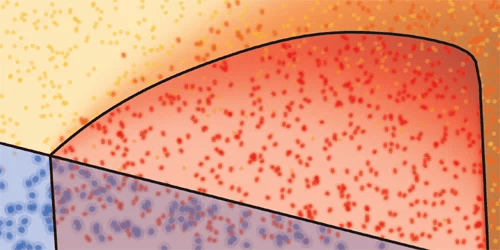
By measuring repeated collisions between a pair of levitated particles, researchers found that triboelectric charging follows a universal pattern over longer times — insights that could improve models of charging in real-world phenomena.
Read more: https://t.co/IXSVSBa0Vb
In an iron-based superconductor, researchers identified a plateau in conductance at zero voltage associated with edge currents in the material — a hint of topological superconductivity that could offer a new way to probe candidate materials.
Read more: https://t.co/cD4hKTLlFJ
Researchers used ultrasound to perturb UTe2’s superconductivity and measure its mechanical properties. Under high pressure, a second superconducting phase had strong supercurrent fluctuations — a hallmark of unconventional superconductivity.
Learn more: https://t.co/aBvV6CrNIZ
The first experimental demonstration of a one-positron quantum cyclotron — one that can store an individual positron while manipulating its quantized cyclotron and spin states — offers a step towards more precise tests of CPT symmetry.
Read more: https://t.co/yy01VcVJYx
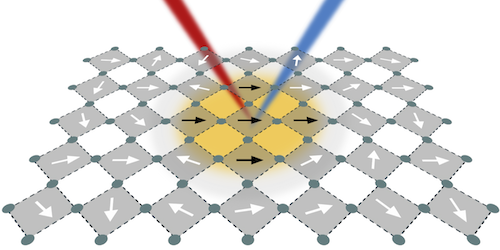
Researchers have developed a method that allows quantum gas microscopes to simultaneously observe both an atom’s position and its momentum — creating snapshots that could reveal features invisible to position-only microscopes.
Read more: https://t.co/njmMUG9epD
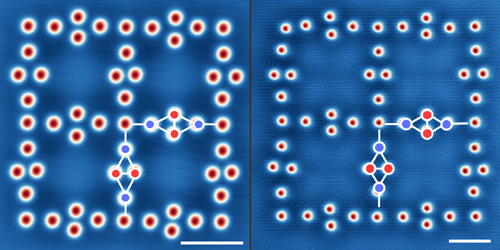
Electrons in flat bands can theoretically manifest exotic, many-electron states. Now, with an artificial lattice of iron atoms on a substrate of silver, researchers provide a new way to realize these bands and make their physics more accessible.
More: https://t.co/iFBeyTUB0d
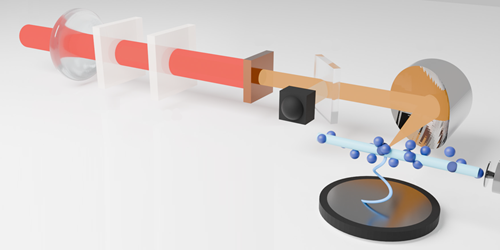
⚛️ Using two cooling techniques, researchers trapped about 4,000 cesium atoms — 6 times more than the conventional method — beside an optical nanofiber and kept them there for 5 times longer.
Read the paper in PRX Quantum: https://t.co/LUgh6yaQbn
By splitting a low-intensity laser in two and sending the beams into single-pixel detectors, researchers show how they can create an image of an object even after discarding all of the photons that interacted with it.
Read more: https://t.co/tDa1sXyBPx
Using an ultrafast optical method, researchers found that nanometer-scale polarized regions form before the macroscopic ferroelectric phase — offering new clues into the origin of bulk polarization in quantum ferroelectric materials.
Read more: https://t.co/XHs8694yIP
By analyzing what happens when delayed IR pulse probes are prepared in a squeezed-vacuum state, researchers find that the statistics of quantum light can be imprinted on electrons — offering a sensitive way to probe them.
Read more: https://t.co/pKZSoMleDN
Researchers find that every major derivation of the Born rule relies on a probabilistic assumption — casting doubt on the existence of a nonprobabilistic origin for quantum probabilities.
Read the viewpoint: https://t.co/e8ZyaxBJQl
The 2026 Nobel Prize in Physics recognizes the vision behind the IceCube Neutrino Observatory, which turned a cubic kilometer of Antarctic ice into the world’s largest neutrino detector.
Read about how it launched the field of neutrino astronomy: https://t.co/9w39rLSUH4
Using bright squeezed vacuum to knock electrons out of xenon atoms, researchers found the light’s photon-number fluctuations were imprinted onto the electrons — offering a tool to probe and control electron motion.
See what the researchers found: https://t.co/hk5Zb6T5sG
Pairing superconducting qubits with microwave cavities could reduce the hardware requirements for quantum simulations of fundamental physics.
See how this hybrid approach works: https://t.co/ugG5O4ABoA
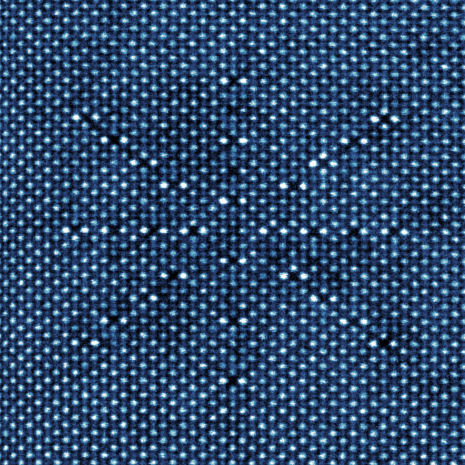
“There’s just as much wow on the inside.”
@MIT researchers Julian Klein and Frances Ross used electron beams to reposition atoms inside a chromium sulfur bromide crystal with picometer-scale precision.
Learn more about their work: https://t.co/gsBHWZmiuM
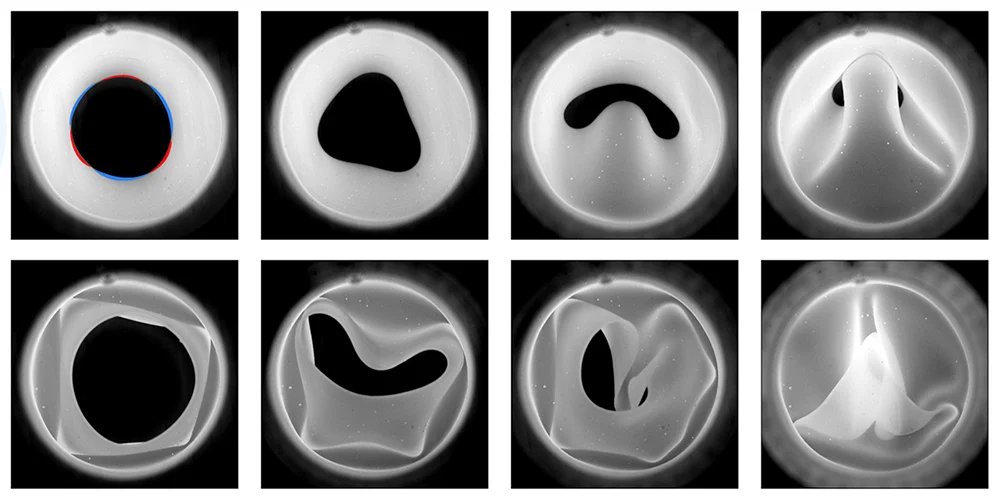
A simplified model of the heart’s mitral valve shows that flow fluctuations — which are often treated as unwanted noise — can help a soft valve close with about 10% of the pressure needed under a steady flow.
🔗 https://t.co/OXNOqkE6Hk
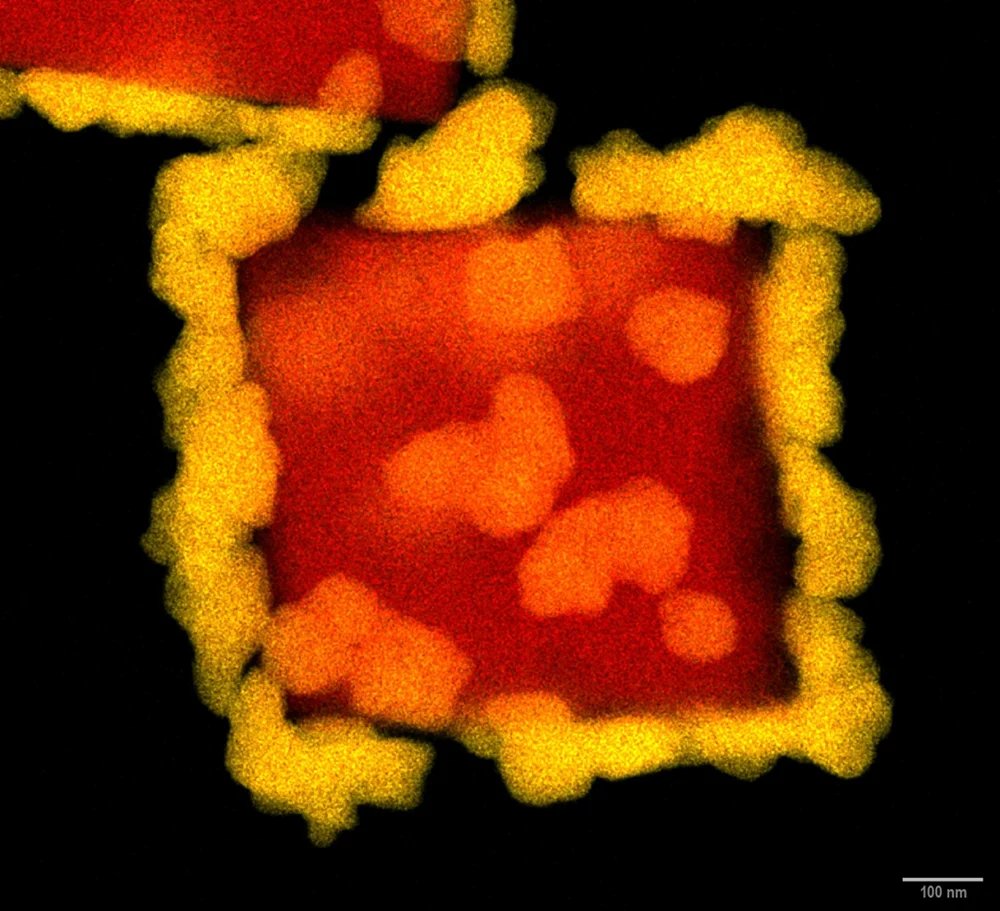
Our snapshot series features stunning images from across #physics — like this one of gold nanostructures. These structures change shape depending on how they are imaged.
Learn more: https://t.co/mVOEpkOwBH
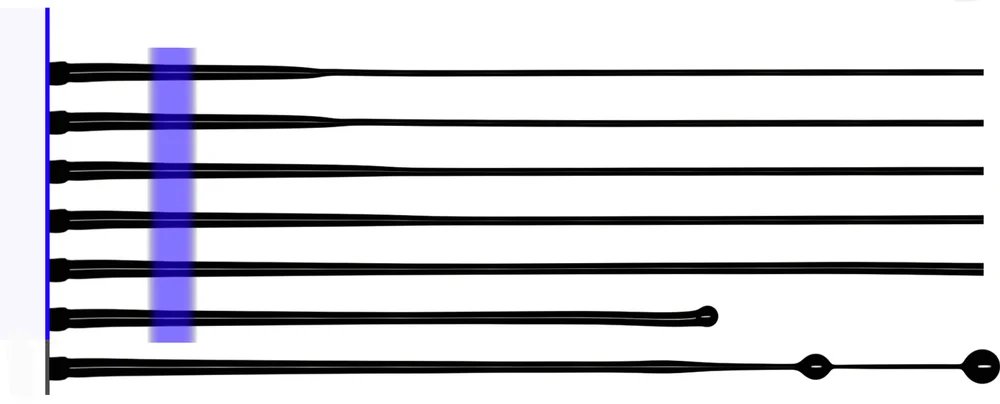
A new technique for spinning — the process of generating solid fibers from a liquid jet — makes it easier to model and control than current methods. Learn more about how the method could reduce trial and error in industrial manufacturing: https://t.co/lP5aaa9xG5
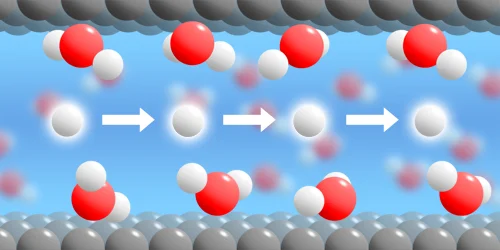
Why does nanoconfined water have strong dielectric anisotropy and enhanced in-plane proton conductivity? A proposed microscopic mechanism could be the answer. Learn more about it: https://t.co/BlszB6AB5x
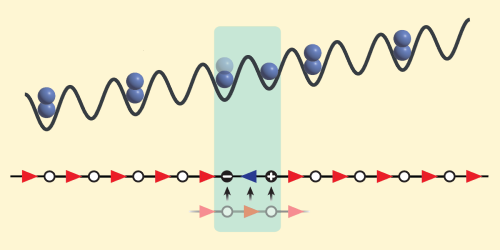
By placing rubidium atoms in a 1D optical lattice and tuning the lattice’s potential energy, researchers simulated false vacuum decay.
See what they observed: https://t.co/xapkUlzhkW