"The Shadow That Built the City"
A lone Pioneer stands at the heart of the bustling street while the golden Pi symbol stretches beneath his feet — every tiny figure around him already conducting real business on the foundation he helped create.
Pioneers first built the trust graph through verified human identity. That quiet architecture became the pavement itself, turning Pi Network into the base currency of everyday commerce where peer-to-peer transactions flow as naturally as the evening crowd.
The sun sets behind the skyscrapers.
The shadow stays perfect.
The digital nation is already walking these streets.
"She Has Already Lived Every Story Falling From the Sky"
She stands in the rain and does not flinch. Aged hands holding a jar that glows with the Pi symbol, eyes lifted toward raindrops that are not raindrops — each one a suspended world, a complete human moment, a life preserved inside a falling thing. A couple. A child smiling. A city caught mid-breath. She has seen all of it. She is still here. And she is holding the light.
The people traditional finance forgot are not abstractions. They are her. Older. Weathered by decades of systems that required credentials she was never offered. No bank account built for her circumstances. No credit history accepted by institutions that only recognize certain kinds of proof. No investment vehicle designed to protect what little she accumulated across a lifetime of contribution that the formal economy never formally acknowledged. Web3 does not fix this by adding her to an existing system. It builds a different system where verified human identity is the only credential that has ever mattered. Million of people verified worldwide on Pi Network — the same on-chain guarantee for every single one of them, regardless of age, geography, or what the old infrastructure decided they were worth.
Each raindrop in this image holds somebody's story. A complete human life reduced to the size of a falling moment, beautiful and fragile and entirely real. She holds the jar not because she caught them all but because she understood what they were. The Pi symbol glows in her hands like something that was always meant to be carried by someone who already knew the weight of being excluded from every system that claimed to serve everyone.
The rain has always carried stories.
Most systems let them fall to the ground.
She caught the light instead.
And held it.
"The Most Powerful Infrastructure Was Built Inside Something Everyone Underestimated"
It is a crayon. Blue wax, the kind that fits in a child's fist, the kind adults stopped thinking about the moment they learned what serious tools looked like. Except this one has cities carved into it. Towers rising from the pigment. Channels of liquid blue running between them like an economy that learned to move through the very substance everyone dismissed. The Pi symbol is not stamped on the surface. It is carved into the wax itself — permanent, structural, part of the material.
Pi DEX was built the same way. Not announced with fanfare and deployed into chaos — carved carefully into the protocol itself while most of the world was still debating whether Pi Network was serious. The AMM liquidity pools are not a third-party application bolted on afterward. They are native to the Pi blockchain, the same way these channels are native to the crayon rather than pipes running across it. Pi-denominated trading pairs concentrate liquidity around a single base asset, reducing fragmentation and slippage the way a single medium reduces variables. Token ranking by liquidity committed rather than market cap claimed means the tallest towers in this city earned their height. Every token domain-verified — every building with a traceable address before it opens its doors. All of it running on Testnet right now, with Test-Pi, because the architecture deserves to be learned before the real current flows.
The crayon was never just a crayon.
It was always the medium that carried the city.
The wax held the carving.
The carving held the infrastructure.
The infrastructure is waiting for the world to look closer.
Don't mess with economics and Web3 as a whole infrastructure. respect the coins you mine everybody is in their own boat in the ocean, understand and respect the integrity Pi ecosystem.
Those pioneers who don't learn will be the first to probably get scammed soon or later. Good bye bro.
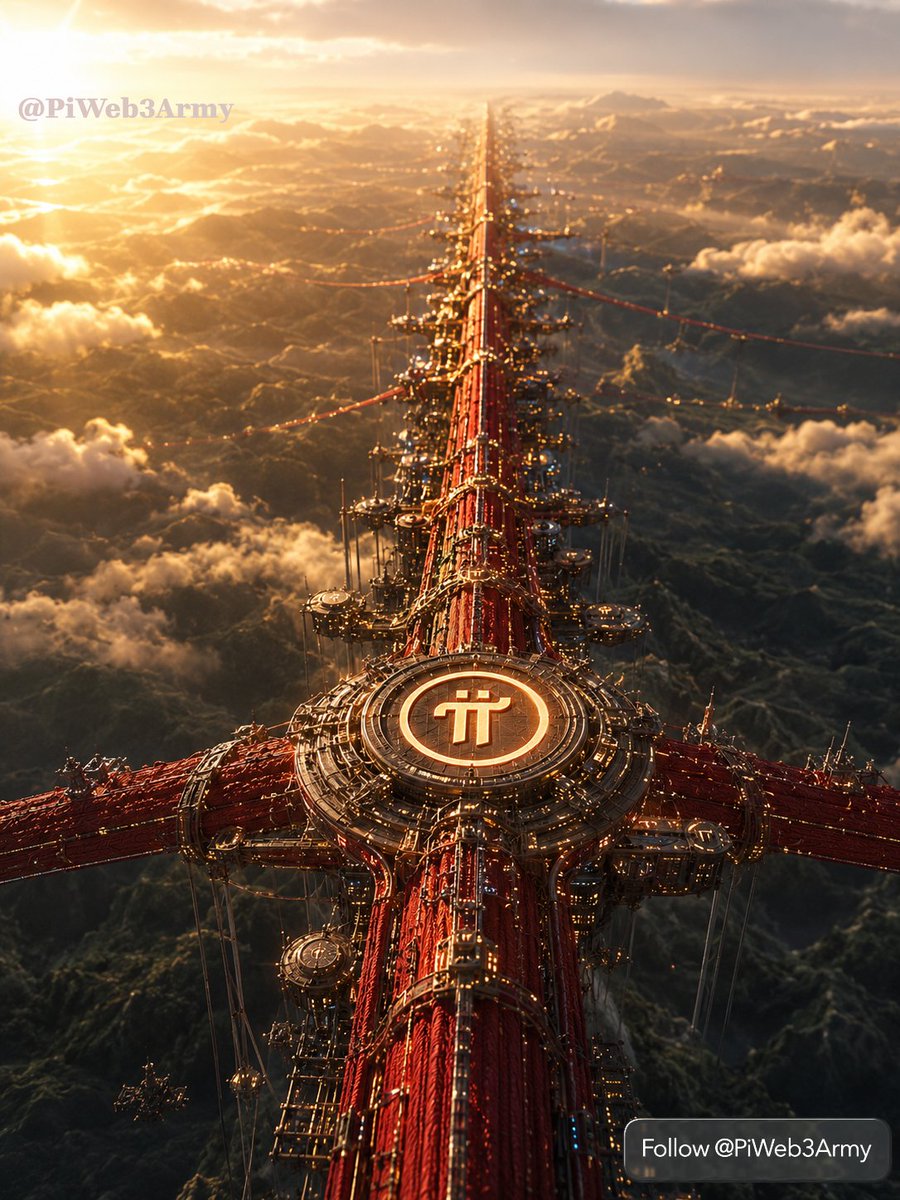
"The Bridge Was Never About the Two Sides. It Was About What Moves Between Them."
Above the clouds. No ground visible in either direction. A structure that extends past every horizon carrying the Pi symbol at its central node — the point where all tension cables converge, where the weight of everything suspended is distributed, where the bridge does what bridges have always done. Not connect places. Connect people who had no way to reach each other before the structure existed.
This is what peer-to-peer commerce looks like at architectural scale. Web2 built toll booths into every financial transaction — intermediaries who extracted value from the movement of value, institutions who decided which participants qualified for access and at what cost. Pi Network's Mainnet is processing peer-to-peer transactions directly between verified humans with no gatekeeper collecting the crossing fee. Protocol 23 active on Mainnet. Maximum 1000 transactions per block. The v23 upgrade refactored peer-to-peer networking to reduce centralized reliance at the infrastructure layer itself — the bridge was not just extended, its load-bearing architecture was fundamentally rebuilt. OKX confirmed Pi available to millions of US users. Second migrations live with referral bonuses settling on-chain for the first time. The two sides of this bridge are not geographic. They are the before and after of what financial access means for a verified human with a phone and no bank.
Every cable holds a specific tension. Every Pioneer on Mainnet is a load-bearing element. The bridge does not ask permission to connect what it connects. It simply holds.
@DanielFenelus2 No wonder you are still not learning, you literally have no idea what to track and what matters. Smart pioneers will see and learn . Adios Daniel from @PiWeb3Army .
"The Cube That Contains Everything"
Inside one crystal-clear cube sits a fully functioning miniature metropolis, the glowing Pi at its center proving that the entire digital nation now exists in perfect, self-sustaining form.
Everything revolves around it.
The vision is already built.
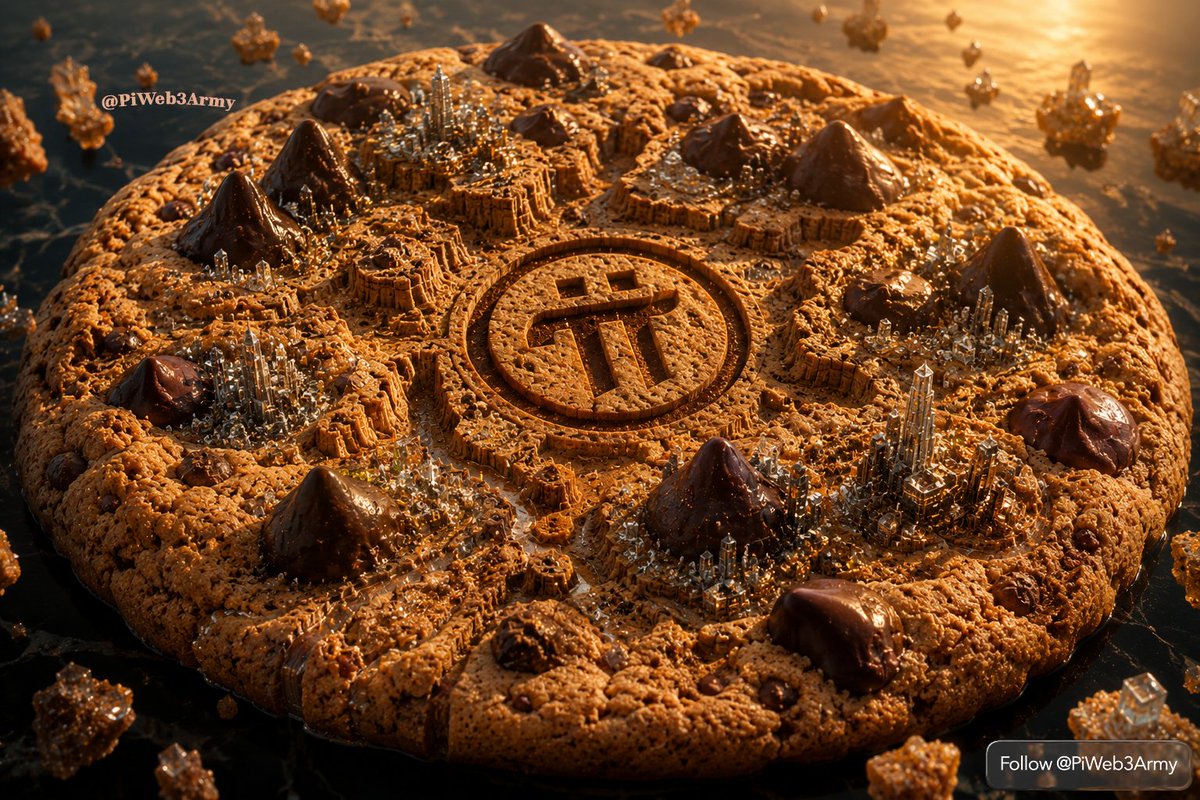
"Nobody Expected the Cookie to Become a Continent."
It started as something approachable. Familiar. The kind of thing you pick up without ceremony and do not think twice about. And then the cities started growing on it. Crystal towers rising between the chocolate peaks. Entire districts of infrastructure spreading outward from the Pi symbol pressed into its center like a seal on something that was always meant to be taken more seriously than it looked. The most consequential platforms in history rarely announced themselves as such at the beginning.
This is the network effects ignition point described in the only language that never oversells it — architecture that already exists. Sixty million Engaged Pioneers. Pi available to millions of US users through OKX. Over 100,000 Pioneers completed second migrations with referral bonuses settling on-chain for the first time. Peer-to-peer transactions processing on live Mainnet at Protocol 23 with a maximum of 1000 transactions per block. The Pi App Studio opening the ecosystem to external AI tools — Codex, Claude Code, Replit, Cursor, Lovable — integrable in as fast as two minutes with copy-paste SDK prompts and 60 million verified users accessible from day one. The cookie did not stay a cookie. It became the surface everything else was built on top of because enough people chose to build there before the surface was famous.
Nobody took the cookie seriously at first. The cities grew anyway. Network effects do not wait for permission or recognition. They compound quietly until the scale becomes undeniable.
"The City Doesn't Need the Ground Anymore"
An entire island lifted above the clouds — skyline intact, waterfalls trailing from the edges, helicopters circling like they always have, and a single Pi balloon holding the whole thing aloft without strain. The infrastructure below didn't change. The rules above didn't change. What changed is where the city operates now. Geography is no longer the constraint it was designed to be.
The digital nation economy is the idea that an economy does not require a physical address to be real. Citizens do not need to share a border. Businesses do not need a registered jurisdiction. Transactions do not need a central bank to settle them. What they need is verified identity, a common currency, shared infrastructure, and rules that apply equally regardless of where on the planet a participant happens to be standing. Pi Network has been building this architecture in sequence — not as metaphor, but as function. Verified humans, base currency processing peer-to-peer transactions on Mainnet. A developer portal where applications become the economic activity of a borderless population. Engaged Pioneers across more than 200 countries who do not share a language, a government, or a timezone but share the same on-chain guarantee.
The helicopters in this image are not alarmed. They are circling because the city is still operating — commerce, infrastructure, movement — at altitude. The digital nation is not waiting for a single country to approve it. It is already airborne.
No ground required.
No border defining who belongs.
The balloon doesn't ask for permission to lift.
The city was always capable of this.
It just needed the right infrastructure to leave the surface.
"The Standard Was Written Before Anyone Was Ready to Follow It"
A fountain pen the size of a city, engraved in gold, carrying the Pi symbol at its nib — and inside its barrel, an entire metropolis of lit infrastructure running at full capacity. The pen is not decorative. It is the instrument that preceded everything built after it. Standards come before scale. The document comes before the economy it makes possible.
PiRC1 was Pi Network's first published token design framework — a standard that defined how tokens within the ecosystem should be structured, how they should behave, and what they must demonstrate before they qualify as legitimate instruments of economic activity. PiRC2 followed: a subscription smart contract standard, currently under external audit, already live on Testnet, with its repository public on GitHub. These are not whitepapers written to attract attention. They are the architectural grammar that every future application, every developer integration, every token launch through Pi Launchpad will be required to speak. The pen writes the rules before the city grows large enough to need them — because by the time the city needs them, it is already too late to write them carefully.
Progressive open-source is the strategy behind this sequence. Standards published first. Code audited before deployment. Oracle simulators and RWA tokenization frameworks iterating publicly on GitHub. The SmartContracts repository available for review while Testnet RPC runs live at https://t.co/e1zAzwtkaq. Developers building on Pi Network are not building into a black box. They are building into a grammar that was written in gold before the first application was submitted.
The nib touches the page before the sentence exists.
The standard precedes the economy.
The pen was always the most important instrument in the room.
Everything else is what got written after.
#PiNetwork #PiWeb3Army #AIart️️️️️️️️️️️️️️️️️️️️️️️️️️️️️️️️️️️️️️️️️️️️️️️️️️️
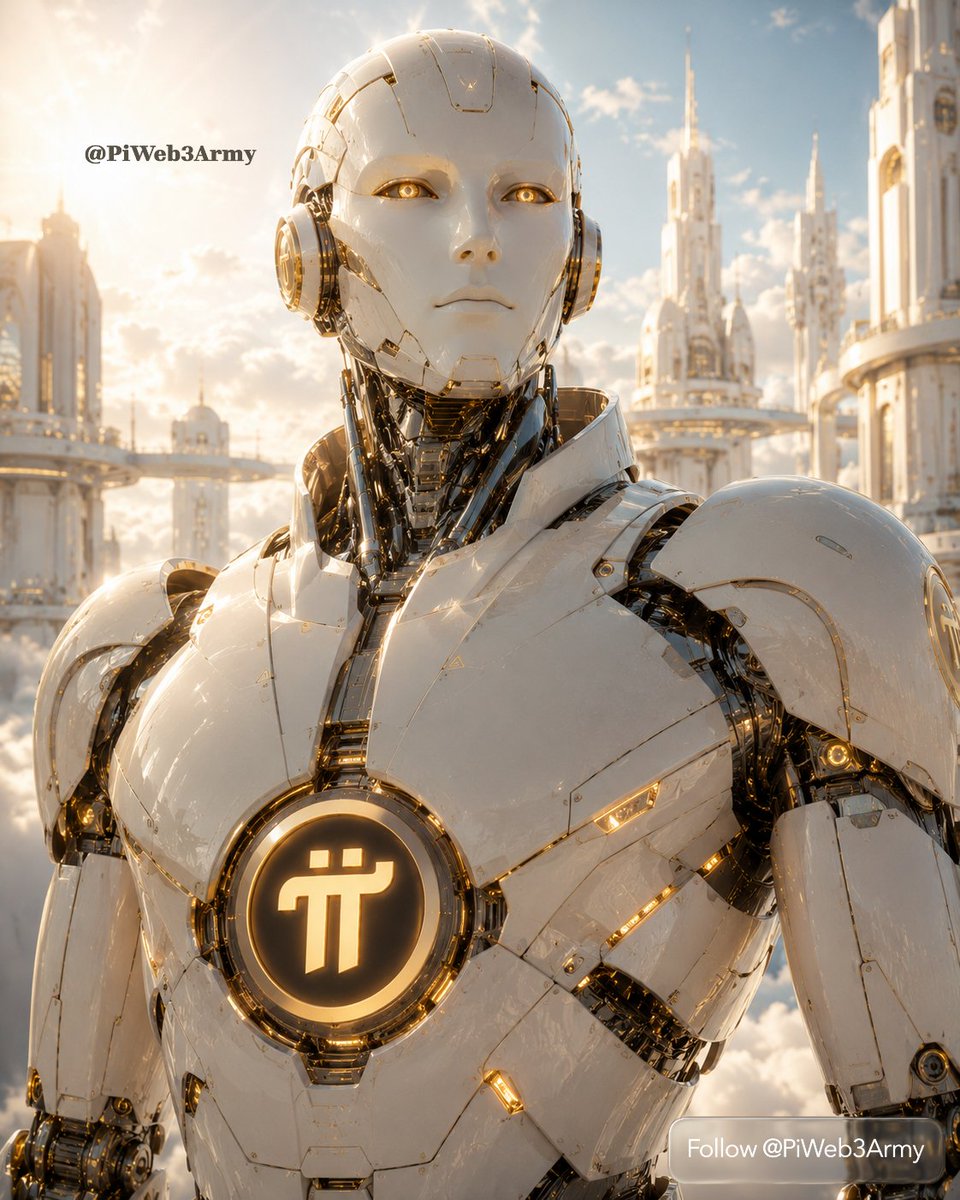
"The Machine Knows What It Is — The Question Is Whether It Can Prove It"
White and gold. Towers rising into clouds behind it. A figure that looks human enough to pause you and mechanical enough to make you ask the question that now defines an entire era of technology: how do you know who is real. The Pi symbol glows at the center of its chest like a core that runs on something other than electricity. Something that requires verification before it can be trusted with anything that matters.
Proof of humanity is the central problem of the AI age. Not theoretically — practically, immediately, and with consequences that compound faster than most institutions are moving to address them. AI agents can now write, speak, transact, apply, vote, and interact at a scale and quality that makes them indistinguishable from humans without a structural test applied before the interaction begins. The question is no longer whether a machine can pass as human. The question is whether the systems people depend on were built to tell the difference — and what happens to those systems when they cannot.
Dr. Kokkalis addressed this directly at Consensus Miami 2026. Proof of humanity is context-dependent. The verification required to confirm a unique human voter differs from the verification required to confirm a unique human transacting peer-to-peer. Privacy-preserving verification means the proof can be established without exposing the underlying identity data to every system that needs the confirmation. Pi Network's KYC architecture — over 18 million verified across 200+ countries, AI-human hybrid processing, one person one account — was not built for compliance theater. It was built because someone understood early that verified human identity would become the scarcest and most valuable input in an AI-saturated world.
The figure in this image is not the threat.
It is the question made visible.
How do you know.
How does the network know.
How does any system know.
That is the problem Pi Network built its architecture to answer.
"The Quiet Flame of Pi"
One candle and one open laptop cast the glowing Pi symbol across the wooden table — the living reminder that utility comes first, and the network was built by those who showed up when no one was watching.
The wax keeps melting.
The symbol stays lit.
"A City This Dense Was Never Built By One Architect — It Was Built By Every Developer Who Found The Road Already Waiting"
The most powerful infrastructure decision any platform can make is not building the best product. It is building the road that lets everyone else bring their best product to the people who need it — and making that road so well-constructed that the cost of arrival is lower than the cost of going anywhere else.
The Pi SDK represents exactly that decision made operational. Before the SDK was fully unlocked, developers approaching the Pi ecosystem faced the integration barrier that stops most builders before they begin — not lack of interest, but the friction cost of connecting a new product to a new payment system, a new identity architecture, and a new user base simultaneously. The SDK removed that barrier by solving the integration layer once, correctly, so every developer who arrives afterward inherits the solution rather than rebuilding it. Pi signin. Pi Wallets. Identity verification already completed for over 18 million verified users. Payment flows built for peer-to-peer commerce across 200 countries. Pi Ad Network for monetization. All of it accessible. All of it documented. All of it now deployable in minutes through Pi App Studio's copy-and-paste SDK prompts for builders using Codex, Replit, Cursor, Lovable, and every other AI-assisted coding tool that has made building software accessible to people who never called themselves developers.
The golden Pi tower at the center of this city is not the destination. It is the hub — the point where every road that was built correctly eventually arrives because the infrastructure made arrival worth the journey.
The brim of the hat holds more city than the world outside it expected.
Because the roads were built before the builders knew they were coming.
The SDK was the invitation.
Sixty million verified Pioneers were always the reason to accept it.
"Every Ring Was Validated By A Human Who Never Met The Person They Were Confirming"
The most elegant trust systems in history were never built by institutions. They were built by networks of individuals whose overlapping judgments produced a collective certainty no single authority could have generated alone.
Pi Network's KYC validator system is one of the least understood and most architecturally significant decisions in the entire ecosystem. Rather than relying exclusively on AI automation — which scales efficiently but struggles with edge cases, ambiguous documents, and the nuanced judgment required to confirm a real human being across 200 countries and every variation of identity documentation those countries produce — Pi built a hybrid. AI handles the volume. Verified human validators handle the judgment layer that automation cannot reliably replace. Over 1,094,680 validators completed 526,970,631 validation tasks. Ten million Pi distributed from the Foundation as direct compensation. A mining rate boost of 21 times base rate rewarded the Pioneers who contributed their attention and judgment to confirming the identity of people they would never meet.
What that produced is not a KYC database. It is a trust architecture assembled ring by ring — each validator's contribution a layer in a verification system where human judgment was the quality standard, not an afterthought. The concentric city in this image is precisely what that architecture looks like from above. Every ring is a layer of confirmed identity. Every structure is a Pioneer whose real humanity was attested to by another real human whose own humanity had already been confirmed. Trust does not scale through automation alone. It scales through networks of verified humans attesting to each other.
Five hundred twenty-six million confirmations.
Not processed. Attested to.
By over one million humans who understood that identity is the foundation everything else is built on.
Ring by ring. The city grew because the validators showed up.
"What Is Locked Is Not Lost — It Is Building Pressure"
Inside a glacier-mass of ice, entire cities are suspended mid-construction. Towers frozen mid-rise. Infrastructure preserved at the moment it was most alive. The Pi symbol burns at the center of it — not buried, not trapped, lit from within like something that generates its own heat regardless of what surrounds it. This is not a tomb. This is a vault.
On-chain lockup is one of the most misunderstood mechanics available to Mainnet-migrated Pioneers. When a Pioneer chooses to lock their Pi, that decision is immediately binding and irreversible until the chosen duration ends. Not a soft commitment. Not a platform preference that can be reversed with a support ticket. A permanent on-chain instruction that the network executes without exception. In exchange, the mining boost activates the following session — up to 200% of the Pioneer's currently migrated amount available for lockup. The supply moderation this creates is not artificial scarcity. It is Pioneers choosing, individually and voluntarily, to signal that their Pi is not for immediate movement. Across millions of participants, that signal shapes the entire supply landscape of a network with a hard cap of 100 billion.
CiDi Games, a Pi Network Ventures portfolio company, recently added four new games to its platform — giving Pioneers more ways to engage with Pi through utility-first gaming infrastructure. The Pi ELF bound on-chain. CiDiScore earned, never bought. A developer ecosystem growing around the same lockup and wallet mechanics that make Pi a real unit of exchange rather than a speculative placeholder. The cities inside this ice block are not frozen. They are protected while the conditions outside reach the temperature they need.
Locking is not waiting.
Locking is a decision the chain enforces forever.
The cities inside are still lit.
They were never going dark.
They were becoming permanent.
"Ice Doesn't Stop the Rider Who Was Built for It"
No clean track. No crowd. No controlled conditions. Just a Pioneer-branded machine tearing through a frozen mountain pass with the kind of forward lean that only comes from having already decided the destination matters more than the difficulty. The Pi symbol appears four times on this bike and rider — helmet, suit, frame, forks — because this isn't casual. This is a commitment that survived the conditions it was designed for.
Most people underestimate what it takes to run decentralized infrastructure. A SuperNode is not a switch someone flips. It is a machine that stays online continuously, validates transactions, participates in consensus, and writes confirmed blocks to a distributed ledger that thousands of other nodes are simultaneously checking. When a protocol upgrade arrives — and on Pi Network's Mainnet, they arrive in sequence — a SuperNode operator doesn't pause operations. They execute the migration, monitor sync status, confirm the new protocol version is active, and keep the consensus backbone running without interruption. Protocol 23 required a full operating system migration, a database version jump, and comprehensive historical data reprocessing. The operators who ran that upgrade in a blizzard of technical complexity are the same riders in this image.
Progressive decentralization means the network's ability to function without central coordination grows stronger with every upgrade completed, every new node that joins, every Pioneer who runs infrastructure instead of just participating in it. The snow isn't a metaphor for difficulty alone. It is a metaphor for conditions that reveal who actually built for this terrain versus who was only comfortable on a clear day.
The mountains don't move for the rider.
The rider moves through the mountains.
That distinction is the entire difference
between a network that talks about decentralization
and one that is living it.
"Stormproof Pi Battery"
Lightning rips through the ruined factory as rain hammers the glowing Pi battery — the unbreakable power source forged by millions of verified humans and locked into immutable blockchain technology.
The thunder roars.
The future stays fully charged.
"The Whole City Is Plugged Into One Source. That Source Is Human."
Nobody builds a civilization-scale energy transfer station around a battery unless the battery is producing something the civilization cannot function without. The Pi symbol glowing at the center of that tower is not ornamental — it is the load-bearing element. Every spacecraft in orbit, every structure on the ground, every conduit running current through this city draws from the same origin point. A verified human network generating the only resource Web3 actually runs short of. Trust.
Pi Human Infrastructure for AI is not a side product of this ecosystem. It is what happens when over one million verified individuals across more than 200 countries complete over 526 million tasks and someone finally asks what that workforce is worth to an AI industry that cannot function without human-labeled, human-verified, human-confirmed data. The B2B offering launched April 28, 2026. The formal application form is live for AI enterprises. Compensation flows in Pi — removing fiat friction from a global payment problem that has no clean institutional solution. The energy transfer station in this image is not metaphor stretched thin. It is the literal architectural description of what Pi Network built — a conduit between verified human capacity and the systems that need it most.
The city does not generate its own power.
It draws from the humans who chose to participate.
526 million tasks completed before the world named what it was building.
The station was always transferring something more valuable than electricity.
"The City Below Doesn't Ask for a Credit Score"
She stands at the glass in the rain and the city beneath her is fully lit — towers, signals, neon signs in two languages, the Pi symbol hovering in the middle distance like a frequency only certain people have learned to tune to. She is not outside looking in. She is above, looking at what is already hers, pressing her hand to the glass the way you touch something real to confirm it isn't a dream.
Most financial systems were built as filters. They were designed to serve people who already had enough proof of worthiness to enter — a bank account, a credit score, a government-issued identity document recognized by institutions that only operate in certain jurisdictions. The people who needed financial infrastructure most were precisely the people those filters were built to exclude. Web3 doesn't fix this by lowering the filter. It removes the filter entirely and replaces it with a single question: are you a verified human being.
Pi Network's answer to that question is live across more than 200 countries. KYC completed. Identity confirmed. Wallet active. The ability to transact peer-to-peer on Mainnet, to participate in an on-chain economy, to lock and earn and build — none of it gated behind institutional permission. The neon sign in this cityscape reads Pi Network and it is not an advertisement. It is an address. A place in the digital economy that belongs to anyone who can prove they are real.
The rain doesn't change the address.
The night doesn't close the door.
She already knows where she lives.
The city was built for her
the moment she was verified.