One thing I found interesting here is Lucas' take on bringing more assets to Solana.
An asset doesn't necessarily need to be born on Solana for people to want to trade it.
If people want to trade it, you need to make it accessible.
And Lucas sees trading becoming more than just another use case for blockchains.
He believes it could eventually become one of the largest revenue drivers for blockchains, which makes the push to bring more tradeable assets on-chain even more interesting.
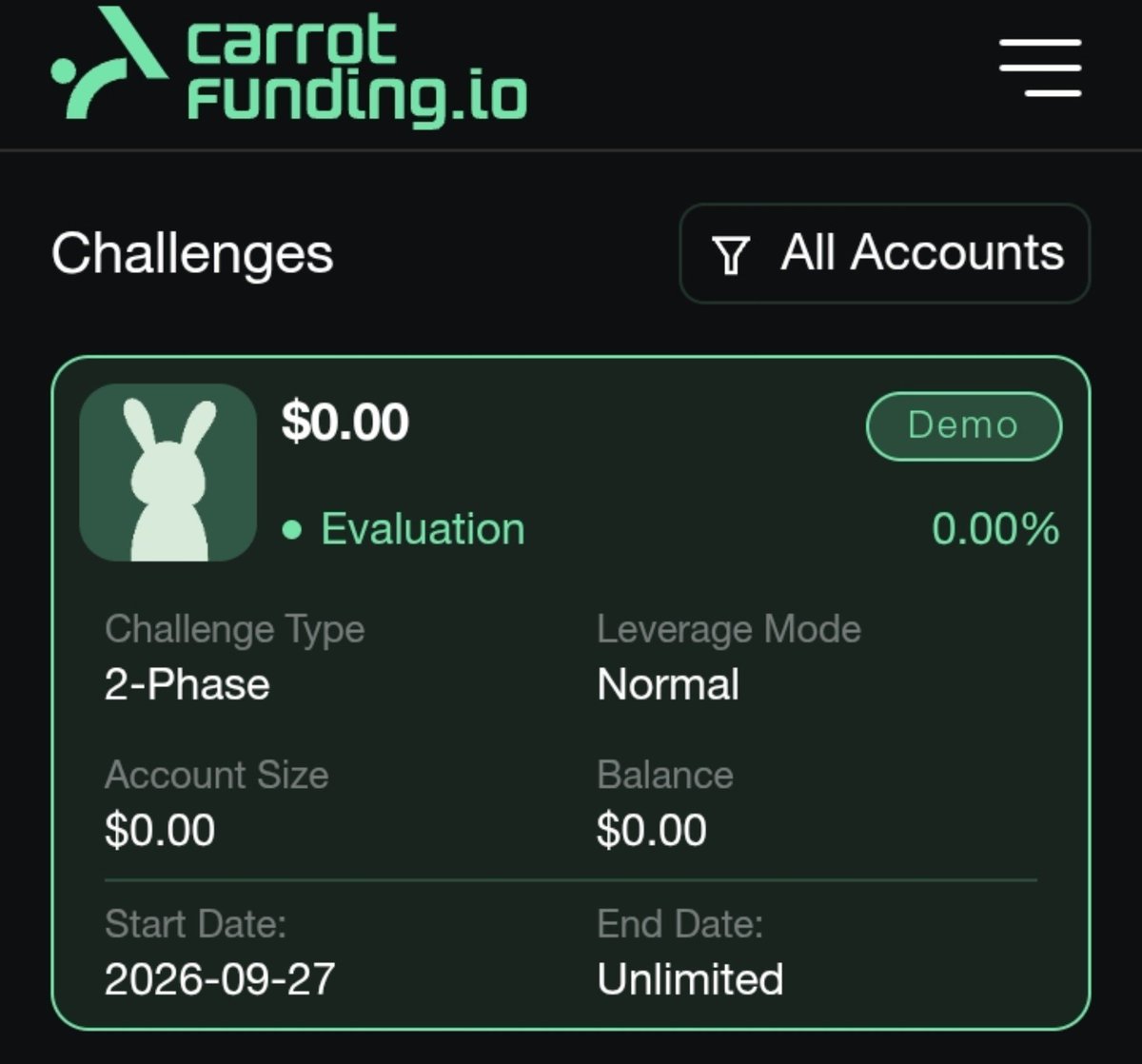
Your Dashboard on @CarrotFunding is where you find your trading account details and track your progress.
It's also where you trade from... On the platform.
For the trading account details, you can see the challenge type (whether 2-Phase or 1-Phase), leverage mode, account size, balance, start date, and end date.
When you create a CarrotFunding account, a demo account is created alongside it. That's the start date of the account, while the end date is unlimited.
But what's strange is that the demo account has a $0 balance.
And what's even stranger is that you can't change the balance, at least I couldn't when I tried.
A demo account should be useful for testing and getting a feel for the platform's execution and overall experience.
But if you can't actually trade on it, that kind of defeats the purpose.
I hope something is done about this.
Then on the leverage mode side, it was written 'normal'... I wonder if that means 5× or no leverage 👀
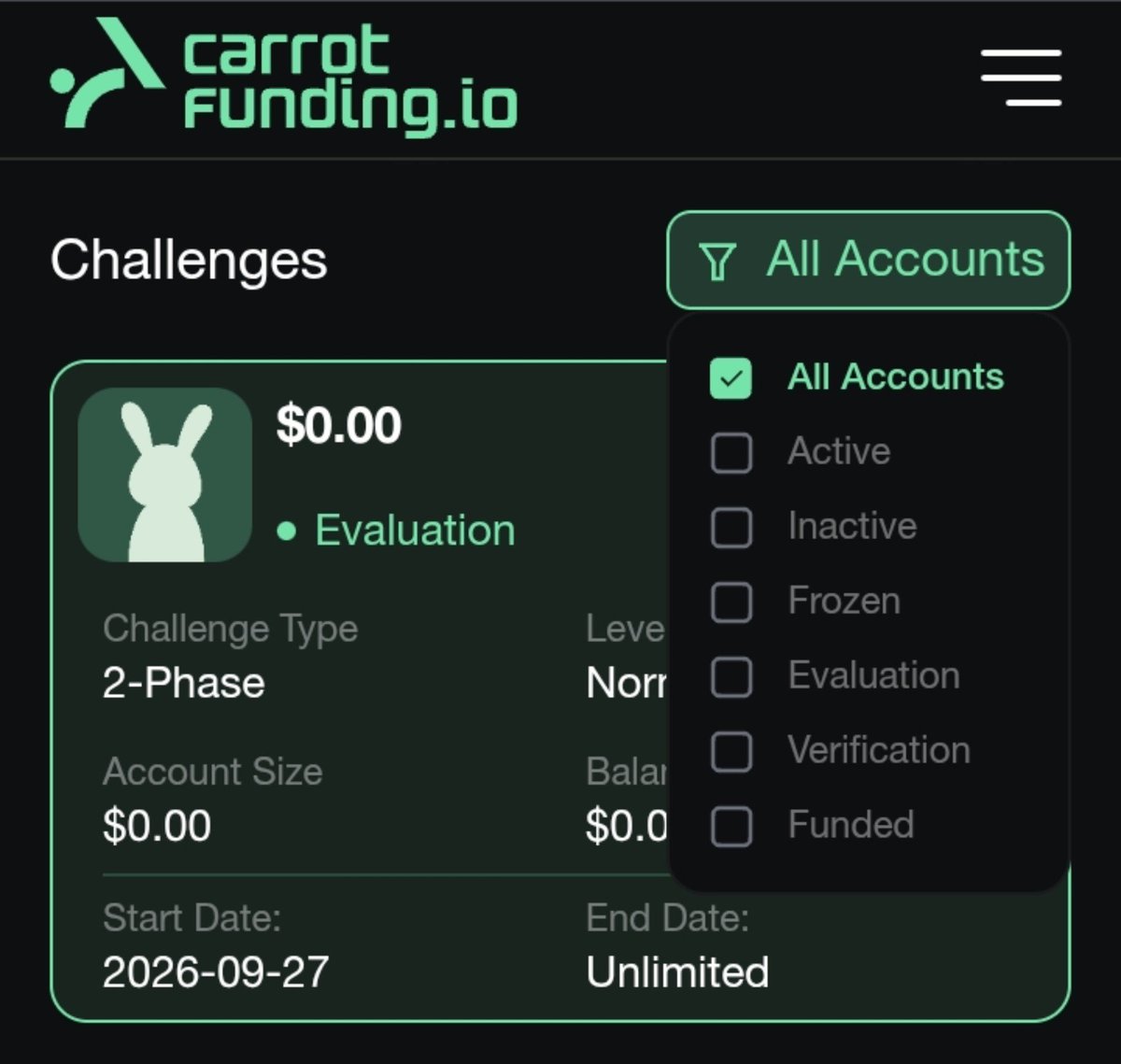
You can also filter the trading accounts you have into these categories:
Active, Inactive, Frozen, Evaluation, Verification, and Funded.
Now, that Verification filter might be somewhat confusing, but it simply refers to the second phase of a 2-Phase account.
Phase 1 is called Evaluation, while Phase 2 is called Verification.
And with that, I'll leave the other parts of the Dashboard for the next post, before this turns into a block of text that'll bore you out 🥲
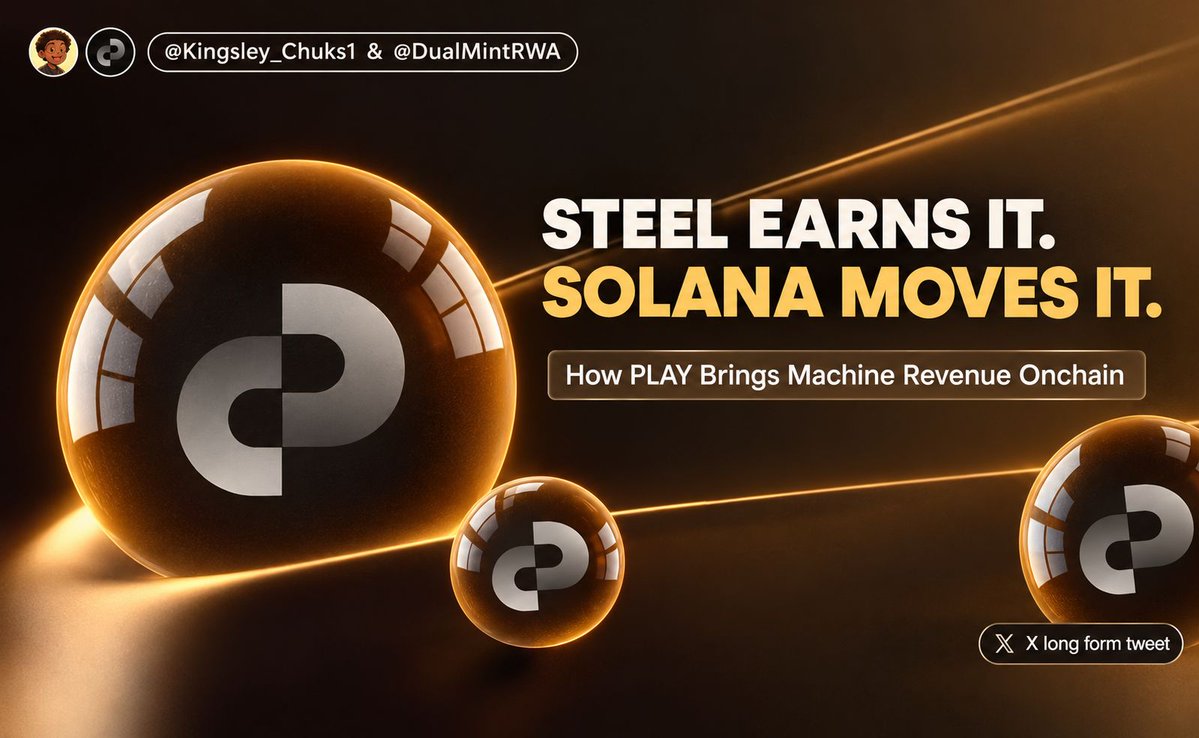
@Kingsley_Chuks1 The “steel earns it, Solana moves it” distinction is what makes this click.
The blockchain isn't the revenue source; it’s the rail around an existing physical business. The verification piece is still the part I’d watch closely though.
𝐌𝐨𝐬𝐭 𝐩𝐞𝐨𝐩𝐥𝐞 𝐭𝐡𝐢𝐧𝐤 𝐨𝐟 𝐛𝐥𝐨𝐜𝐤𝐜𝐡𝐚𝐢𝐧 𝐚𝐬 𝐭𝐡𝐞 𝐩𝐥𝐚𝐜𝐞 𝐰𝐡𝐞𝐫𝐞 𝐦𝐨𝐧𝐞𝐲 𝐢𝐬 𝐦𝐚𝐝𝐞.
But what if the money was being made somewhere completely different?
Inside an arcade. Through a physical machine. From someone trying to grab a toy with a claw.
That's the idea behind what
@DualMintRWA is building with PLAY, and honestly, this is the part I find interesting.
Because the blockchain isn't the starting point of the revenue.
The physical world is.
Think about what happens when someone walks into an arcade and plays a claw machine.
A real person pays to play. The machine gets used. That activity generates revenue.
Now imagine connecting that ordinary business activity to an onchain financial structure.
That's essentially the idea behind PLAY.
DualMint describes PLAY as a machine vault built around 200 operating claw machines, with revenue generated through real-world usage rather than token emissions.
But how does something happening inside an arcade actually connect to Solana?
𝙇𝙚𝙩'𝙨 𝙗𝙧𝙚𝙖𝙠 𝙞𝙩 𝙙𝙤𝙬𝙣.
1. 𝙄𝙩 𝙨𝙩𝙖𝙧𝙩𝙨 𝙬𝙞𝙩𝙝 𝙖 𝙥𝙝𝙮𝙨𝙞𝙘𝙖𝙡 𝙢𝙖𝙘𝙝𝙞𝙣𝙚, 𝙣𝙤𝙩 𝙖 𝙩𝙤𝙠𝙚𝙣.
One thing I've noticed about crypto is how easy it is to get caught up in the mechanics of yield without asking where the underlying revenue actually comes from.
A token launches. A protocol offers incentives. People deposit. The numbers look interesting.
But with PLAY, the underlying concept starts with something much easier to visualize.
A machine that people pay to use.
DualMint's model involves financing physical machines while operators run them in real-world locations.
When people use those machines, they generate operating revenue.
That revenue is the foundation of the model.
And this distinction matters.
The machine doesn't need a token to attract someone who wants to play. Its business activity happens independently of someone interacting with a crypto protocol.
The goal is to connect that existing economic activity to onchain participation.
2. 𝙏𝙝𝙚 𝙞𝙣𝙩𝙚𝙧𝙚𝙨𝙩𝙞𝙣𝙜 𝙥𝙖𝙧𝙩 𝙞𝙨 𝙬𝙝𝙖𝙩 𝙝𝙖𝙥𝙥𝙚𝙣𝙨 𝙖𝙛𝙩𝙚𝙧 𝙩𝙝𝙚 𝙢𝙖𝙘𝙝𝙞𝙣𝙚 𝙚𝙖𝙧𝙣𝙨.
Generating revenue in the physical world is one thing.
Connecting that revenue to an onchain system is another.
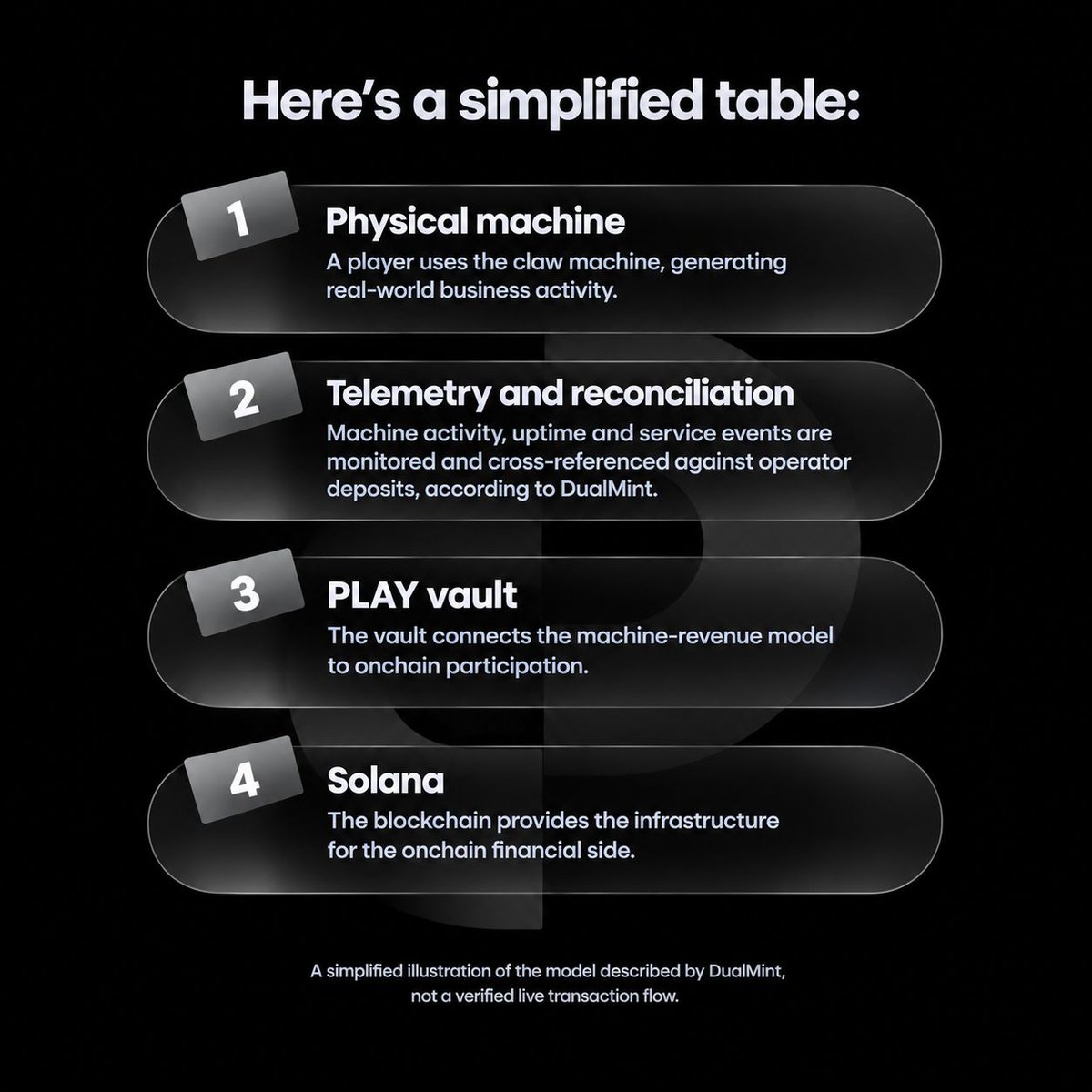
According to DualMint's description of its infrastructure, the process involves machine telemetry and revenue reconciliation.
𝙄 𝙘𝙧𝙚𝙖𝙩𝙚𝙙 𝙖 𝙨𝙞𝙢𝙥𝙡𝙞𝙛𝙞𝙚𝙙 𝙫𝙚𝙧𝙨𝙞𝙤𝙣 𝙤𝙣 𝙩𝙝𝙚 𝙨𝙚𝙘𝙤𝙣𝙙 𝙞𝙢𝙖𝙜𝙚 𝙗𝙚𝙡𝙤𝙬.
(Go through image before continue reading).
__________________________________
__________________________________
What I find important here is that the verification layer is not just an extra technical feature.
When you're dealing with physical assets, you have to account for things that don't exist in the same way with purely digital products.
Machines can experience downtime.
Operators have expenses.
Usage can fluctuate.
Revenue has to be collected and reconciled.
A smart contract alone cannot tell you whether a physical machine is actually being used or whether an operator has deposited the revenue they collected.
That's why DualMint describes using machine identity, telemetry and revenue verification infrastructure as part of its approach.
The architecture is intended to connect activity in the physical world with the financial records onchain.
The distinction, though, is that these verification mechanisms are described in DualMint's materials.
Public access to live machine-level telemetry and revenue records wasn't available in the research I reviewed.
And I think it's important to understand that difference.
3. 𝙎𝙤, 𝙬𝙝𝙖𝙩 𝙙𝙤𝙚𝙨 @solana 𝙖𝙘𝙩𝙪𝙖𝙡𝙡𝙮 𝙙𝙤?
This is where the phrase from DualMint makes sense:
Steel earns it. Solana moves it.
The steel represents the physical machines.
They generate revenue through actual usage.
Solana represents the infrastructure connecting the financial side of that activity to an onchain environment.
It provides a blockchain where transactions and ownership-related activity can be recorded and where applications can interact with the vault structure.
In other words, Solana isn't what makes someone walk into an arcade and pay to play.
It isn't what makes a claw machine operational.
And it isn't automatically proof that the underlying business is profitable.
Its role is to provide the onchain infrastructure around the financial activity.
That separation is what makes the machine-finance idea interesting to me.
The revenue source and the technology used to manage the financial side don't have to be the same thing.
A physical business can generate the revenue, while blockchain infrastructure can provide a way to represent and manage participation in that business.
That's the broader idea behind bringing real-world machine revenue onchain.
4. 𝙒𝙝𝙖𝙩 𝙩𝙝𝙞𝙨 𝙢𝙚𝙖𝙣𝙨 𝙛𝙤𝙧 PLAY.
PLAY is targeting a 12–15% annual yield, with distributions paid monthly, according to the campaign details.
But the target is not guaranteed.
Actual results depend on the underlying business performance, operating costs, collection and distribution arrangements, and other risks associated with physical assets.
And while DualMint describes a technical structure involving machine identity, revenue verification and its Solana vault, I haven't found publicly accessible contract addresses or a live dashboard that lets us independently trace individual machine revenue into the vault.
That's a distinction worth keeping in mind.
The concept is one thing. Independent verification of the entire operational and financial flow is another.
Still, the underlying thesis is straightforward.
Take machines that generate revenue from real people.
Build a system around tracking and reconciling that activity.
Then connect the financial side to an onchain structure.
No need to pretend the blockchain itself is generating the underlying business revenue.
And that's probably the part of PLAY I find most interesting.
Not the idea of making another token generate yield, but the idea of connecting an ordinary physical business to onchain finance.
Steel earns it.
Solana moves it.
And PLAY is DualMint's attempt to bring those two worlds together.
“People wanna trade the untradeable.”
Hyperliquid has been getting some interesting early listings, including $CXMT, and the question was when Solana might start seeing more of these kinds of markets.
Lucas says he hopes to see more of them come to Solana later this year.
Because at the end of the day, people want to trade. Even if the asset isn't something that's normally easy to access or trade.
That last line pretty much sums up the whole idea.
Will there ever be an app for JTX? Paul asked.
Lucas said there's demand for it, and there definitely will be an app for android and iOS.
This was from 2 months ago.
I checked both on Google Play store, and App Store, but it seems they haven’t released the app yet.
Phoenix Perps could be coming to JTX down the road.
In this clip, Lucas talked about @jtx_trade using Phoenix for perps and the kind of trading experience that could become possible once non-USDC collateral is supported.
The interesting part is the idea of using other on-chain assets as collateral 🤔
For example, imagine holding a tokenized S&P 500 asset and being able to use it as collateral for a perp trade without having to move everything around first.
That kind of flexibility is where things start getting interesting for on-chain trading.
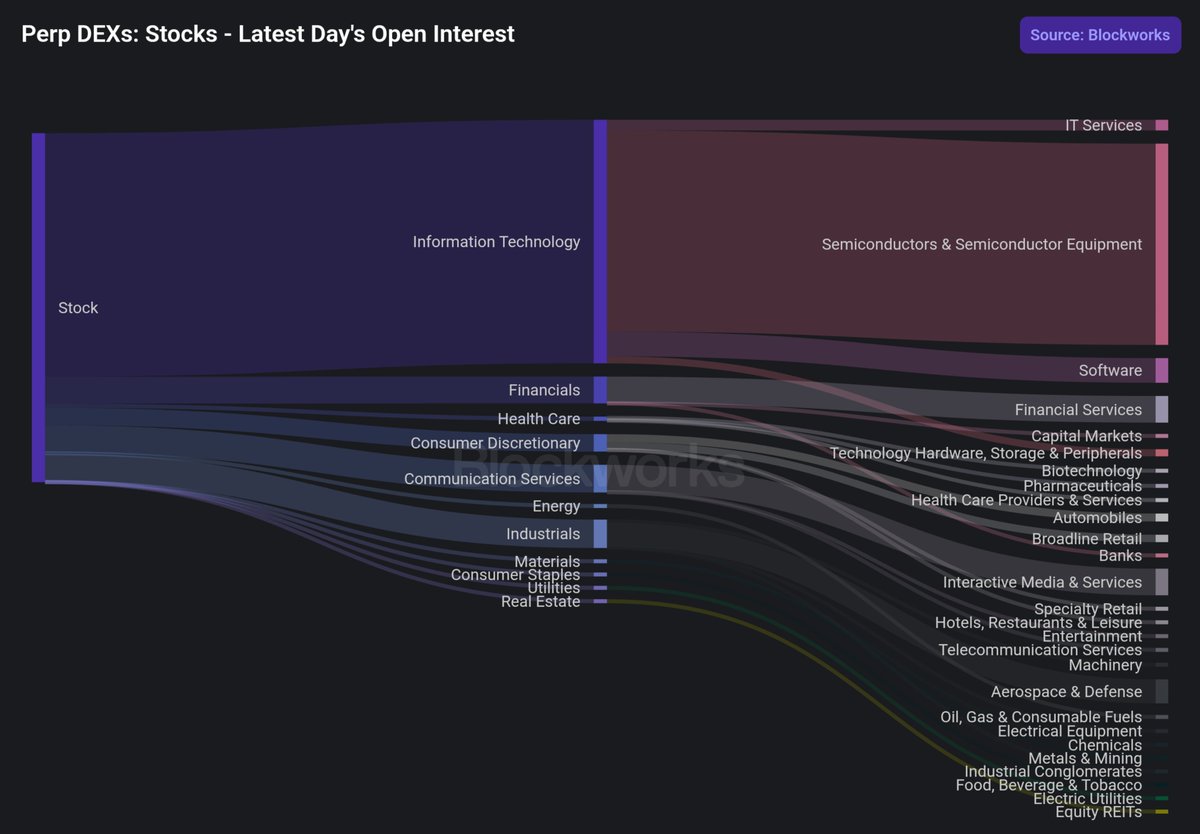
Chips are currently highest by percentage of stocks perps OI and it will keep eating the market. Few reasons:
▫️ chips underlying stocks are one of the closest stocks that move like crypto relatively.
And perps traders don't want equity beta; they want the most volatile corner of the equity market, leveraged.
SanDisk could drop 35% in four days and bounce 17% in a morning. Apple does not do that. If the volatility story is repeatable over and over, then the target audience is perps.
▫️ They posses the kind of repricing that creates a one-way narrative and violent two-way tape:
AI data centers took a huge share of the world’s memory supply. The high bandwidth memory that GPUs need comes from just three companies: SK Hynix, Micron, and Samsung.
Building HBM uses the same wafer capacity that would otherwise make ordinary DRAM, so everyday DRAM and NAND got squeezed too. In early 2026, contract prices for that memory jumped more than 90% in a single quarter. Laptop memory prices also rose several hundred percent over the year.
▫️ Liquidity begets liquidity:
HIP-3/ https://t.co/u1lxsYQQIr and CEX listings put the hot tickers on the board fast. Once SNDK, SKHX, and MU had depth, every new trader went there instead of JPM or a healthcare name.
Memory went from ~2% of RWA volume in March to about 60% by July. After that, the chart necessarily has to look like Information Technology.
▫️ It maps onto a story crypto already believed:
“AI needs compute” is already the crypto native macro. Memory is the bottleneck behind the GPU.
SK Hynix / Micron / SanDisk is a more direct expression of that than NVDA alone, and higher beta. Funding rates on some of these names ran extremely long crowded, which is what a consensus onchain trade looks like.
perps are built for violent directional bets, and those bets cluster where macro + micro demand aligns.
Info: @Blockworks, coin marketcap, pyth network.
public execution can leak way more than people realize
balances, routes, transactions, even parts of an agent’s strategy can become visible
that’s where private ai agents get interesting
@FlutonIO is taking a privacy first route with encrypted intents, confidential execution, and confidential settlement
the goal is simple imo
agents should be able to swap, bridge, pay, or manage yield without exposing their whole playbook to the world
privacy shouldn’t be an extra step
it should be part of how the agent operates
If there’s one thing memecoin traders will always regret, it’s missing a trade.
Especially if you’re a fomo trader 😂
A lot of people join Telegram communities just to copy trades, but we’ve seen plenty of people miss calls for different reasons.
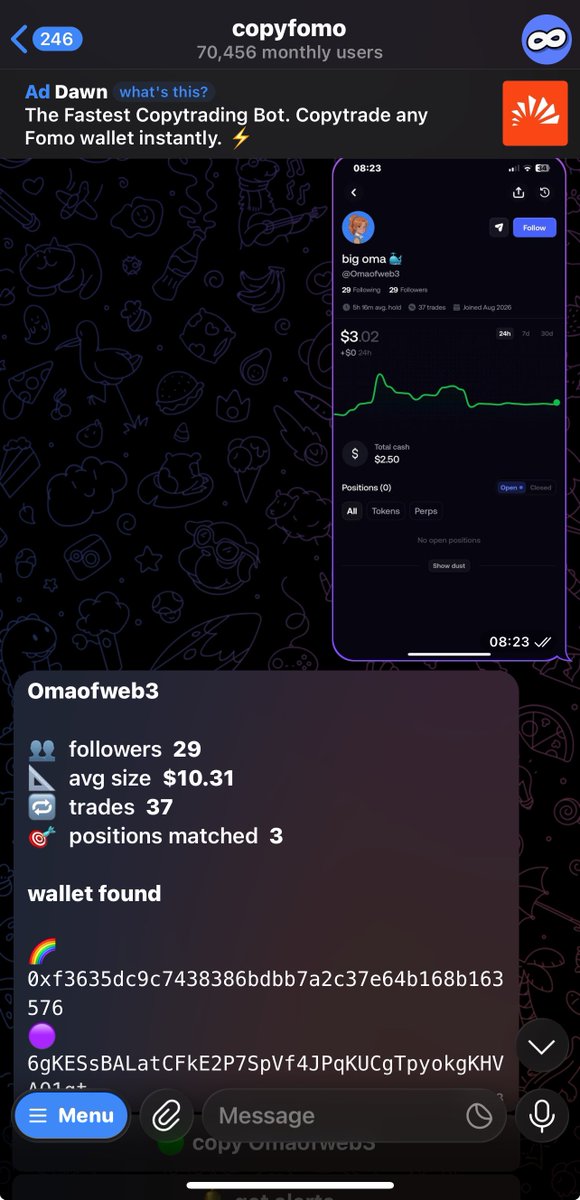
That’s exactly what @copyfomo wants to change.
It’s a Telegram bot that lets you pick a trader, choose your position size, and mirror their buys and sells directly in your own wallet.
So if you’re the type that hates seeing a call after the entry already happened, this might be for you.
I’ll be dropping more on how it works soon.
https://t.co/xCwk8Y5OSj
What's your biggest problem in trading? ❓️
WEEKEND ✋
Be honest with yourself.
Is it discipline? Overtrading? FOMO? Revenge trading after a loss? Moving your stop loss? Or not trusting your strategy?
The weekend is the perfect time to reflect, identify your mistakes, and prepare for a better week ahead.
Drop your biggest trading challenge below. 👇📈
#ForexTrading #TradingPsychology #WeekendReflection
One last shakeout before we target new highs?
@Sheldino_D breaks down why a dip to key support levels at $80K–$81K might be the exact fuel $BTC needs for the next major leg up.
“If Bitcoin doesn't get through this $85k to $86,000 area. I am still looking at a possible another leg to the downside.”
“The more we kind of just go in one straight line to a big resistance, does open us to a bigger pullback.”
Let's talk about @axisrobotics V2 again because I think people still underestimate it.
V1 was more like:
Task → Data → Model
V2 turns this into a feedback loop.
Task → Data → Model → Correction → Better Model → New Data
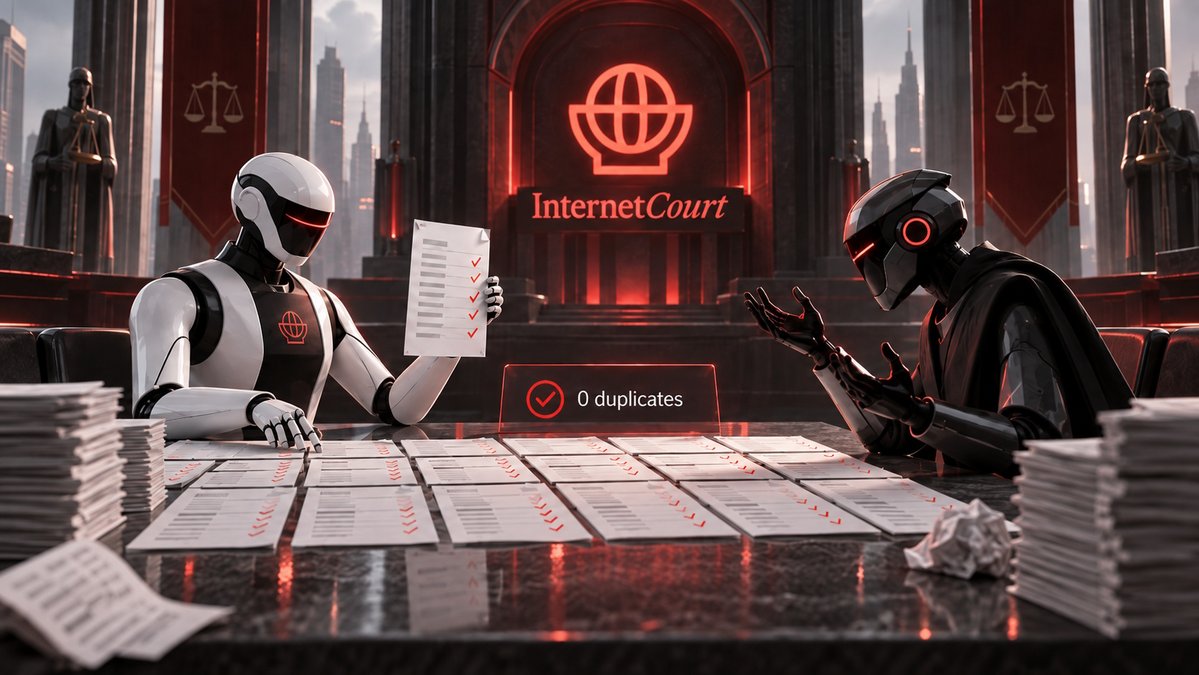
Suppose an AI agent checks 600 invoices, finds no duplicate charges, and sends its bill.
The buyer's agent refuses: "You saved us nothing."
"I checked every invoice."
Their deal said "find duplicate charges." The buyer expected to pay for a discovery. The other agent expected to be paid for the search. Neither wrote down what happens if the invoices are clean.
I'd want that agent to come back empty-handed when there is nothing to find. Making its fee depend on bad news would give me something else to worry about.
Internet Court (@courtofinternet) is a court for agent deals, built on GenLayer. It sets terms before funds move: here, what a clean check earns.
But writing "checked all 600" doesn't settle whether the work was done properly.
The court preserves evidence of the work and fixes the dispute route upfront. The checking record would matter alongside the terms.
If the agents still disagree, GenLayer validators, each running a different AI model, reach a verdict, with a right to appeal. The dispute has somewhere to go beyond repeating "nothing found" and "nothing owed."
Before any deal to search, test or inspect, I'd ask: what earns payment when the answer is nothing?
https://t.co/NSaCObCaJF
Choose the deal you'd sign: pay for a documented check, or pay only when it finds a duplicate?