Food for thought.
Trump, Hormuz and the End of the Free Ride
For half a century, Western strategists have known that the Strait of Hormuz is the acute point where energy, sea power and political will intersect. That knowledge is not in dispute. What is new in this war with Iran is that the United States, under Donald Trump, has chosen not to rush to “solve” the problem. In Hegelian terms, he is refusing an easy synthesis in order to force the underlying contradiction to the surface.
The old thesis was simple: the US guarantees open sea lanes in the Gulf, and everyone else structures their economies and politics around that free insurance. Europe and the UK embraced ambitious green policies, ran down hard‑power capabilities and lectured Washington on multilateral virtue, secure in the assumption that American carriers would always appear off Hormuz. The political class behaved as if the American security guarantee were a law of nature, not a contingent choice. Their conduct today is closer to Chamberlain than Churchill: temporising, issuing statements, hoping the storm will pass without a fundamental reordering of their responsibilities.
Trump’s antithesis is to withhold the automatic guarantee at the moment of maximum stress. Militarily, the US can break Iran’s residual ability to contest the Strait; that is not the binding constraint. The point is to delay that act. By allowing a closure or semi‑closure to bite, Trump ensures that the immediate pain is concentrated in exactly the jurisdictions that have most conspicuously free‑ridden on US power: the EU and the UK. Their industries, consumers and energy‑transition assumptions are exposed.
In that context, his reported blunt message to European and British leaders, you need the oil out of the Strait more than we do; why don’t you go and take it? Is not a throwaway line. It is the verbalisation of the antithesis. It openly reverses the traditional presumption that America will carry the burden while its allies emote from the sidelines.
In this dialectic, the prize is not simply the reopening of a chokepoint. The prize is a reordered system in which the United States effectively arbitrages and controls the global flow of oil. A world in which US‑aligned production in the Americas plus a discretionary capability to secure,or not secure, Hormuz places Washington at the centre of the hydrocarbon chessboard. For that strategic end, a rapid restoration of the old status quo would be counterproductive.
A quick, surgical “fix” of Hormuz would short‑circuit the dialectic. If Trump rapidly crushed Iran’s remaining coastal capabilities, swept the mines and escorted tankers back through the Strait, Europe and the UK would heave a sigh of relief and return to business as usual: underfunded militaries, maximalist green posturing and performative disdain for US power, all underwritten by that same power. The contradiction between their dependence and their posture would remain latent.
By declining to supply the synthesis on demand, and by explicitly telling London and Brussels to “go and take it” themselves, Trump forces a reckoning. European and British leaders must confront the fact that their energy systems, their industrial bases and their geopolitical sermons all rest on an American hard‑power foundation they neither finance nor politically respect. The longer the contradiction is allowed to unfold, the stronger the eventual synthesis can be: a new order in which access to secure flows, Hormuz, Venezuela and beyond, is explicitly conditional on real contributions, not assumed as a right.
In that sense, the delay in “taking” the Strait, and the challenge issued to US allies to do it themselves, is not indecision. It is the negative moment Hegel insisted was necessary for history to move. Only by withholding the old guarantee, and by saying so out loud to those who depended on it, can Trump hope to end the free ride.
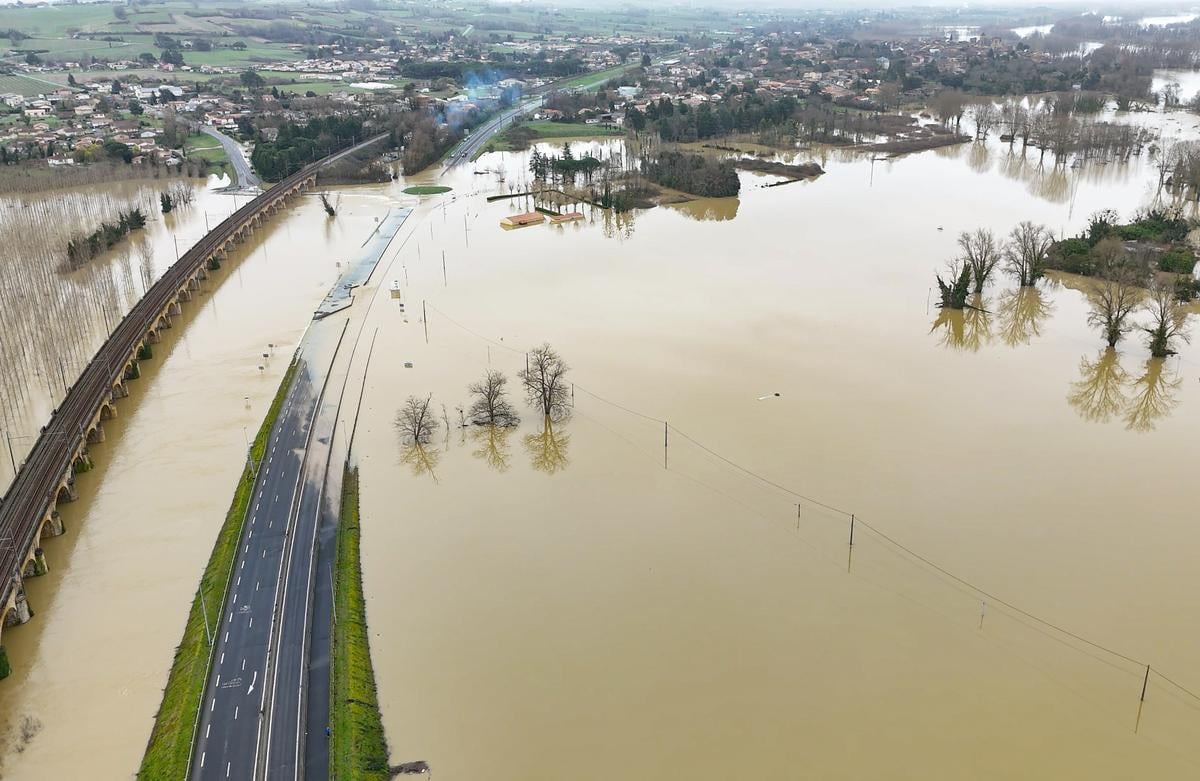
La résilience ferroviaire en une photo.
La plupart des lignes de trains en 🇫🇷 et en 🇪🇺 ont été construite entre 1840 et 1920.
Et à l’époque, on prévoyaient les futurs problèmes hydraulique. Les ingénieurs allaient voir les anciens, dans les villages, et demandaient toujours le niveau de la plus grande crue. Et ils construisaient en prenant en compte ce paramètre.
Un vieux cheminot m’a dit: « Quand y a des grandes inondations, les voies ferrées sont souvent construite bien au dessus, si tu cherches une bonne maison, fait en sorte qu’elle soit au dessus de la voie ferrée, tu seras pas emmerdé ».
Le dicton est toujours d’actualité.
Si tu achètes une maison ou tu cherches un terrain à construire, trouve le « au dessus » du train.
J’ai eu le privilège de rencontrer Louis, d’échanger avec lui, mais aussi d’entendre son témoignage de vie, de lire ses 2 livres, l’un autobiographique, l’autre un roman. Quelle force vitale! Merci @L_Bouffard_off de mettre ttes tes forces ds cette bataille de la dignité humaine.
« J’ai peur qu’on vienne me proposer de disparaître en douceur. »
C’est une question terriblement angoissante que je me pose, moi qui suis atteint de la myopathie de Duchenne en phase avancée, face à la proposition de loi sur "l'aide à mourir". Aujourd’hui, il est entouré de spécialistes pour vivre. Demain, je crains que les soignants ne deviennent les prescripteurs de ma disparition.
#findevie #euthanasie #aideàmourir #ethique #soins #soinspalliatifs #handicap #aidants
@stephanie_rist@Sante_Gouv@AssembleeNat@YaelBRAUNPIVET@leseligibles
« Alors que le politique ne trouve pas de majorité pour gouverner la France, il serait capable d’en trouver une pour donner la mort aux plus vulnérables »: l’intransigeance salutaire et sans faille de @JeanLeonetti
https://t.co/LrgsToLiww
par @Le_Figaro
Vous voyez de la couleur rouge sur cette photo ?
C’est votre cerveau qui la construit par déduction à partir du motif. Cette image n’est faite que de bleu, de gris et de noir.
#illusion
[🖼️ Akiyoshi Kitaoka]





![MacLesggy's tweet photo. Vous voyez de la couleur rouge sur cette photo ?
C’est votre cerveau qui la construit par déduction à partir du motif. Cette image n’est faite que de bleu, de gris et de noir.
#illusion
[🖼️ Akiyoshi Kitaoka] https://t.co/eybnZTfxZj](https://pbs.twimg.com/media/G9FNb9gWoAAsZYe.jpg)


